
Samsung Exynos 1680 Introduced! Mid-Range is Set to Soar!

Just hours before the official launch of the Galaxy A57, the new star of Samsung’s globally popular Galaxy A series, the South Korean giant made a surprise move by detailing the next-generation Exynos 1680 chipset. The technical data confirms that this processor is not just a minor update but a hardware powerhouse designed to rewrite the rules of the mid-range segment.
Samsung Exynos 1680 Pushes the Boundaries
Manufactured using Samsung’s refined 4-nanometer (nm) process, the Exynos 1680 features a smarter tri-cluster core arrangement. At its heart lies a performance-oriented Cortex-A720 core running at 2.9 GHz for heavy workloads. This is accompanied by four Cortex-A720 cores at 2.6 GHz and three Cortex-A520 efficiency cores running at 1.95 GHz for daily tasks.
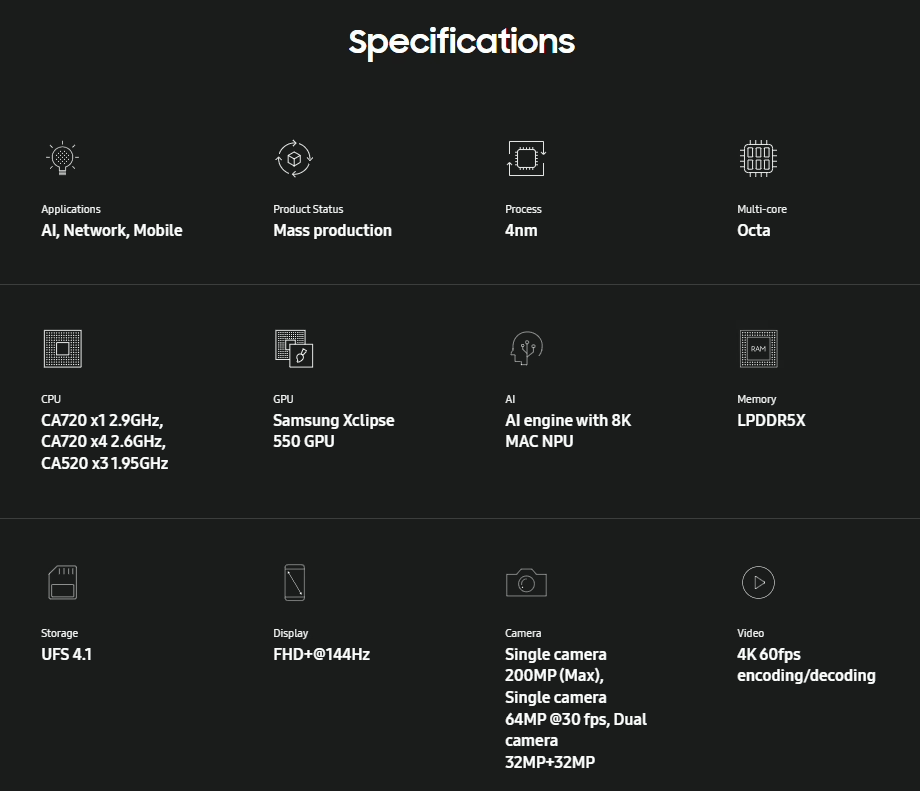
This 1+4+3 configuration, where Samsung has replaced one efficiency core with an additional performance core compared to previous designs, aims to increase multitasking fluidity while managing power consumption more balanced during prolonged use.
AMD-Powered Graphics and High-Level Processing Power
For mobile gamers and content creators, the Exynos 1680 brings significant upgrades. The chipset is equipped with the Xclipse 550 GPU, based on AMD’s RDNA 3 architecture. This new hardware promises up to a 15% increase in graphics processing performance compared to the previous generation.
However, the real leap occurs in the Neural Processing Unit (NPU). Reaching a capacity of 19.6 trillion operations per second (TOPS), this advanced NPU will allow One UI’s smart features, live translation functions, and advanced photo processing to run flawlessly directly on the device without needing the cloud.
Premium Standards Arriving for the Mid-Range
The most striking aspect of the Exynos 1680 is its ability to bring memory and storage technologies previously reserved for flagships down to the mid-range. The new chipset supports LPDDR5X RAM and ultra-fast UFS 4.1 storage, significantly boosting app launch speeds and overall system responsiveness.
- Multimedia: Supports single camera sensors up to 200 megapixels and 4K 60 FPS 10-bit HDR video recording.
- Display: Full support for 144Hz refresh rates at Full HD+ resolutions.
- Connectivity: Integrated 5G capable of 5.1 Gbps download speeds, Wi-Fi 6E, and Bluetooth 6.1.
The Galaxy A57, which will house this power, is reported to feature a slim 6.9 mm chassis, a 6.7-inch 120Hz Super AMOLED+ display with 1900 nits peak brightness, IP68 certification, and a 5,000 mAh battery with 45W fast charging.
With the Exynos 1680, Samsung is clearly aiming to dominate the mid-range competitive landscape in 2026. Do you think the 19.6 TOPS NPU will make a noticeable difference in daily AI tasks, or is the AMD-based GPU the more exciting upgrade? Share your thoughts in the comments!
Your comment has been submitted,
it will be published after approval.