
AMD Zen 6 Processors Challenge Nvidia with 256-Core Power

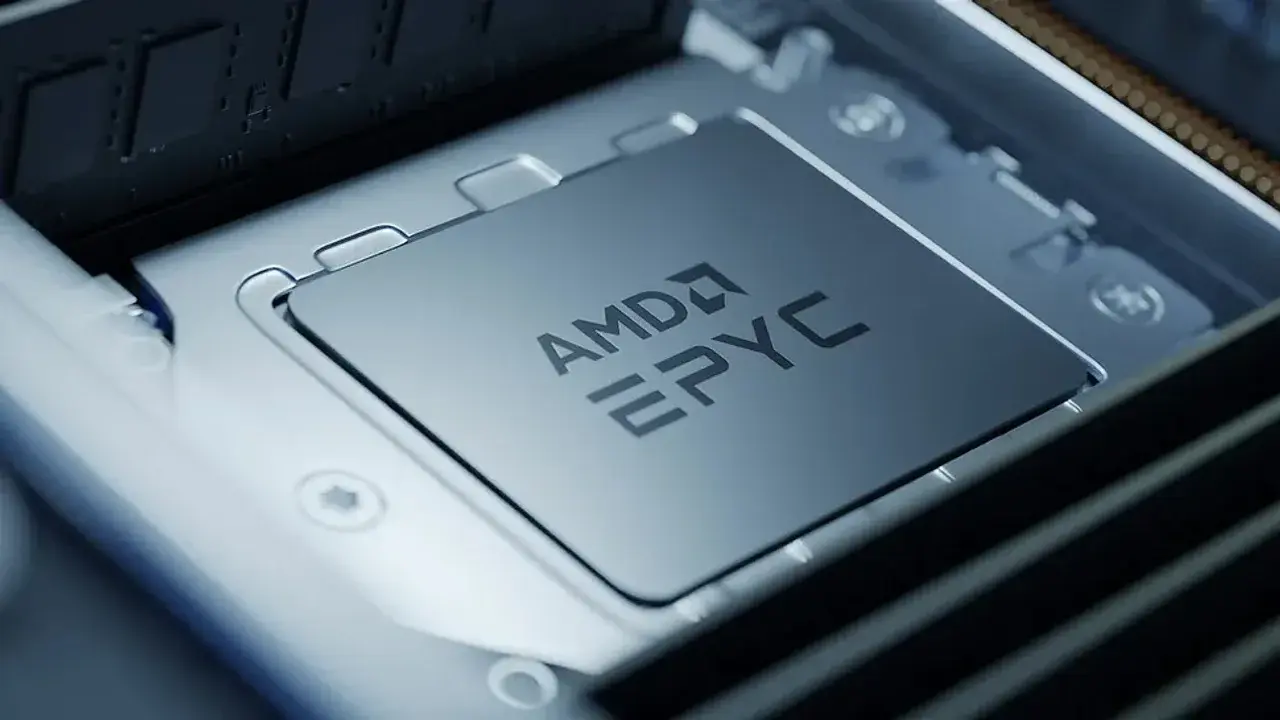
AMD has officially revealed performance projections for its upcoming Zen 6 architecture-based EPYC Venice processors, positioning them as a formidable rival in the high-performance computing sector. In a direct challenge to Nvidia’s market dominance, the company claims its flagship 256-core EPYC Venice model will deliver up to 3.3 times the performance of Nvidia’s Vera processor when evaluated at a 100kW data center rack scale. This strategic announcement serves as a calculated response to recent industry benchmarks, highlighting AMD’s intent to capture a larger share of the enterprise and server market through its next-generation silicon capabilities.
- AMD projects that its 256-core EPYC Venice processors will outperform Nvidia Vera chips by 3.3 times within a 100kW power budget.
- The company derived these performance estimates through internal modeling rather than direct physical rack testing.
- AMD utilized scaled data from existing EPYC 9965 chips and Nvidia Grace benchmarks to project these competitive figures.
- The firm intends to disclose more comprehensive technical specifications regarding the Zen 6 roadmap at its upcoming Advancing AI event.
This bold performance claim underscores the intensifying competition between AMD and Nvidia for supremacy in the global data center infrastructure.
Modeling Methodologies Replace Physical Testing
AMD clarified that the provided figures are based on comprehensive system modeling rather than physical measurements of a fully populated rack. By calculating the total number of nodes that could fit within a 100kW power envelope and applying performance multipliers to individual processor TDPs, the company established its theoretical baseline. 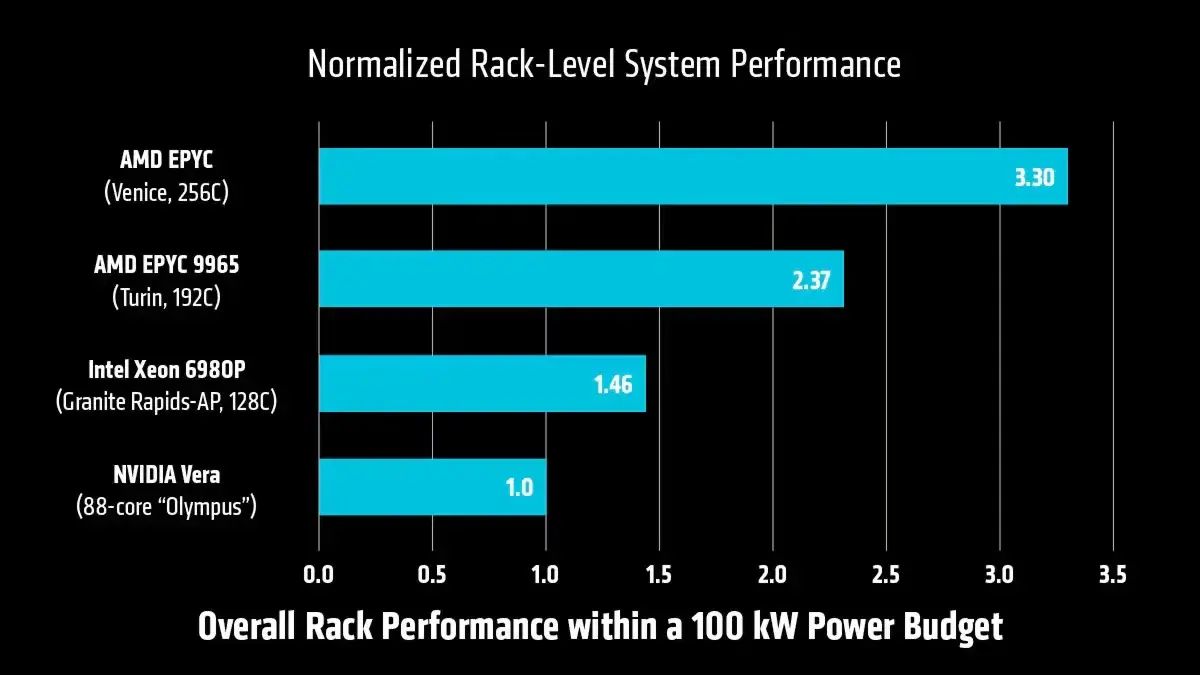
Because the company lacks physical access to Nvidia’s proprietary Vera hardware, the estimation process involved extrapolating data from Nvidia Grace chips using Phoronix-verified metrics. The EPYC Venice performance was similarly modeled by applying a 1.7x scaling factor to the current EPYC 9965 architecture. Industry analysts note that such projections often ignore real-world constraints, such as thermal throttling and interconnect latency, which frequently limit linear scaling in massive server environments.
Data Centers Focus on Performance Metrics
The comparative analysis centers on critical workloads relevant to modern enterprise environments. AMD utilized standard industry benchmarks, including SPEC CPU 2017 for integer throughput, SPECjbb 2015 for Java-based server performance, and high-demand operations involving NGINX, Redis, and MySQL databases. These metrics demonstrate the processor’s capability to handle massive parallel computing tasks efficiently.
Strategic reliance on these benchmarks aims to prove that Zen 6 architecture can handle diverse real-world applications more effectively than existing competitive solutions.
Future Roadmap Provides Detailed Insights
The tech industry is now looking toward the upcoming Advancing AI event, where AMD is expected to provide deeper technical insights into the Zen 6 architecture and its long-term enterprise strategy. This event will likely address concerns regarding how these theoretical gains translate into actual physical server deployments. As the company prepares to roll out its Venice lineup, observers remain curious about how external factors, such as cooling requirements and power delivery, will influence the practical adoption of these high-core-count processors.
We invite you to share your perspective on these ambitious performance projections; do you believe AMD’s modeling approach provides an accurate representation of future market competition, or will real-world limitations prove to be a significant challenge?
Your comment has been submitted,
it will be published after approval.