
Google Unveils Gemini-SQL2 to Revolutionize Data Analysis Accuracy


Google Research has officially unveiled Gemini-SQL2, a groundbreaking system designed to transform natural language into complex SQL queries, marking a significant advancement in data analysis. Built upon the sophisticated Gemini 3.1 Pro architecture, this innovative tool eliminates the need for manual coding by automating database interactions. Recent evaluations conducted on the BIRD benchmark dataset confirmed that the system achieves an impressive 80.04% success rate. By prioritizing functional execution over mere syntactical correctness, the technology ensures that generated queries perform flawlessly within real-world database environments, ultimately empowering non-technical users to conduct advanced data exploration with unprecedented ease and speed.
- The Gemini-SQL2 system leverages the advanced Gemini 3.1 Pro model to automate database query generation.
- Performance testing on the BIRD benchmark dataset demonstrated an 80.04% success rate in query accuracy.
- The framework evaluates query success based on actual database outputs rather than relying solely on syntactic structure.
Gemini-SQL2 Surpasses Existing Industry Performance Standards
Traditional text-to-SQL systems have historically focused on the structural integrity of a query, often neglecting the actual result produced by the database. Google’s latest development shifts this paradigm by executing queries against live datasets to verify their accuracy, a critical feature for professional environments. 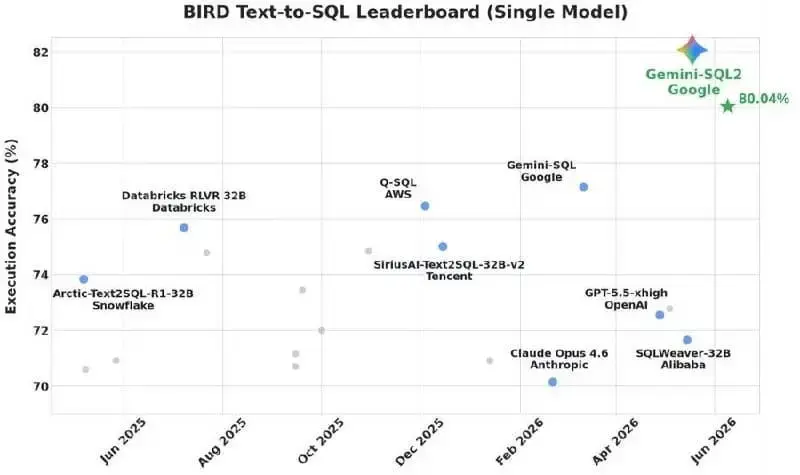
This functional validation approach effectively eliminates common errors found in traditional automated SQL generation.
By ensuring that the logic translates into actionable data insights, the model mitigates the risks associated with manual coding errors and ambiguous prompts. This transition toward execution-based validation represents a major leap forward for enterprises that rely on high-volume data processing and rapid business intelligence.
Database Management Becomes Significantly More Accessible
The 80.04% accuracy rate achieved by Gemini-SQL2 highlights the model’s capacity to interpret and resolve complex, multi-layered database inquiries without human intervention. This level of automation lowers the entry barrier for analysts and business developers, allowing them to extract deep insights without needing extensive SQL expertise. For many organizations, this development signals a long-awaited democratization of data-driven decision-making processes.
Furthermore, the reduction in manual coding time translates into lower software development costs and increased operational efficiency across the board. By automating the most tedious aspects of data retrieval, the system allows technical teams to focus on higher-level strategic initiatives rather than debugging syntax.
AI models now manage complex data extraction processes entirely on behalf of the user.
Future Analytics Transformations Are Expected Globally
The introduction of Gemini-SQL2 underscores the transformative potential of generative artificial intelligence in the realm of database management. As the technology matures, it is anticipated that even employees with minimal technical training will be able to generate sophisticated reports from large-scale databases. Google Research has positioned this tool as a cornerstone of the next generation of data analytics platforms.
Looking ahead, the shift toward natural language interfaces will likely redefine the professional requirements for data analysts and database administrators. While the tool manages the complexity of the backend, human oversight remains vital for interpreting the strategic context of the results. As these systems become more integrated into daily business operations, the gap between data generation and actionable insight will continue to narrow significantly.
Do you believe that AI-generated SQL queries will eventually replace the need for professional data analysts, or will human expertise remain essential for interpreting complex trends? Share your thoughts and personal experiences in the comments section below.
Your comment has been submitted,
it will be published after approval.