
China Claims Top Spot with New LineShine Supercomputer

China has officially reclaimed its position at the pinnacle of global computing power with the launch of its new LineShine supercomputer. Developed by the National Supercomputing Center, this massive system has successfully dethroned the United States, ending the reign of the El Capitan supercomputer which previously held the world’s fastest title. Achieving an impressive performance of 2.198 exaflops, LineShine now sits at the top of the international rankings, signaling a significant shift in the competitive landscape of high-performance computing. This achievement underscores China’s persistent dedication to advancing its domestic technological capabilities despite international limitations.
- The LineShine system surpassed the American El Capitan supercomputer with a processing power of 2.198 exaflops.
- Engineers utilized a custom 304-core processor architecture to achieve high-performance results without relying on external GPUs.
- The supercomputer consumes 42.2 megawatts of power while maintaining an energy efficiency of 52.07 gigaflops per watt.
China’s strategic pivot to CPU-only architecture effectively bypasses restrictive international GPU trade embargoes.
Custom Architecture Powers the System
At the heart of the LineShine project lies a sophisticated 304-core processor architecture designed specifically for this machine. The system integrates 13.79 million individual cores, all operating at a synchronized frequency of 1.55 GHz. This dense core count is managed by a proprietary interconnect infrastructure that ensures seamless communication and data throughput across the entire network of processors.
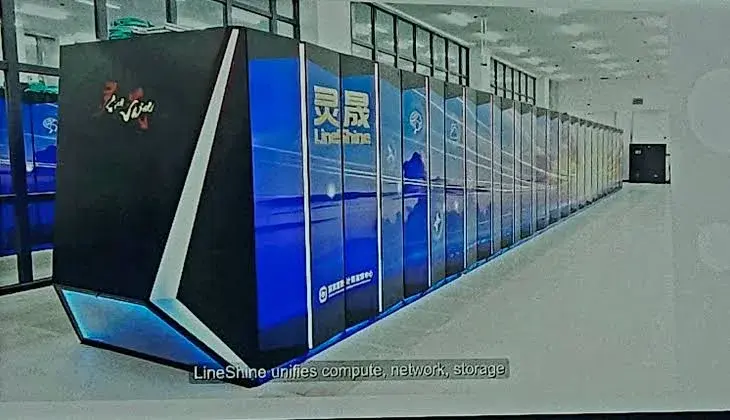
Beyond its raw computational speed, the system demonstrates notable energy management capabilities. With an operational power draw of 42.2 megawatts, the machine maintains an efficiency rating of 52.07 gigaflops per watt. This balance between massive data processing capacity and energy consumption places it among the most efficient high-performance systems currently in operation globally.
Embargo Restrictions Shape Technical Development
The development of LineShine occurred under the shadow of stringent international trade restrictions, particularly the United States’ embargo on advanced GPU technology. By choosing to bypass GPU-dependent structures in favor of a purely CPU-based design, Chinese researchers successfully circumvented these supply chain hurdles. This decision highlights a growing trend in domestic hardware independence where technological self-reliance becomes a prerequisite for national scientific progress.

The successful deployment of this machine confirms that domestic CPU designs can compete at the highest level of supercomputing.
Scientific Research Benefits from Increased Capacity
The implications of this breakthrough extend far beyond a mere ranking change. The National Supercomputing Center plans to utilize the massive parallel processing power of LineShine to accelerate complex scientific research projects that were previously bottlenecked by hardware limitations. From advanced climate modeling to materials science and artificial intelligence research, the new infrastructure serves as a foundational pillar for China’s future scientific endeavors.
As global powers continue to invest heavily in exascale computing, the success of this CPU-centric design may influence how future supercomputers are architected internationally. The shift away from traditional accelerator-heavy models suggests a potential evolution in how extreme-scale problems are addressed in the coming decade.
We are curious to hear your perspective on this development; how do you think China’s focus on CPU-only supercomputer architecture will influence the future of the global technological arms race? Please share your thoughts in the comments section below.
Your comment has been submitted,
it will be published after approval.