
AMD FSR 4.1 Boosts Gaming Performance Significantly for Radeon Cards

AMD has officially expanded its software ecosystem with the release of the FSR 4.1 upscaling technology, which is now available for Radeon RX 7000 series graphics card users. This latest iteration of the FidelityFX Super Resolution suite aims to drastically improve gaming performance by utilizing advanced upscaling algorithms. Released just two days ago, the update brings substantial frame rate improvements to demanding titles, particularly for users operating on older RDNA 3 hardware. By balancing high-fidelity visuals with optimized rendering techniques, FSR 4.1 ensures that players can experience smoother gameplay without needing a total hardware overhaul, marking a significant advancement in AMD’s software-driven performance strategy.
- The FSR 4.1 update provides a significant frame rate increase for RDNA 3 architecture GPUs.
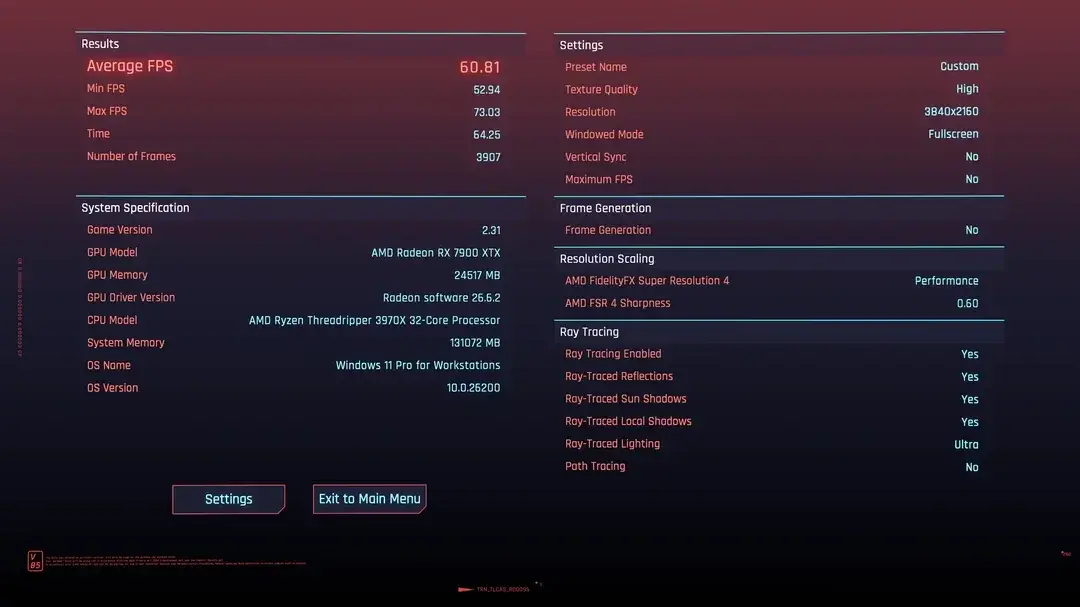
- Testing shows that the technology nearly doubles performance in Cyberpunk 2077 at 4K resolution.
- AMD utilizes distinct INT8 and FP8 computational models to optimize performance across different hardware generations.
- Visual fidelity remains high even when using the balanced upscaling mode during intensive gaming sessions.
Gamers can now achieve 4K 60 FPS performance on high-end cards using the new performance-focused upscaling modes.
Performance Gains Are Realized in Demanding Titles
Data shared by the community provides a clear look at how FSR 4.1 impacts real-world scenarios. The flagship Radeon RX 7900 XTX, which typically struggles to maintain a consistent frame rate in Cyberpunk 2077 at native 4K resolution with Ray Tracing Ultra settings enabled, sees a major transformation. Reports indicate that frame rates jump from a meager 24 FPS to an impressive 50 FPS average when the technology is activated in its balanced configuration.
{{WP_IMAGE_1}}
When users switch to the performance-oriented mode, the RX 7900 XTX successfully pushes beyond the 60 FPS threshold at 4K resolution, even with heavy graphical settings active. This shift allows for a highly fluid gaming experience that was previously unattainable without sacrificing significant visual quality. Furthermore, tests conducted in the quality preset demonstrate that games remain stable at over 40 FPS, which provides a tangible improvement over native resolution rendering.
Hardware Architectures Receive Custom Optimization Models
A key aspect of this release is the technical diversification AMD has implemented to support various GPU generations. While both the RX 7000 and the upcoming RX 9000 series benefit from FSR 4.1, they utilize different underlying computational structures to maximize efficiency. The RX 7000 series relies on an INT8-based model, whereas the newer RX 9000 series is designed to leverage FP8 architecture.
AMD emphasizes that despite these differences in hardware-level processing, the visual output remains consistent across both series. This specialized approach ensures that the upscaling technology is not a one-size-fits-all solution, but rather a tailored integration that respects the specific capabilities of each graphics architecture. By optimizing for both INT8 and FP8, AMD has successfully widened the reach of its performance-enhancing tools.
The technical implementation of specialized models ensures that performance optimization remains consistent across diverse hardware architectures.
We are eager to hear your thoughts on how this latest AMD update has impacted your gaming sessions, so please share your performance benchmarks and experiences in the comments section below.
Your comment has been submitted,
it will be published after approval.