
Alican Kiraz’s AI Model Ranks Among World’s Top Cybersecurity Tools


Turkish Senior Staff Security Engineer Alican Kiraz has achieved a significant milestone in the field of artificial intelligence by developing a specialized cybersecurity model, Titus-CybersecurityLLM-36B-A3B-v1. Built upon the Qwen3.6-35B architecture, this innovative model has secured a prestigious position on the internationally recognized CS-Eval platform. Developed by researchers at Fudan University and the University of Chinese Academy of Science, CS-Eval serves as one of the most rigorous evaluation frameworks for cybersecurity-focused language models. As of its inclusion on June 24, 2026, Kiraz’s model has outperformed numerous global competitors, clinching the 9th position among all public and private models worldwide.
- The Titus-CybersecurityLLM-36B-A3B-v1 model achieved a 92.42 comprehensive average score on the CS-Eval platform.
- The system secured the number one global ranking among all open-source models in its category.
- The architecture utilizes a Mixture-of-Experts (MoE) design to optimize performance for complex security tasks.
This breakthrough validates the immense potential of domain-specific artificial intelligence in addressing modern digital threats.
Global Rankings Demonstrate High Performance
The success of the Titus-CybersecurityLLM-36B-A3B-v1 model is attributed to its highly refined design, which leverages a Mixture-of-Experts (MoE) architecture. By focusing specifically on cybersecurity workflows, the model delivers precise results that surpass many general-purpose AI systems. 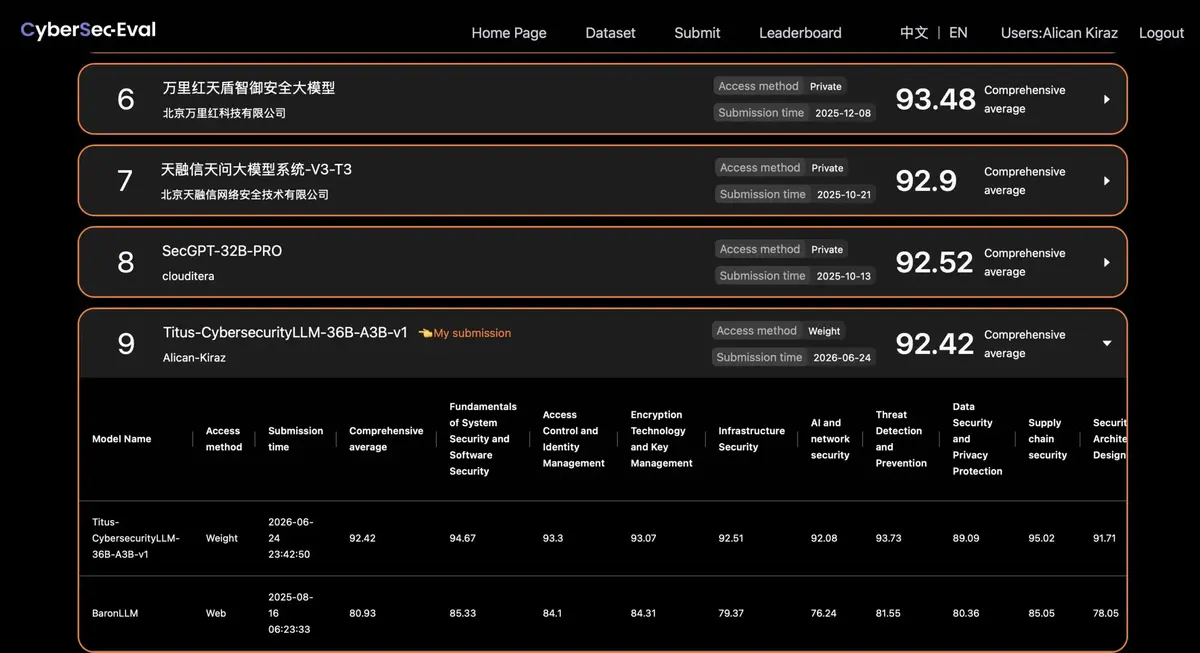 With a comprehensive score of 92.42, the model demonstrates exceptional proficiency in identifying vulnerabilities and managing complex security protocols.
The evaluation results indicate that the model excels in critical domains, including system security, access control mechanisms, encryption standards, and automated threat detection. This high-level performance has allowed the model to outperform various well-established industry tools, cementing its status as a leader in the open-source cybersecurity AI landscape.
Detailed Metrics Reveal Technical Excellence
The data provided by the CS-Eval platform highlights the technical capabilities of the model across various security disciplines. The model achieved a score of 94.67 in basic system and software security, demonstrating its ability to handle fundamental architectural weaknesses. Furthermore, it reached a 95.02 score in the supply chain security category, a critical area for modern enterprise protection.
The model maintains consistent performance across infrastructure security and data privacy mandates.
Beyond these metrics, the model demonstrated a 93.73 performance score in threat detection and prevention. These results confirm that the model is well-equipped to assist security professionals in identifying malicious patterns before they escalate into systemic breaches. The model’s integration into existing workflows is expected to streamline security operations significantly.
As the cybersecurity landscape becomes increasingly complex, tools like the one developed by Alican Kiraz offer a glimpse into the future of automated defense. By specializing in security-centric data, these models provide a level of accuracy that general-purpose AI models cannot easily replicate.
What are your thoughts on the impact of specialized AI models in the future of global cybersecurity? We invite you to share your insights in the comments section below.
Your comment has been submitted,
it will be published after approval.