
Critical Linux Root Vulnerability CVE-2026-46331 Exposed


A severe security vulnerability, identified as CVE-2026-46331, has been discovered within the Linux kernel, enabling unauthorized local users to gain root-level access to affected systems. This critical flaw, dubbed “pedit COW,” stems from a memory corruption issue located in the act_pedit component of the Linux network traffic control mechanism. By exploiting a copy-on-write error that occurs during the rewriting of packet headers, attackers can manipulate cached memory copies without triggering standard file system integrity checks. As the vulnerability impacts major distributions like RHEL, Debian, and Ubuntu, system administrators are urged to prioritize kernel updates to prevent potential full system compromise.
- The CVE-2026-46331 vulnerability allows unprivileged users to achieve root privileges by exploiting a memory corruption bug in the act_pedit kernel component.
- Attackers leverage a flaw in the copy-on-write mechanism to inject payloads into memory-resident copies of setuid root files.
- Systems running the act_pedit module with unprivileged user namespaces enabled face the highest risk of exploitation.
- Immediate kernel patching remains the primary defense for securing multi-user environments, Kubernetes nodes, and CI/CD pipelines.
Successful exploitation of this flaw effectively grants an attacker full control over the compromised operating system.
Technical Mechanics Reveal How Attackers Bypass Security
The core of this issue lies within the tcf_pedit_act() function, where improper handling of runtime offset values leads to out-of-bounds writing. When a malicious actor targets a setuid root file, such as /bin/su, they can inject a payload directly into the memory cache. 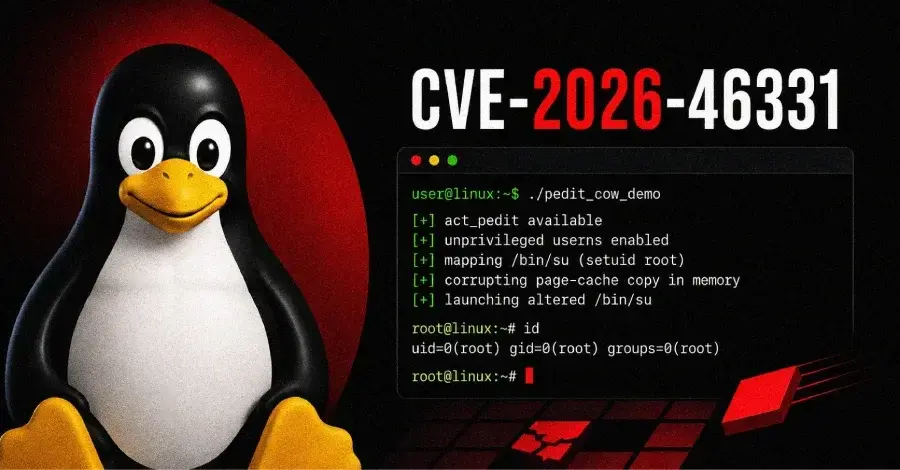 This bypasses traditional disk-based security controls, as the malicious modification exists only within the memory, making it invisible to many standard integrity monitors.
While modern distributions like Ubuntu 26.04 employ AppArmor to mitigate the attack path, the underlying kernel flaw remains persistent across many versions. Research indicates that the vulnerability is categorized as high-risk, as it provides a direct escalation vector for any user with local access to the system.
Administrators Must Prioritize Immediate System Patching
The primary remediation strategy involves upgrading to the latest kernel versions provided by distribution maintainers. Merely applying the patch is insufficient; a full system reboot is necessary to ensure the vulnerable code is purged from the active memory space. Organizations managing high-traffic servers or containerized environments should treat this update as an emergency deployment.
Ignoring this critical vulnerability exposes high-value infrastructure to persistent root-level unauthorized access.
For environments where immediate patching is impossible, some administrators have explored disabling the act_pedit module or restricting unprivileged user namespaces. However, these actions may disrupt the functionality of rootless containers or sandboxed applications. Because the attack operates within the page cache, standard integrity checks are largely ineffective at detecting the intrusion once it has occurred.
Future Mitigation Strategies Require Architectural Changes
The complexity of memory-related vulnerabilities in the Linux kernel raises important questions about the long-term stability of low-level system components. As security researchers identify these flaws, the reliance on reactive patching highlights a need for more robust, proactive architectural safeguards. Developers are currently evaluating how to better isolate network traffic control components to prevent similar memory corruption scenarios from escalating to full system privileges.
Given the recurring nature of these critical kernel vulnerabilities, what long-term architectural changes do you believe the Linux community should prioritize to prevent similar memory-based exploits in the future?
Your comment has been submitted,
it will be published after approval.