
Google Patches Over 1,000 Chrome Security Vulnerabilities Using AI


In a significant milestone for browser security, Google successfully addressed 1,072 vulnerabilities within its Chrome browser throughout June, utilizing advanced artificial intelligence tools to accelerate the patching process. This achievement, which surpasses the total number of security fixes implemented over the previous two years, marks a transformative shift in how tech giants approach digital defense. By leveraging proprietary AI models, Google has demonstrated the capacity to identify and neutralize threats at an industrial scale. This rapid deployment of security updates underscores how artificial intelligence is fundamentally changing the landscape of software maintenance, ensuring that Chrome remains a robust defense against evolving cyber threats.
- Google resolved 1,072 security vulnerabilities in June by utilizing AI-driven detection processes.
- The company surpassed its total security patching output of the previous two years within a single month.
- Microsoft integrated similar AI strategies to resolve a record-breaking 570 vulnerabilities in its recent cycle.
- Apple continues to maintain a traditional, slower pace regarding its security patch deployment compared to its competitors.
AI Models Transform the Cybersecurity Economy
The integration of large language models into security protocols has been a subject of intense debate among industry experts for years. Google Engineering Director Doug Turner recently highlighted that these advanced systems have fundamentally altered the economics of cybersecurity. By automating the discovery of vulnerabilities, the process has shifted from manual oversight to a large-scale, automated operation. 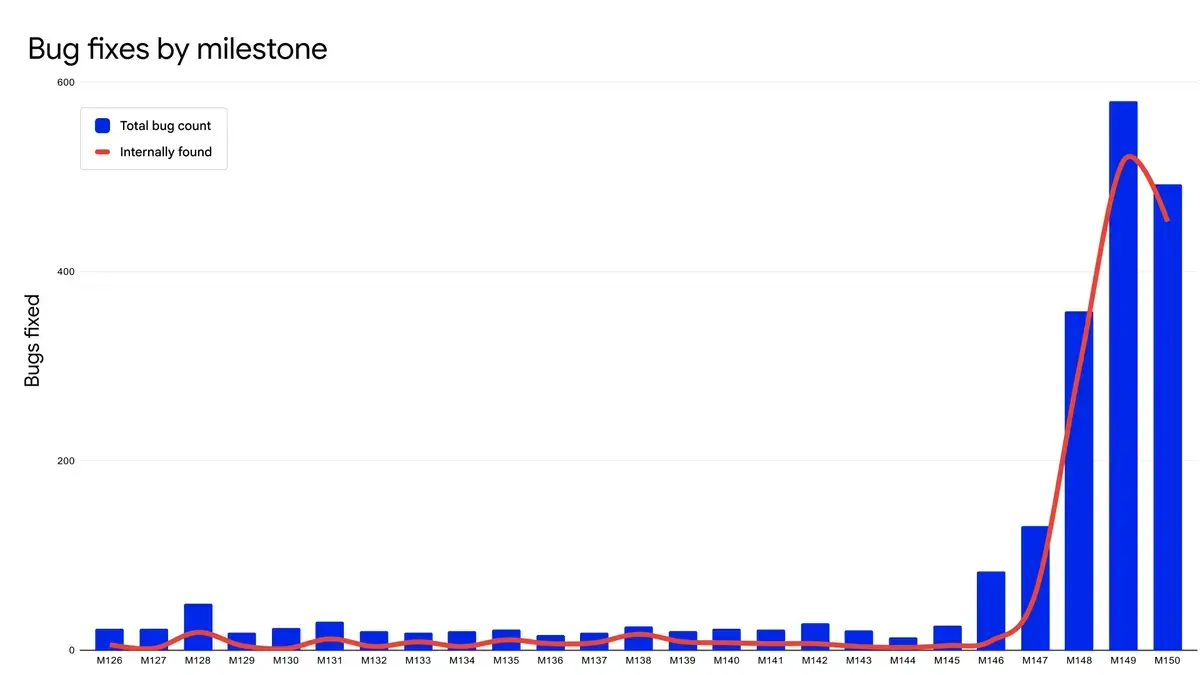
AI-driven models now consistently outperform human analysts by identifying complex software bugs before they can be exploited.
Technical reports published by the company reveal an exponential increase in the efficiency of error corrections. Each milestone update serves as a testament to how refined artificial intelligence processes can fortify defense lines. As these systems become more sophisticated, they allow for a deeper audit of codebases that were previously considered too complex to inspect thoroughly in short timeframes.
Major Technology Firms Adopt Divergent Strategies
Google is not the only industry leader embracing this high-speed approach. Microsoft has also reported record-breaking success, having utilized AI to patch 570 vulnerabilities in its latest monthly cycle. This trend confirms that automated, AI-assisted security is rapidly becoming the industry standard for major software providers. The ability to push updates at this speed creates a competitive advantage, as it minimizes the window of opportunity available to malicious actors.
Technology giants are now competing by leveraging AI to define the future of software security.
Despite this industry-wide momentum, not all major players are following the same path. Independent research indicates that Apple continues to follow a more traditional, consistent pace for its security updates, moving at a speed comparable to its 2015 data. While the company has not issued a formal statement regarding this discrepancy, the aggressive AI strategies adopted by Google and Microsoft provide a clear roadmap for the future of software protection. As the landscape grows more hostile, the speed of response will likely become the most critical metric for browser and operating system security.
How do you view the shift toward fully automated, AI-driven security patching in your favorite software? Do you believe machines should handle the entirety of digital defense, or does human oversight remain essential for long-term safety? Share your thoughts with us in the comments section below.
Your comment has been submitted,
it will be published after approval.