
Automotive SCT Revenue Reaches 419 Billion TL Amid Market Decline


Automotive journalist Emre Özpeynirci has unveiled critical data regarding the Special Consumption Tax (SCT) revenue collected from vehicle sales in Turkey. According to the reported figures, the total SCT revenue generated from the automotive sector reached 419.9 billion TL during the first seven months of the year. This financial performance reflects a cooling period for the industry, as the government experiences the direct effects of a shrinking automotive market on its tax collection efforts. The data highlights a significant turning point, as the sector faces its first notable decline in tax contributions after a long period of consistent growth.
- The automotive sector generated 419.9 billion TL in total SCT revenue during the first seven months of the year.
- July recorded a 24.5 percent contraction in the automotive market, leading to a 2.55 percent drop in monthly tax collection.
- Only 44.16 percent of the annual SCT target for 2026 has been met as of the end of July.
- Experts warn that the ongoing market contraction threatens the realization of year-end tax revenue goals.
Market Contraction Impacts State Tax Revenue
The recent figures indicate that the automotive sector is undergoing a period of structural adjustment. Specifically, the month of July saw a sharp downturn, with the market contracting by 24.5 percent compared to previous periods. Consequently, the SCT collection for the same month fell to 60.1 billion TL, marking a 2.55 percent decrease. This decline is particularly significant as it serves as a barometer for the broader economic environment and consumer purchasing power.
The current trend suggests that the government may need to re-evaluate its fiscal strategies if the automotive market continues to struggle.
Annual Revenue Targets Face Potential Risks
As of the end of July, the government has managed to secure only 44.16 percent of its total projected SCT revenue for the 2026 fiscal year. This figure stands in contrast to the 47.16 percent achievement rate recorded during the same period in the previous year. 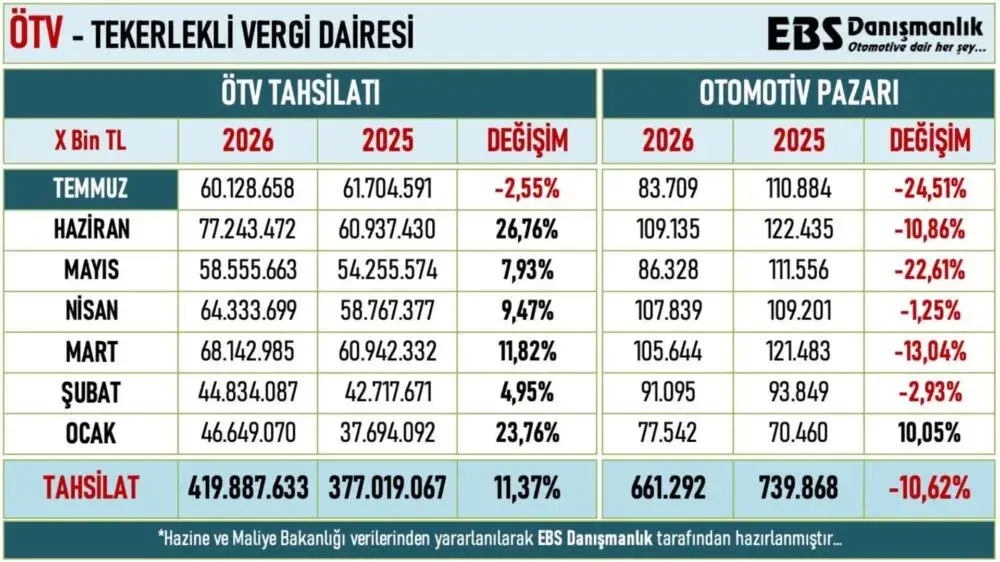 Because the first seven months failed to meet the proportional expectations, the final five months of the year have become vital for the Treasury. Financial analysts emphasize that if the current downward trend persists, the government might exercise its authority to adjust tax regulations to compensate for the shortfall.
Industry experts believe that the next few months will be decisive for the annual economic projections.
Alarm Bells Ring for the Automotive Sector
The shrinking automotive market remains a focal point of the current economic agenda, primarily due to its direct impact on national tax revenue. Emre Özpeynirci has frequently pointed out that the cooling in vehicle sales creates significant pressure on public finances. With the market showing signs of instability, the uncertainty surrounding future tax policies is growing among stakeholders. Whether these tax adjustments will occur depends largely on the sales performance of the automotive industry during the final quarter of the year. The sustainability of the current tax regime remains a subject of intense debate among market participants.
We value your perspective on the current state of the automotive industry; do you believe this market contraction will persist until the end of the year, or is a recovery on the horizon? Please share your thoughts in the comments section below.
Your comment has been submitted,
it will be published after approval.