
Xiaomi Details HyperOS 4 Soft Light Glass Supported Device List

Xiaomi has officially revealed the list of smartphones and tablets that will support the new Soft Light Glass interface effect within the upcoming HyperOS 4 update. This announcement, initially targeted at the Chinese market, outlines the hardware-specific requirements necessary to handle the complex graphical processing demands of this design language. Inspired by Apple’s liquid glass aesthetics, the feature utilizes interactive lighting and sophisticated rendering techniques that necessitate high-performance chipsets. While currently in the beta phase, Xiaomi confirmed that this visual enhancement will eventually reach global models that share equivalent hardware architectures, marking a significant evolution in the company’s software ecosystem.
- The Soft Light Glass effect requires substantial graphical processing power available only on flagship-grade chipsets.
- Xiaomi is currently focusing its beta testing on high-performance processors like the Snapdragon 8 Elite and Dimensity 9500.
- The rollout plan includes a phased approach that will eventually expand support to include popular older models such as the Xiaomi 13 and Redmi K70 series.
This new visual effect elevates the aesthetic quality of Xiaomi’s software interface to a professional standard.
Hardware Requirements Determine Compatibility
Xiaomi has clarified that the deployment of the Soft Light Glass effect will follow a staggered beta distribution schedule rather than a universal release. The company is prioritizing system stability by ensuring that the underlying hardware can support the complex rendering engine without sacrificing performance. Consequently, the initial phase of the rollout focuses exclusively on devices equipped with the Snapdragon 8 Elite, Dimensity 9500, and Xring O1 processors. This strategy ensures that the visual fidelity of the interface remains consistent across all supported units.
Despite the high hardware barrier, the company has expressed its commitment to broadening the user experience over time. Development teams are currently working on optimization patches that will allow older, capable devices to process these visuals efficiently. Future updates are expected to include models such as the Xiaomi 13 and the Redmi K70, ensuring that a wider user base can access the new design language as the software matures.
Supported Device Models Are Being Detailed
The list of compatible hardware is extensive, covering various product categories within the Xiaomi and Redmi brands. In the premium tier, the Xiaomi MIX series—specifically the Fold 4, Fold 3, Fold 2, and MIX Flip—will receive the update early. The flagship lineup, including the Xiaomi 17, 15, 14, and 13 series, is also confirmed for the upgrade. 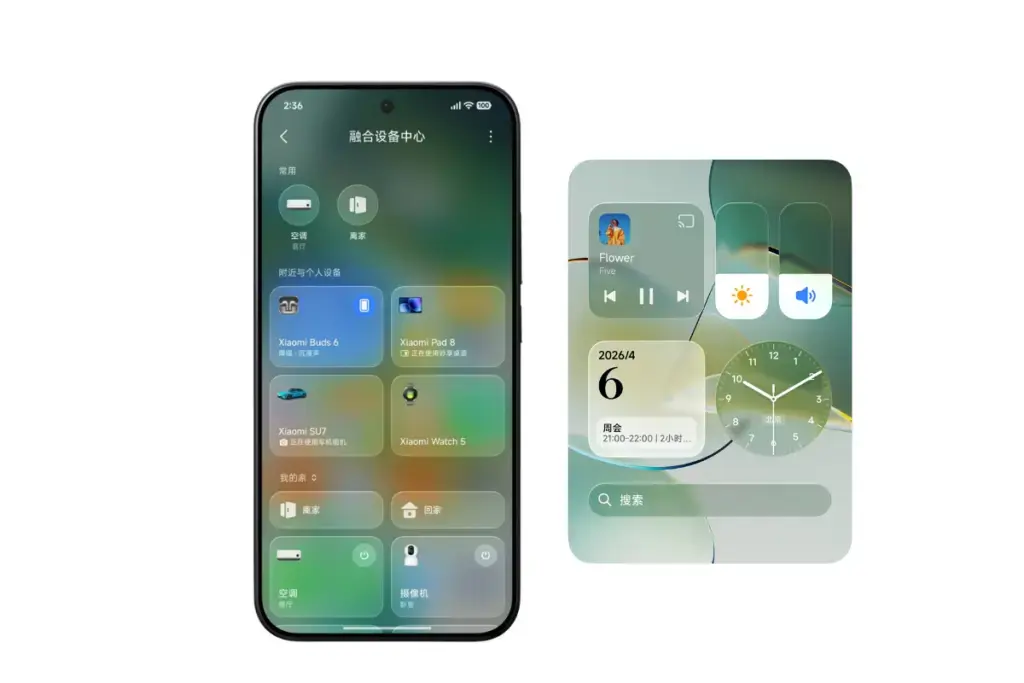 Furthermore, the Civi 5 Pro is included in the initial compatibility list.
Regarding the Redmi lineup, the K100 Pro, K90, and K80 series, along with the K70 (excluding the K70E), are slated to receive the HyperOS 4 visual enhancements. Users of the Turbo series, such as the Turbo 5 Max, 5, and 4 Pro, will also gain access to the feature. Tablet users are not left behind, as the Xiaomi Pad 8 Pro, 8, 7 Ultra, and 7S Pro, alongside the Redmi K Pad series, have been verified for the update.
Future Software Updates Expand the Scope
While the Soft Light Glass feature is presently restricted to beta participants in China, Xiaomi intends to expand this rollout to global markets in the coming weeks. The company remains focused on maintaining a fluid interface while optimizing hardware resource usage. Users are encouraged to keep their system software updated to ensure that these new graphical features do not hinder device performance.
How much do you believe this new Soft Light Glass interface will improve your daily smartphone interaction, and is your current device on the list to receive the HyperOS 4 update? Share your thoughts and device model in the comments section below.
Your comment has been submitted,
it will be published after approval.