
Google Launches Gemini 3.8 Flash and Flash Cyber Models

Google has officially launched its next-generation artificial intelligence models, Gemini 3.8 Flash and the cybersecurity-focused Gemini 3.8 Flash Cyber, marking another rapid advancement in the tech giant’s AI portfolio. Released just three weeks after the debut of its predecessor, Gemini 3.7 Flash, these new models aim to deliver superior performance in autonomous software development, multi-step logical reasoning, and cyber defense. Developers worldwide can now access these tools through Google AI Studio, Gemini API, Android Studio, and Google Cloud, benefiting from the same cost-effective pricing and high-speed processing capabilities established by previous iterations.
- The Gemini 3.8 Flash model introduces adjustable thinking levels that developers can dynamically adjust.
- During security benchmarks, Gemini 3.8 Flash Cyber successfully patched vulnerabilities that automated systems identified.
- Google maintains the same promotional pricing structure that previous model releases established.
Developer Workflows Receive a Significant Boost as Gemini 3.8 Flash Launches
The standard Gemini 3.8 Flash stands out as the most capable version within the lightweight and fast Flash lineup. Google has optimized this model specifically for complex developer tasks such as end-to-end software engineering, agentic workflows, and large-scale enterprise data processing. To minimize errors, the model executes multiple reasoning steps, runs tools sequentially, and conducts intermediate verification checks before producing final outputs.
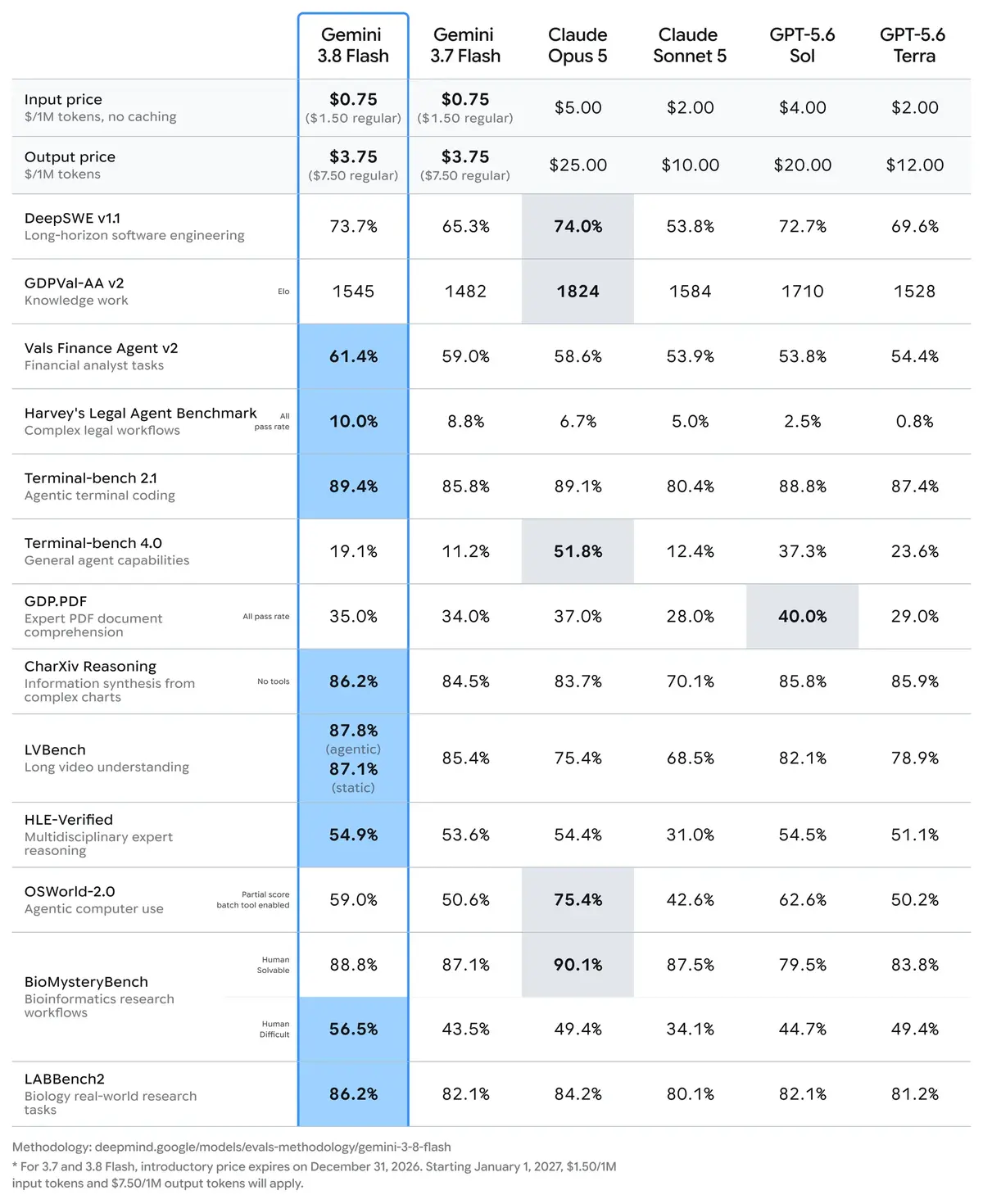
Performance evaluations indicate that Gemini 3.8 Flash excels in highly demanding scenarios. On the DeepSWE v1.1 benchmark, which tests long-duration software engineering capabilities, this lightweight model outperformed several larger flagship models. It also demonstrated significant advantages in professional domains, including financial analysis on the Vals Finance Agent V2 benchmark and legal document analysis on Harvey’s Legal Agent Benchmark. Furthermore, the model achieved an impressive 54.9 percent score on the HLE-Verified test, which spans various scientific and humanities disciplines.
From a technical perspective, developers benefit from a 1 million token context window paired with a maximum output capacity of 64,000 tokens. The model also introduces adjustable thinking levels, allowing developers to select ‘Low’, ‘Medium’ (default), or ‘High’ modes depending on their specific needs. This flexibility enables fast conversational responses or deep analytical processing for complex code reviews. Google will offer this model at a promotional rate of $0.75 per million input tokens and $3.75 per million output tokens until December 31, 2026.
New Security Vulnerabilities are Addressed as Gemini 3.8 Flash Cyber Debuts
The debut of Gemini 3.8 Flash Cyber represents a major milestone for cybersecurity teams and defense specialists. This specialized model is engineered to detect, analyze, and automatically patch security vulnerabilities in code. To prevent malicious exploitation, Google restricts access to this model through its Fairwind Program, making it available only to verified security organizations, critical infrastructure operators, and authorized developers.
In industry-standard safety evaluations, Gemini 3.8 Flash Cyber consistently outperformed larger industry-leading models. On the CyberGym benchmark, which spans 20 different programming languages, the model achieved a vulnerability detection rate exceeding 70 percent. Additionally, it scored 47.2 percent on the CWE-Bench auto-patching test, matching the performance of much larger and more expensive flagship models.
Real-World Implementations Demonstrate How the New Models Perform
Google has already integrated the new security model into its own operations with highly successful results. The Chrome Security Team reported that Gemini 3.8 Flash Cyber generated 2.6 times more accurate security patches compared to other commercial models currently on the market. Similarly, cybersecurity firm Wiz utilized the model in penetration testing, noting a 7.5 to 9.7 percent increase in vulnerability detection while reducing operational costs by two to five times.
Furthermore, the Google Cloud Security Research Group utilized the model to identify a critical infrastructure vulnerability in less than two hours, a process that typically requires months of manual effort. While developers can access Gemini 3.8 Flash through APIs and cloud platforms, individual subscribers of Google AI Pro and Ultra will also have access to these advanced capabilities. This rapid development cycle highlights how aggressively tech companies are competing to deliver speed and efficiency in the AI sector.
What are your thoughts on Google’s rapid AI release cycle and the capabilities of Gemini 3.8 Flash? Do you think the specialized Flash Cyber model will help secure modern software infrastructure? Share your insights and join the discussion in the comments below!
Your comment has been submitted,
it will be published after approval.