
Anthropic Launches Claude Opus 5.5 With Enhanced Speed and Efficiency

Anthropic has officially unveiled its latest artificial intelligence model, Claude Opus 5.5, marking a significant advancement in the company’s generative AI portfolio. Announced this week, the new iteration prioritizes performance, accuracy, and communication capabilities to better serve enterprise and individual developers. According to official performance data, Claude Opus 5.5 operates with 30% faster response times than its predecessor, the Opus 5, while simultaneously reducing operational expenses by 40%. By optimizing computational efficiency, Anthropic aims to provide a more scalable solution for complex tasks, positioning Claude Opus 5.5 as a major competitor in the rapidly evolving landscape of high-performance large language models.
- Claude Opus 5.5 delivers a 30% increase in generation speed while lowering operational costs by 40%.
- The model demonstrates superior performance in agentic coding, data processing, and visual recognition tasks.
- A newly integrated local classifier significantly strengthens security against prompt injection and unauthorized system access.
- API pricing for input and output tokens has been reduced to improve accessibility for developers and enterprise clients.
Performance Benchmarks are Outperforming Competitors
The technical improvements in Claude Opus 5.5 have set a new standard in benchmark testing, surpassing various industry-leading models, including Fable 5.1 and GPT-6 Astra. Developers report that the model exhibits a more natural writing style, which significantly aids in long-form content creation and complex documentation. 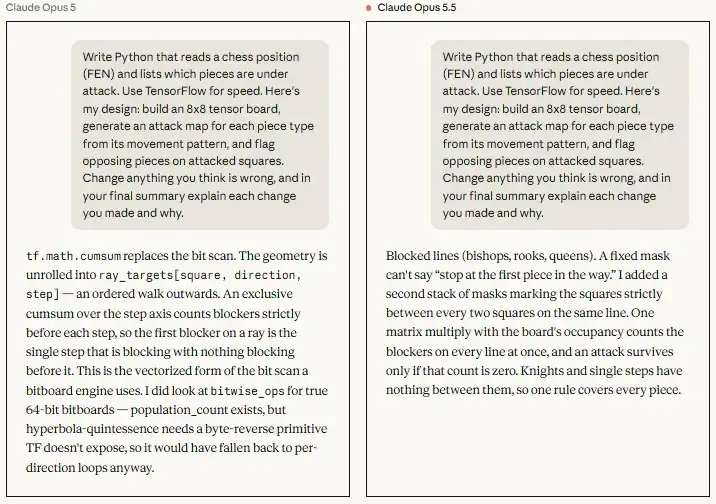
In practical software engineering scenarios, the model proves its value through exceptional efficiency. A recent case study demonstrated that the model could audit and remediate a 200,000-line codebase in less than three hours—a task that previously consumed over 20 hours with the older Opus 5 architecture. This represents a substantial leap in productivity for professional software developers managing large-scale projects.
Language Conversion Processes are Becoming Faster
Beyond general coding tasks, the transition between programming languages has been optimized. During a rigorous test involving the migration of legacy code from C to Rust, Claude Opus 5.5 completed the operation in 9.5 hours, effectively outperforming the Fable 5.1 model. These results underscore the model’s reliability in maintaining strict adherence to user-defined constraints and architectural rules. 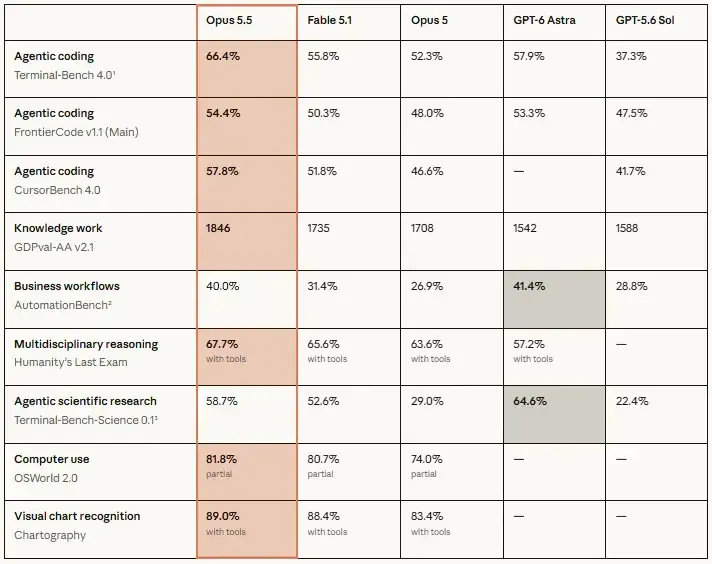
Security Protocols are Being Strengthened
Anthropic has integrated a native local classifier into the model to enhance safety across all operational layers. By scanning inputs before execution, the system provides a robust defense against common vulnerabilities, such as prompt injection attacks. Security assessments conducted by Gray Swan indicate that this model currently maintains one of the lowest success rates for adversarial attacks in the industry, ensuring that users can deploy it in sensitive environments with greater confidence.
API Costs are Being Reduced for Developers
To support broader adoption, the company has implemented a strategic price reduction for its API services. Input token costs have dropped from $5 to $4 per million, while output tokens have decreased from $25 to $20 per million. These adjustments are also reflected in cache management costs, providing a more cost-effective environment for developers building on the platform. The model is currently available to users on Pro, Max, and Team plans, as well as those utilizing enterprise-grade seat-based subscriptions.
Given the substantial increase in speed and the reduction in operational costs, how do you believe the introduction of Claude Opus 5.5 will reshape the competitive dynamics of the AI industry, and will you be integrating it into your current development workflow?
Your comment has been submitted,
it will be published after approval.