
The Witcher 3 Remastered PC System Requirements Are Revealed


CD Projekt RED has officially released the updated PC system requirements for The Witcher 3 Remastered, signaling a massive leap in hardware demand for the legendary RPG. The studio has unveiled a comprehensive technical breakdown covering a wide performance spectrum, ranging from standard 1080p gaming to high-end 4K Path Tracing. To achieve the pinnacle of visual fidelity, including 4K resolution at 60 FPS with full Path Tracing enabled, the developer specifies the need for the cutting-edge NVIDIA GeForce RTX 5080. This demanding target relies heavily on advanced upscaling technologies like DLSS and Frame Generation to maintain stable frame rates on modern high-end hardware.
- The developers now require an RTX 5080 GPU to achieve 4K resolution with Path Tracing enabled.
- System memory requirements have scaled up to 24 GB for high-end graphical profiles.
- Support for older GPU architectures like Maxwell and Pascal has been officially discontinued.
- Installation on an SSD is mandatory for all players to ensure proper asset loading and game stability.
New Lighting Technologies Push Hardware Boundaries
The updated specifications highlight how modern lighting techniques significantly increase the computational load on user systems. While traditional rasterized graphics remain accessible to a broader range of users, the integration of Ray Tracing and Path Tracing necessitates the use of AI-driven upscaling solutions such as DLSS, FSR, or XeSS. 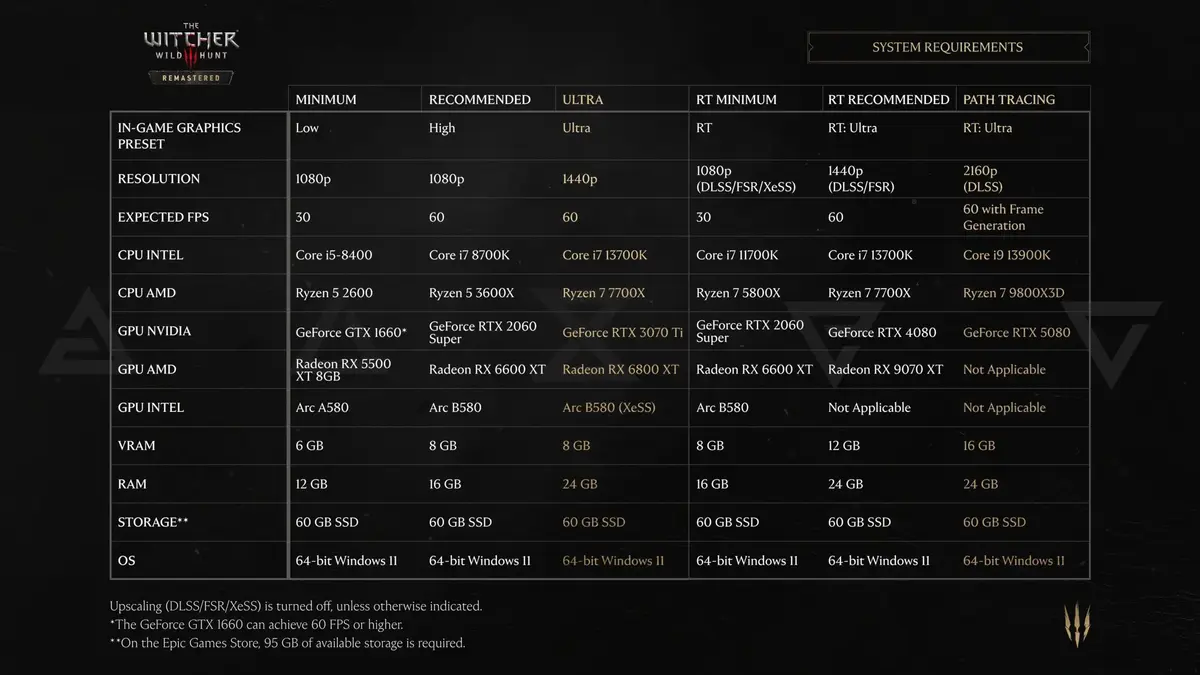 For the 4K Path Tracing profile, the demand on system resources is substantial, requiring high-performance CPUs like the Intel Core i9-13900K or the AMD Ryzen 7 9800X3D to avoid bottlenecks during intensive sequences.
Older Architectures Face Official Sunset
The transition to updated technical requirements marks a departure from older hardware support. CD Projekt RED has explicitly stated that they will only provide software optimization for components that continue to receive official driver updates from manufacturers. Consequently, legacy architectures including Maxwell, Pascal, and Volta are no longer supported by the latest version of the game. This shift ensures that the development team can focus resources on modern features while maintaining compatibility with contemporary hardware standards.
Operating Systems Require Modern Standards
Beyond graphics cards and processors, the developer has clarified that the title is now optimized exclusively for Windows 11. While the game may function on older versions of Windows, the studio no longer tests or guarantees performance on legacy operating systems. Furthermore, the reliance on high-speed data transfer has made an SSD an absolute requirement rather than a recommendation. This change is essential to accommodate the complex texture streaming and asset loading systems required for the remastered experience. For players who find their hardware unable to meet these rigorous new demands, the studio continues to provide access to previous versions of the game, such as 4.04 or the classic 1.32 branch, through major distribution platforms.
We are curious to hear your thoughts on these demanding hardware requirements for The Witcher 3 Remastered. Does your current PC setup meet the new standards, or do you feel it is time for an upgrade? Share your specs and opinions in the comments section below.
Your comment has been submitted,
it will be published after approval.