
AMD FSR 4.1 Expands to Radeon RX 6000 and Xbox

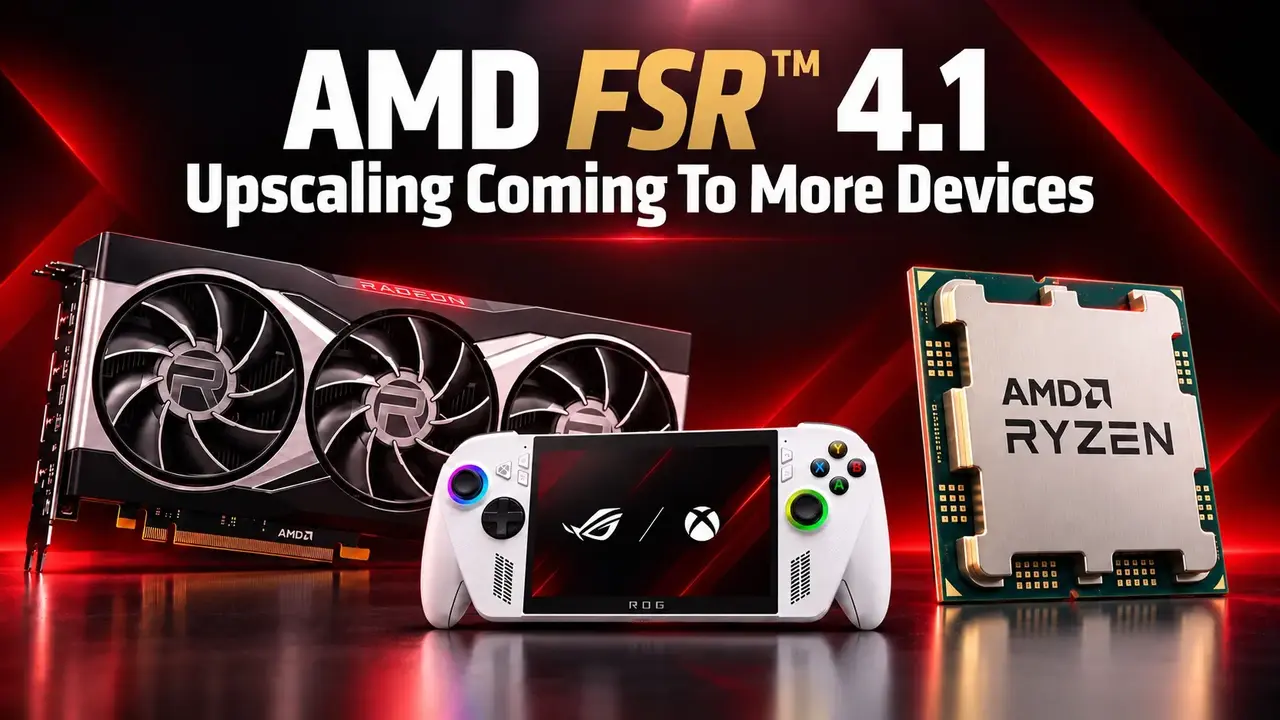
On October 20, 2026, AMD Computing and Graphics Senior Vice President Jack Huynh officially announced the rollout of FidelityFX Super Resolution (FSR) 4.1, extending the advanced AI-driven upscaling technology to a significantly wider range of hardware. This major update brings machine learning-based image enhancement to Radeon RX 6000 series graphics cards, various Ryzen AI processors, and mobile handheld devices, with support for Xbox Series X|S confirmed to arrive in the near future. By leveraging specialized optimization for older architectures, AMD aims to enhance visual fidelity and frame rates across a vast ecosystem of gaming platforms via the latest Adrenalin software update.
- AMD has released the FSR 4.1 update for Radeon RX 6000 series GPUs and specific Ryzen AI-enabled devices through the Adrenalin 26.10.1 driver.
- The new technology utilizes machine learning models to improve image sharpness and performance on hardware lacking dedicated AI acceleration.
- Official support for Xbox Series X|S consoles has been confirmed for a future release date.
- The company plans to expand FSR accessibility further by introducing support for the Vulkan API.
FSR 4.1 Enhances Visual Fidelity Through Machine Learning
The transition to the FSR 4 generation represents a strategic shift for AMD, now branded as “FSR Upscaling.” Unlike its predecessor, FSR 3.1, this version employs sophisticated machine learning models to reconstruct high-resolution images from lower-resolution inputs. This process results in noticeably sharper visuals and improved overall image quality. The underlying technology suite, referred to as FSR Redstone, provides developers with a comprehensive toolkit, including frame generation, ray regeneration, and radiance caching to optimize lighting and fluidity in modern titles.
Optimization Reaches Legacy Radeon RX 6000 Hardware
A critical aspect of this update is the inclusion of RDNA 2-based Radeon RX 6000 graphics cards. Since these older cards lack dedicated AI hardware, AMD developed an optimized INT8 model that runs directly on GPU shader cores. Internal benchmarks provided by the company suggest significant performance gains, with the RX 6800 XT demonstrating higher frame rates when using FSR 4.1 compared to previous versions. This ensures that users do not need to purchase the latest generation of hardware to benefit from modern upscaling improvements.
Handheld Devices and Consoles Receive Expanded Support
The update marks the first time that FSR 4.1 has been integrated into APUs, specifically targeting the Ryzen AI Max and Ryzen AI 9 processor lineups. Furthermore, mobile gaming enthusiasts using handheld devices such as those equipped with Ryzen AI Z2 processors can now access these features. Regarding the console market, the collaboration between AMD and Xbox confirms that Series X|S owners will soon have access to these tools. While a specific timeline for the console integration remains undisclosed, the partnership indicates a long-term commitment to improving performance across all gaming segments.
Future Developments Focus on Broad Compatibility
AMD continues to refine its software ecosystem by focusing on consistent frame pacing and the broader adoption of ray regeneration. The upcoming support for the Vulkan API is expected to simplify the integration process for developers, potentially increasing the number of supported games beyond the current count of over 400 titles. As the company works to bring these advancements to more APUs and further optimize the user experience, gamers are encouraged to monitor future software releases for additional stability improvements and feature expansions.
We are curious to hear your thoughts on this expansion of FSR 4.1 to older hardware; do you think this update will extend the lifespan of your current gaming setup, or are you planning an upgrade soon? Share your experiences in the comments section below.
Your comment has been submitted,
it will be published after approval.