
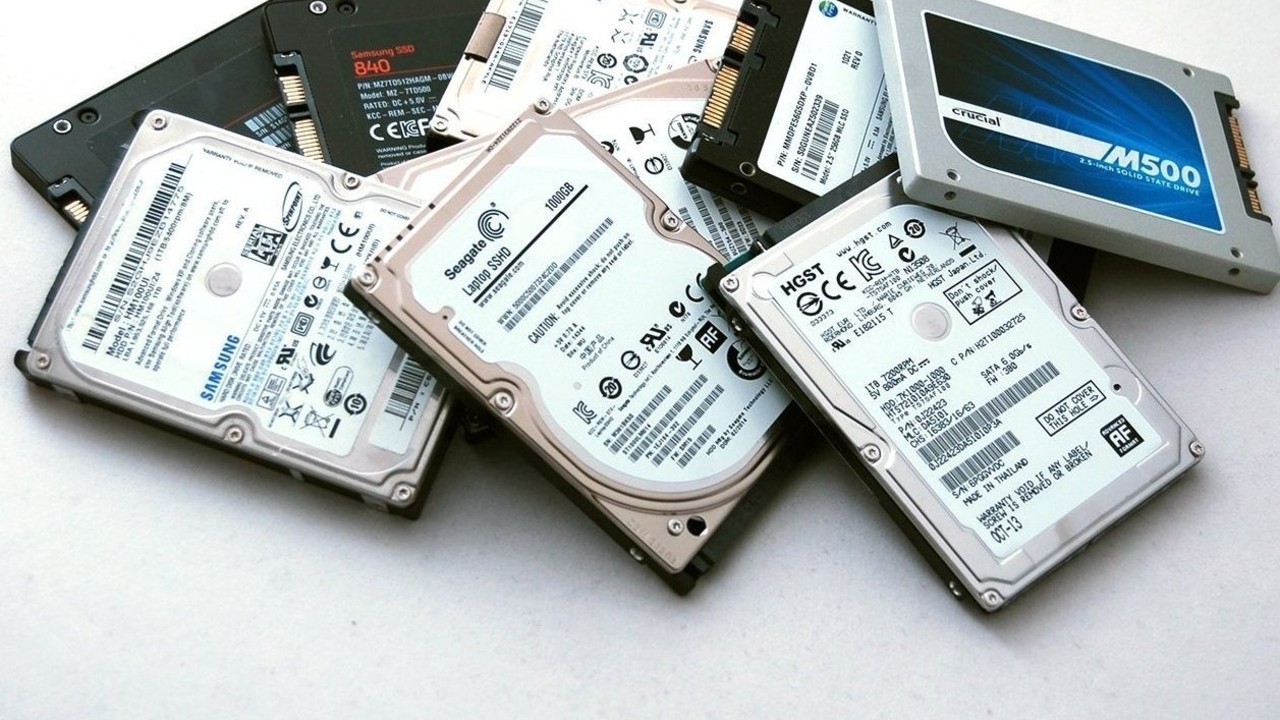
Storage technology giant Toshiba has shared an ambitious roadmap that will shape the future of data centers. Details revealed at a symposium in Japan indicate the company aims to push hard drive capacities far beyond current limits. New slides show that Toshiba plans to release 40 TB models in 2026 and reach 55 TB and above by 2030. This massive capacity increase will be achieved by increasing the number of platters within the disks and using advanced recording technologies.
Hard drive limits are being removed: Toshiba announces 40 TB and 55 TB models
Looking at industry development, capacities that were 10 TB in 2017 have now reached 24 TB. Toshiba has managed to increase storage density by transitioning from CMR designs to FC MAMR systems and increasing the number of platters within the disks to ten. The company has now confirmed a 12-disk stacking design, a first in the industry. This new design uses glass substrates instead of aluminum. The use of glass allows for thinner disks, more precise tolerances, and significantly increased durability.
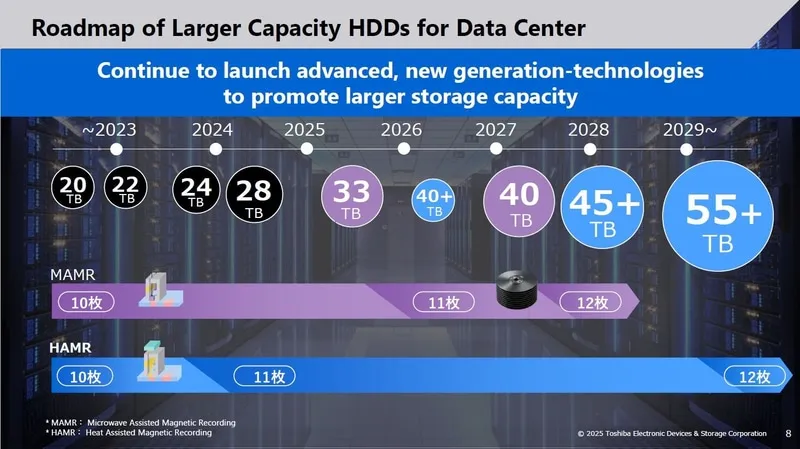
Toshiba’s future plans highlight two critical technologies: MAMR and HAMR. According to the roadmap, the goal is to surpass the 40 TB mark in 2026 with HAMR technology. Drives using microwave-assisted MAMR technology are expected to reach the same capacity in 2027. MAMR uses microwave fields to stabilize the write operation, while HAMR uses heat from a semiconductor laser to instantaneously reduce magnetic resistance. Both methods allow manufacturers to fit significantly more data onto disk platters compared to traditional methods.
In the long term, HAMR technology is expected to play an even larger role. As this technology matures, the company plans to reach 45 TB capacity in 2028 and 55 TB levels after 2029. Toshiba even believes that it’s technically possible to use thirteen platters within the same disk format. These developments are vital, especially for cloud systems and data centers, in a world where data production and storage needs are increasing exponentially every day.
So, what are your thoughts on this rapid increase in hard disk capacity? Do you think we will need such high-capacity disks in our personal computers in the future, or will these technologies remain limited to the corporate sector?