
Humanoid robots have become traffic cops!

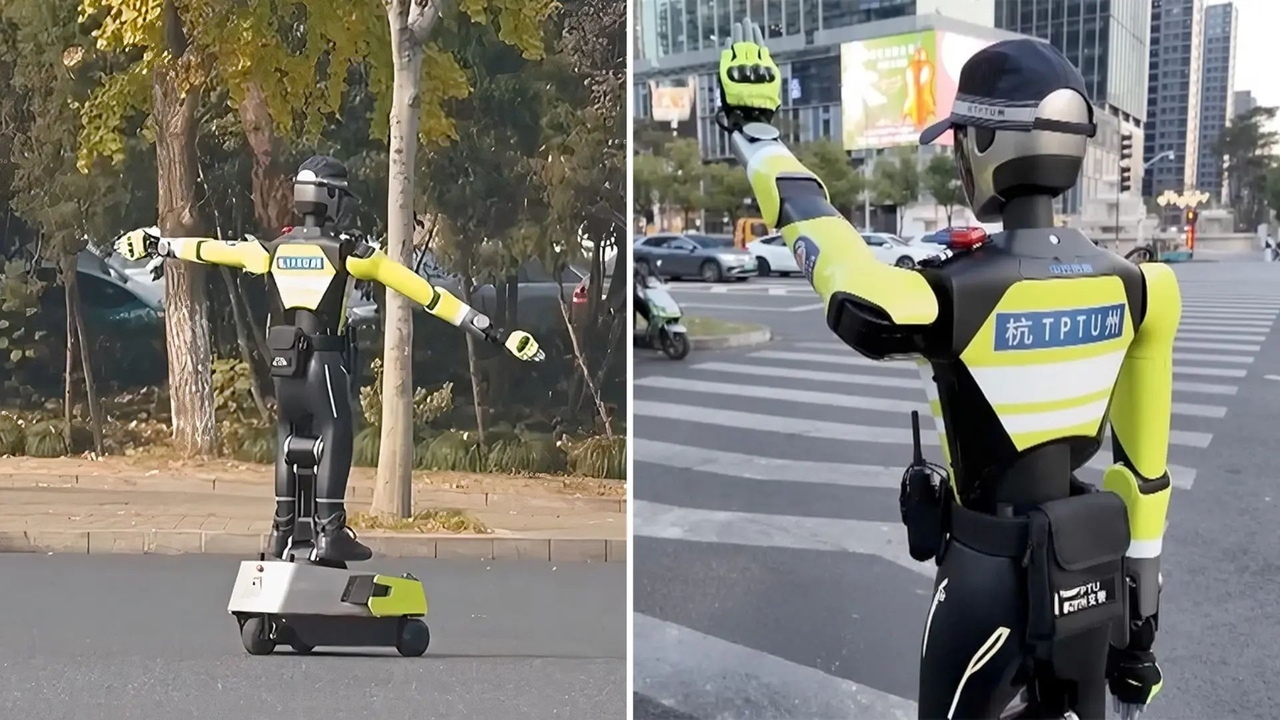
A new AI-powered traffic robot has begun operating at a busy intersection in Hangzhou, China’s technology hub. This 1.8-meter-tall humanoid robot, dubbed “Hangxing No. 1,” marks a new chapter in the city’s automation journey and has been deployed at the intersection of Binsheng Road and Changhe Road in the Binjiang district. It handles tasks such as managing traffic flow, detecting violations, and issuing polite verbal warnings to drivers and pedestrians.
The era of robot police has begun
In Hangzhou, a city of approximately 12 million people, managing the heavy traffic caused by motorcyclists and automobiles has long been a challenge. Developed by the Hangzhou Traffic Police Tactical Unit, the robot began its pilot application on December 1st.
Equipped with cameras, sensors, and gesture-based signaling, the robot is programmed to support human police officers during rush hour for vehicles, scooters, and pedestrians. The robot’s commands, such as “stop,” “go straight,” and “wait,” were trained by modeling the standard movements of real traffic police officers. It can also sound a digital whistle and synchronize its instructions with the existing traffic light network.
Hangxing No. 1 not only directs traffic; it also monitors and detects common violations in real time, such as drivers not wearing helmets, vehicles crossing the stop line, and pedestrians running red lights. When a violation is detected, the robot issues a calm, pre-recorded voice warning, ensuring a non-confrontational behavior correction.
Violation incidents are immediately recorded and transmitted to the police database. In the early stages of the pilot, a human officer is present nearby to intervene if the robot’s polite warnings fail to correct the behavior.
A replaceable battery system, providing approximately 6 to 8 hours of operation, allows the robot to operate continuously during rush hour and automatically returns to the charging station when the battery runs low.
According to Zhang Wanzhe, a traffic brigade employee, engineers are continuously improving the system’s decision-making capabilities. Future updates will also allow the robot to integrate with language models, answer questions, and provide route guidance.
Your comment has been submitted,
it will be published after approval.