
Snapdragon 8 Gen 5 Performance: A Surprising Rival?


The new Snapdragon 8 Gen 5 performance is the talk of the tech world, but Qualcomm’s confusing naming strategy is causing some head-scratching. While the new 8 Gen 5 offers a major leap from the 8 Gen 3, it faces an unexpected challenge from a surprising rival: the Snapdragon 8 Elite.
Snapdragon 8 Gen 5 Performance Against Rivals
To understand the processor hierarchy, it’s crucial to decipher Qualcomm’s naming scheme. Until the Snapdragon 8 Gen 3, everything was straightforward. However, the introduction of the Snapdragon 8 Elite in October 2024 changed everything, as it is effectively the fourth-generation platform. Consequently, the Snapdragon 8 Gen 5, despite its name, falls slightly behind the 8 Elite in some areas while still being a powerful flagship chipset. Therefore, upgrading from an 8 Gen 3 to an 8 Gen 5 is a logical step, but the same cannot be said for current 8 Elite owners.
Technical Specifications and Key Differences
The core differences between these processors range from manufacturing technology to core architecture. The Snapdragon 8 Gen 5 uses TSMC’s advanced 3nm (N3P) process, whereas the 8 Elite is built on the slightly older 3nm (N3E) technology. Both, however, offer significantly better performance and power efficiency compared to the 8 Gen 3’s 4nm (N4P) process. Here is a detailed comparison of the three chipsets:
| Feature | Snapdragon 8 Gen 5 | Snapdragon 8 Elite | Snapdragon 8 Gen 3 |
|---|---|---|---|
| Announcement | November 2025 | October 2024 | October 2023 |
| Process | TSMC 3nm (N3P) | TSMC 3nm (N3E) | TSMC 4nm (N4P) |
| CPU | 2 x 3.8 GHz Oryon (3rd gen) 6 x 3.32 GHz Oryon (3rd gen) |
2 x 4.32 GHz Oryon (2nd gen) 6 x 3.53 GHz Oryon (2nd gen) |
1 x 3.3 GHz Cortex-X4 5 x 3.15/2.96 GHz Cortex-A720 2 x 2.27 GHz Cortex-A520 |
| GPU | Adreno 829 | Adreno 830 | Adreno 750 |
| Memory | LPDDR5x, up to 4.8 GHz | LPDDR5x, up to 5.3 GHz | LPDDR5x, up to 4.8 GHz |
| Connectivity | Snapdragon X80 5G modem, Wi-Fi 7, Bluetooth 6.0 | Snapdragon X80 5G modem, Wi-Fi 7, Bluetooth 6.0 | Snapdragon X75 5G modem, Wi-Fi 7, Bluetooth 5.4 |
Benchmark Tests: What the Numbers Say
Synthetic benchmark results clearly illustrate the power balance. In the Geekbench 6 single-core test, the Snapdragon 8 Elite surprisingly surpasses the Snapdragon 8 Gen 5, thanks to its higher clock speeds. In multi-core performance, the 8 Gen 5 takes a slight lead. The Snapdragon 8 Gen 3, on the other hand, lags significantly behind both models.

The AnTuTu test results paint a similar picture. The Snapdragon 8 Elite narrowly beats the 8 Gen 5 in the total score. A closer look reveals that while the 8 Gen 5 scores 6% higher in CPU tests, the 8 Elite dominates with a 12% lead in GPU performance. This highlights just how capable the 8 Elite is, particularly for gaming.
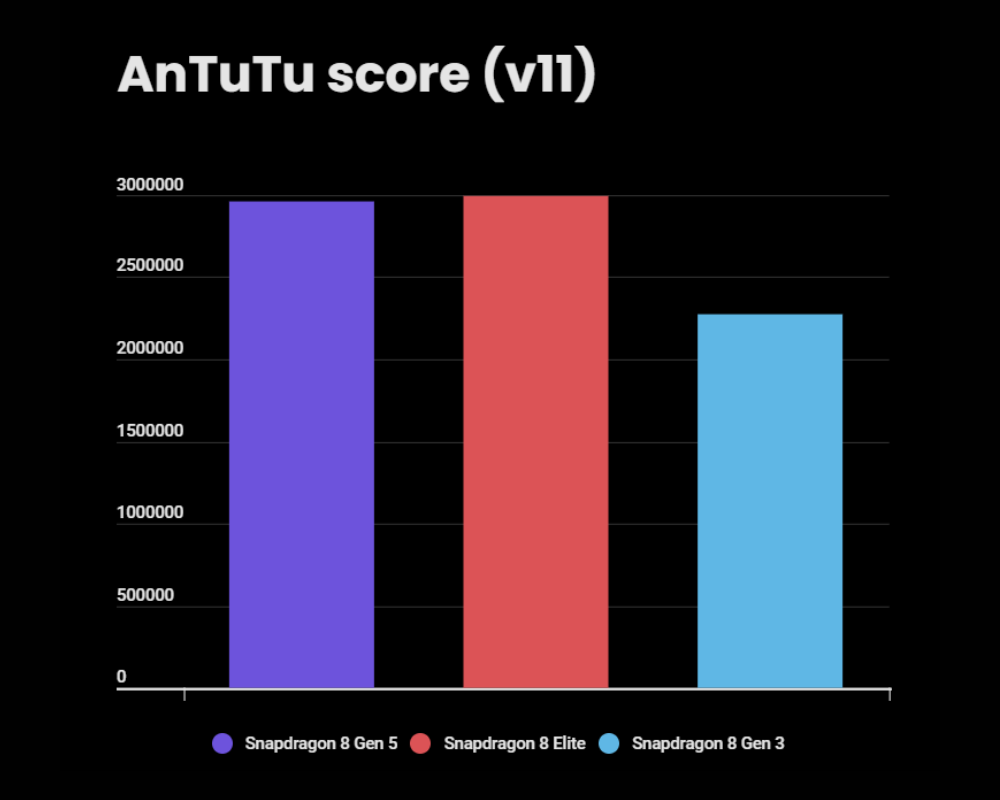
In conclusion, the Snapdragon 8 Gen 5 offers improved camera capabilities, enhanced connectivity, and a clear performance boost for users upgrading from the 8 Gen 3. However, if you already own a device with a Snapdragon 8 Elite, there isn’t a compelling reason to make the switch to the 8 Gen 5.
So, what are your thoughts on the new Snapdragon processors? Share your opinions with us in the comments!
Your comment has been submitted,
it will be published after approval.