
A Solution to Price Hikes: Bringing a Trashed RTX 4090 Back to Life!

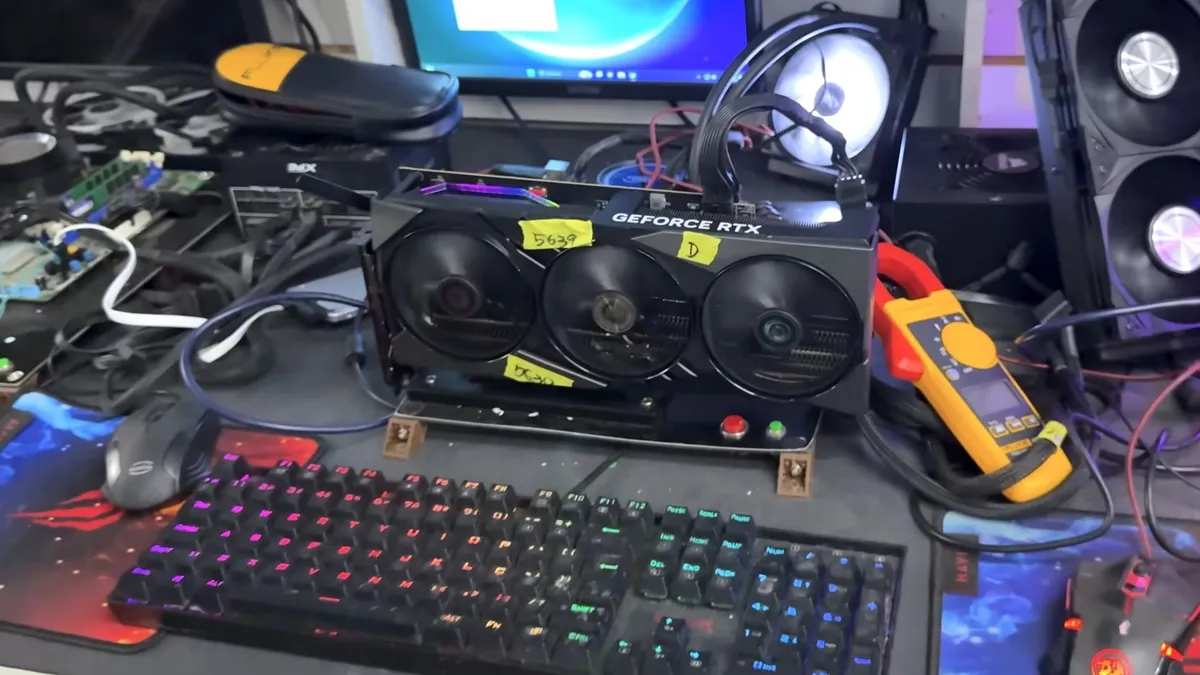
Famous Brazilian YouTuber Paulo Gomes and his teammate Jefferson Silva have saved a physically heavily damaged MSI RTX 4090 graphics card from the scrap heap. The team used jumper wires and custom BIOS software to repair the card’s cracked Printed Circuit Board (PCB). As a result of this challenging operation, the graphics card was made operational once again.
Resurrecting a Trashed RTX 4090 with Custom BIOS
While a standard NVIDIA GeForce RTX 4090 comes with 24 GB of GDDR6X VRAM, this repaired unit dropped to a 20 GB capacity after one memory channel had to be disabled. The team noted that the severe physical damage was caused by the lack of a support bracket. Moving the PC without securing the GPU, or simply the long-term effect of gravity on such a massive card, led to the PCB bending and eventually cracking.
To bring the card back to life, several technical hurdles were overcome:
- Manual Power Routing: 12V and 5V power lines were manually redirected using jumper wires.
- Fan Control Bypass: Since the PWM circuit controlling the cooling fans was destroyed, an extra 5V line was added to keep the fans spinning at a constant speed.
- Channel Disabling: To bypass the broken memory traces, a modified custom BIOS was flashed, effectively telling the GPU to ignore the damaged memory controller.
Despite losing 4 GB of VRAM and some performance, the card became fully functional for gaming and benchmarks.
Benchmark Results and “48 GB” Curiosities
The team tested the resurrected card on a system featuring a Ryzen 5 3600X processor and 8 GB of RAM. In 3DMark (likely Time Spy Extreme), the card achieved scores between 10,300 and 10,700 points.
Interestingly, the video also showcased a different RTX 4090 reporting 48 GB of VRAM. This was achieved using a BIOS designed to support double-sided memory modules often found in Chinese AI server farms. However, it was emphasized that if the hardware actually tries to exceed the physical 24 GB limit, the system will crash.
In an era of skyrocketing GPU prices, saving a high-end card from being e-waste has garnered significant interest in the tech community. However, experts strongly advise users without advanced electrical engineering knowledge to stay away from such “home-made” hardware repairs. What do you think about these extreme hardware resurrections? Which graphics card are you currently rocking in your own rig? Share your thoughts in the comments!
Your comment has been submitted,
it will be published after approval.