
2026 Mobile Processor Comparison: Which Chip Reigns Supreme?

In 2026, the mobile processor comparison landscape reveals a staggering disparity in raw computing power, with the fastest flagship chipsets now delivering 15 times the performance of entry-level mobile silicon. As smartphones become increasingly complex, our comprehensive analysis of 70 different chipsets released over the past 30 months—utilizing rigorous benchmarks like GeekBench and 3DMark—highlights a widening performance gap. While software optimization remains vital, the sheer hardware capabilities of flagship processors like the Snapdragon 8 Elite Gen 5 and Apple A19 Pro define the absolute ceiling for modern mobile computing efficiency and user experience.
- Flagship processors now offer 15 times more performance than entry-level alternatives.
- Apple maintains dominance in single-core speeds while Qualcomm leads in graphical throughput.
- Performance gaps between entry-level and mid-range devices are expanding rapidly.
- Advanced mobile graphics are now 5,600% more powerful than their entry-level counterparts.
Flagship Competition Intensifies in the Processor Market
The race for smartphone dominance has narrowed significantly among premium silicon manufacturers. Current industry leaders, including the Snapdragon 8 Elite Gen 5, Dimensity 9500, Exynos 2600, and Apple A19 Pro, now provide remarkably similar high-end performance metrics.
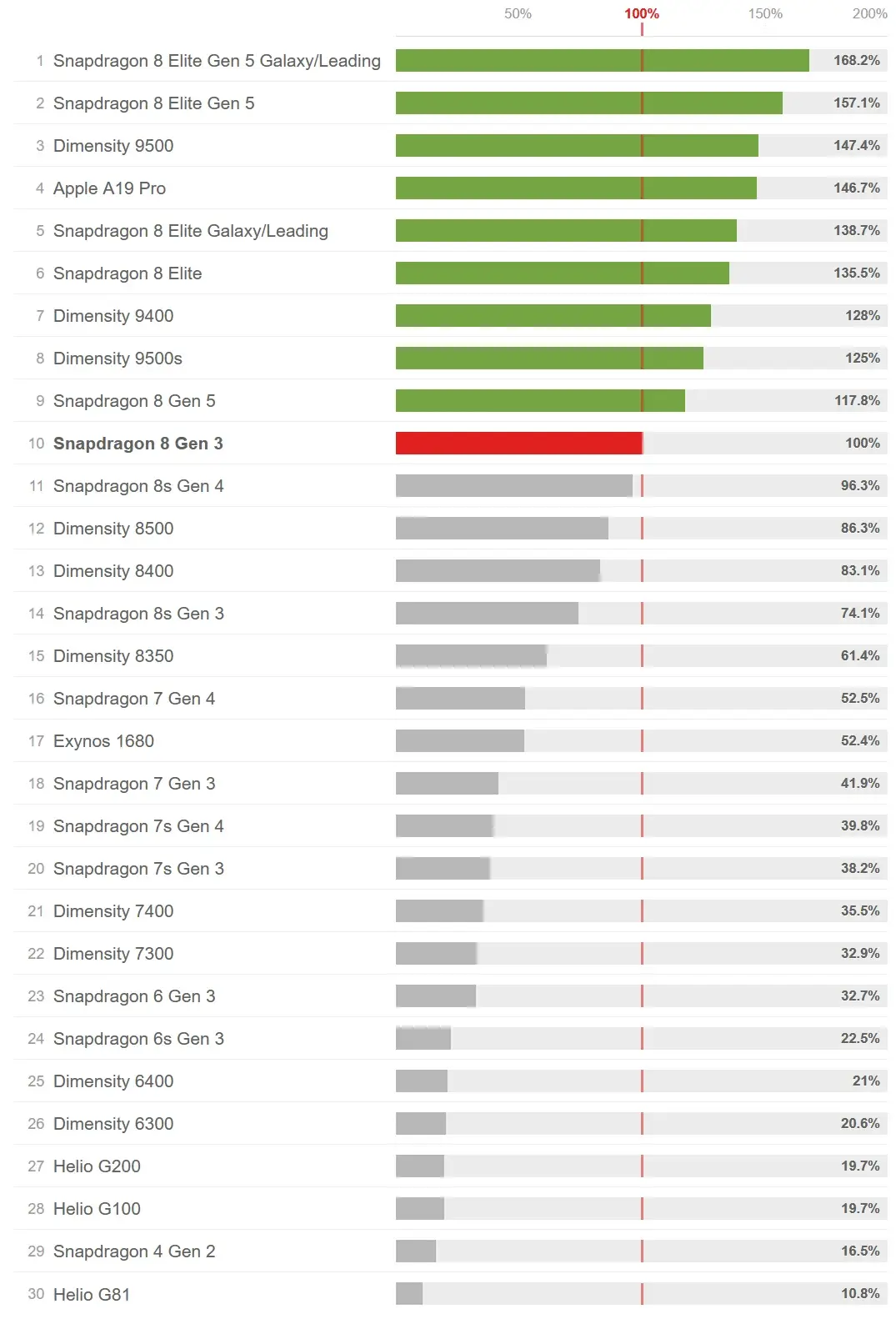
Apple continues to secure its position as the leader in single-core performance, which is essential for instantaneous interface responsiveness and smooth daily operation. Meanwhile, Qualcomm has optimized its Snapdragon 8 Elite Gen 5 to excel in multi-core tasks and high-end graphical processing, making it a formidable choice for gaming enthusiasts.
MediaTek has successfully transitioned its success from the mid-range sector to the high-end market. By narrowing the performance delta with its flagship competitors through the Dimensity 9500, the company has solidified its influence. Additionally, Samsung’s Exynos 2600 has effectively rehabilitated its reputation, returning to a competitive flagship status, whereas Google’s Tensor G5 prioritizes balanced daily operation over raw graphical overhead.
Graphical Performance Shows Unprecedented Growth
The most significant technological evolution in 2026 is the massive leap in graphical processing capabilities rather than raw CPU clock speeds.
There is a massive 5,600% performance difference in graphical rendering between the Snapdragon 8 Elite Gen 5 Leading Edition and the entry-level Snapdragon 4s Gen 2. This observation confirms that the gap between entry-level and mid-range hardware is widening at an unsustainable rate for budget devices.
While entry-level chips like the Helio G81 can still technically run modern applications, they provide only a fraction of the power found in contemporary flagships. Consequently, consumers are increasingly finding that mid-range options offer a significantly better value proposition than entry-level hardware.
Market trends suggest that users should prioritize mid-range processors over entry-level models to ensure long-term device usability.
Given the extreme power modern chipsets now offer, do you believe that raw hardware capability has become more important than software optimization for your daily smartphone usage? Share your thoughts and experiences in the comments section below.
Your comment has been submitted,
it will be published after approval.