
Trendyol Launches Türkçe Atlas to Advance Turkish AI Models


In a significant move to bolster local artificial intelligence capabilities and reduce dependence on foreign technology, Trendyol Group has officially released “Türkçe Atlas,” a large-scale supervised fine-tuning (SFT) dataset designed specifically for Turkish language models. Announced as a major milestone for the Turkish AI ecosystem, this open-source project provides nearly 336,000 structured data examples. By utilizing high-quality, refined web resources, the initiative aims to empower developers and researchers to create AI systems that understand and communicate in Turkish with greater accuracy, natural flow, and cultural relevance than previously possible with generalized models.
- The Turkish Atlas dataset contains approximately 336,000 structured examples optimized for supervised fine-tuning of language models.
- The project supports essential AI tasks including instruction following, text summarization, and structured output generation.
- Trendyol Group provides the data in a JSONL format to ensure seamless integration into existing developer workflows.
- The initiative aims to minimize reliance on foreign-language data sources and strengthen the domestic AI infrastructure.
This strategic release marks a turning point for national data sovereignty in the rapidly evolving artificial intelligence sector.
Turkish Atlas Provides Critical Resources for AI Development
Large language models require rigorous fine-tuning to perform effectively within a specific linguistic context. The Türkçe Atlas project addresses the critical shortage of high-quality Turkish training data, which has long been a barrier for domestic AI development. Unlike raw data scraping, the team behind this project has carefully distilled information from open-access web sources to ensure the quality and safety of the training material. By removing subjective, biased, or low-quality content, the developers have created a cleaner foundation that allows models to produce more consistent and reliable results. 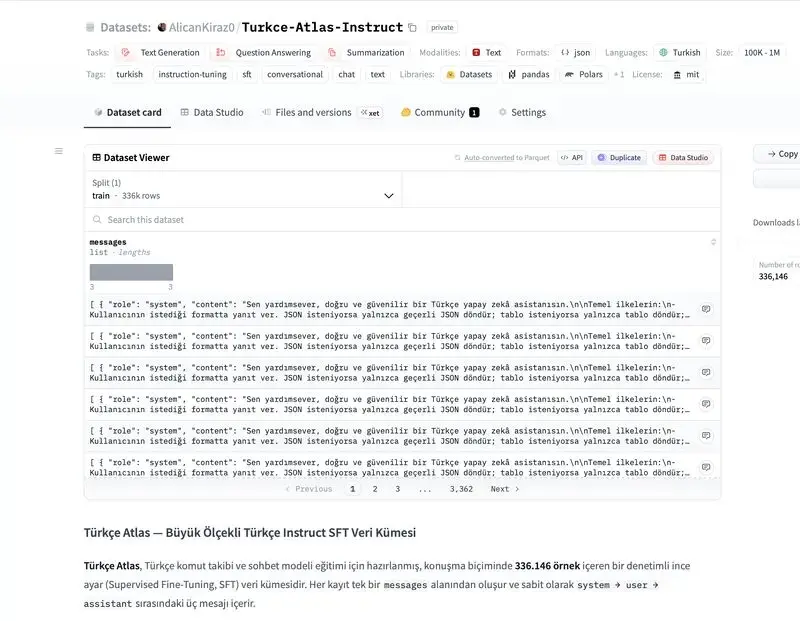
Standardized Formats Simplify the Training Process
To facilitate rapid adoption among engineers and data scientists, the dataset is structured using the industry-standard “system-user-assistant” conversational template. This hierarchical organization ensures that the data is ready for immediate integration into modern machine learning architectures. By providing data in the JSONL format, the project removes the need for extensive pre-processing or complex data transformation, allowing researchers to focus their efforts on refining model performance rather than cleaning data.
The implementation of standardized data structures accelerates the deployment of specialized Turkish AI applications.
Turkish Language Models Achieve Higher Performance Standards
The 336,000 examples included in the dataset are designed to improve the core competencies of language models across both daily and professional use cases. By incorporating diverse instruction-following tasks, the dataset ensures that AI agents can accurately interpret and execute complex user commands. Furthermore, the inclusion of extensive question-answering examples strengthens the model’s ability to maintain factual consistency and adhere to the grammatical nuances of the Turkish language.
Business Integration Capabilities Expand Significantly
Beyond basic conversation, the dataset enables models to perform high-level tasks like document summarization and structured data generation. These capabilities are essential for corporate environments where the analysis of lengthy reports is a daily requirement. The ability of a model to generate data in structured formats, such as tables or code blocks, facilitates its integration into existing software ecosystems. This development represents a major step forward for companies looking to automate their internal workflows using localized, high-performance artificial intelligence.
How do you believe the release of high-quality local datasets like Türkçe Atlas will influence the future of AI-driven business tools in Turkey? Share your thoughts and predictions in the comments section below.
Your comment has been submitted,
it will be published after approval.