
Google Pixel 11 Pro XL Benchmarks Reveal Tensor G6 Power

Google is preparing to redefine its smartphone lineup with the upcoming Pixel 11 series, which has recently surfaced in Geekbench performance databases ahead of its official launch. The flagship Google Pixel 11 Pro XL model is drawing significant attention for its integration of the next-generation Tensor G6 processor. Early benchmark data provides the first concrete evidence of the device’s technical capabilities, highlighting a sophisticated hardware architecture designed to run on the latest Android 17 operating system. As anticipation builds, these test results offer a critical look at how the tech giant intends to elevate its performance standards in the competitive flagship market.
- The Google Pixel 11 Pro XL achieved a single-core score of 2,112 and a multi-core score of 5,196 in Geekbench tests.
- The Tensor G6 processor utilizes a seven-core architecture featuring a primary core clocked at 4.11GHz.
- The device incorporates 16GB of RAM and a PowerVR C-Series CXTP-48-1536 graphics processing unit.
The benchmark scores suggest that the Tensor G6 focuses on consistent, stable performance improvements rather than radical raw power shifts compared to the Tensor G5.
Technical Specifications of the Tensor G6 are Confirmed
The Geekbench results provide a clear breakdown of the core configuration within the new Tensor G6 chipset. The processor features a unique seven-core design, consisting of two cores running at 2.65GHz, four mid-range cores at 3.38GHz, and a singular high-performance core hitting 4.11GHz. This specific structure aligns with earlier industry leaks and confirms Google’s commitment to a custom-tailored silicon strategy.
Earlier prototype testing conducted in February yielded significantly lower scores of 845 for single-core and 2,657 for multi-core performance, indicating that substantial optimization has occurred over the last several months. While these current figures demonstrate that the hardware is reaching maturity, the final market impact will depend on how the Tensor G6 performs against other high-end mobile chipsets during daily usage scenarios. 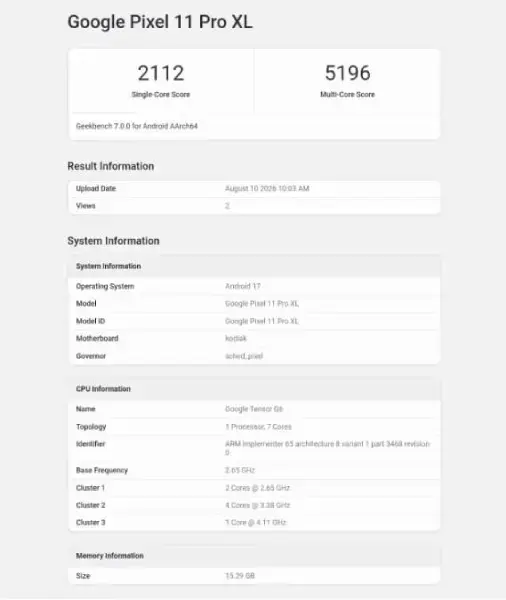
Advanced Hardware and Software Integration are Provided
To support the demands of modern mobile computing, the Pixel 11 Pro XL is equipped with 16GB of RAM, a capacity that ensures smooth operation for intensive multitasking and complex artificial intelligence tasks. The graphics processing duties are handled by the PowerVR C-Series CXTP-48-1536 GPU, which has been the subject of several recent hardware leaks.
The device will arrive with Android 17 pre-installed, marking a strategic milestone for Google in its pursuit of seamless hardware and software cohesion.
Google continues to emphasize efficiency and AI integration over raw processing speed in its hardware development strategy. The latest test results indicate that the Tensor G6 is optimized to support this long-term vision. With retail packaging already appearing in select markets, the excitement surrounding the impending launch of the Pixel 11 series is reaching a peak among technology enthusiasts and industry analysts alike.
We are curious to hear your thoughts on these latest benchmark results; do you believe the Tensor G6 will allow Google to successfully compete with the industry’s top-tier flagships? Share your expectations for the Pixel 11 series in the comments section below.
Your comment has been submitted,
it will be published after approval.