
ASELSAN Launches Mass Production of ASELBUOY P Submarine Detection System


Turkey has achieved a significant milestone in naval defense capabilities as ASELSAN officially commenced mass production of its ASELBUOY P, a sophisticated passive sonobuoy system. Following the successful completion of rigorous verification and testing phases, this domestic system is now ready for deployment. Designed to detect, track, and classify underwater threats, the ASELBUOY P enhances the nation’s anti-submarine warfare (ASW) effectiveness. By utilizing advanced acoustic sensing technologies, the system allows Turkish naval platforms, including patrol aircraft, helicopters, and surface vessels, to monitor underwater environments with unprecedented precision while maintaining operational stealth.
- The ASELBUOY P system utilizes DIFAR sensors to detect and pinpoint the directional origin of underwater acoustic signals.
- The device operates within a 5-2400 Hz frequency range, allowing it to capture the characteristic signatures of submerged submarines.
- Mass production of the system strengthens Turkey’s self-reliance by eliminating dependence on imported consumable ASW assets.
- The equipment is fully compatible with NATO A-size launch tubes used on existing maritime patrol platforms.
The transition to domestic mass production marks a critical shift in sustaining continuous anti-submarine warfare operations.
The System Employs Advanced Acoustic Detection Technologies
At the core of the ASELBUOY P lies the Directional Frequency Analysis and Recording (DIFAR) sensor. Unlike traditional passive sonobuoys that merely signal the presence of a target, DIFAR technology provides the specific bearing of the sound source. This directional data is crucial for maritime operators, as it enables them to triangulate the exact position of a submarine when multiple buoys are deployed in a coordinated pattern.
The system is engineered to operate in challenging environments, specifically targeting the 5-2400 Hz frequency band. This range is essential for isolating the low-frequency mechanical noises generated by submarine propellers and hull machinery, which are often masked by background ocean noise. By remaining completely passive, the system ensures that the searching platform remains undetected by the target, as no active sonar pulses are emitted.
Design Specifications Ensure Seamless Operational Integration
ASELSAN has optimized the ASELBUOY P to meet NATO A-size standards, ensuring it can be integrated into existing launch mechanisms on various naval platforms without requiring hardware modifications. The device offers flexibility in deployment, with users able to select operating depths of either 30 or 150 meters. This depth selection is vital for countering submarines that attempt to hide beneath the thermocline—a layer of water where temperature changes affect sound propagation.
The ability to reach depths of 150 meters allows the system to effectively track targets hiding beneath thermal layers.
Operational endurance is another key feature, as the system can be programmed for mission durations ranging from 30 minutes to eight hours. Once the mission is complete, the unit is designed to self-sink, preventing sensitive acoustic technology from falling into unauthorized hands. 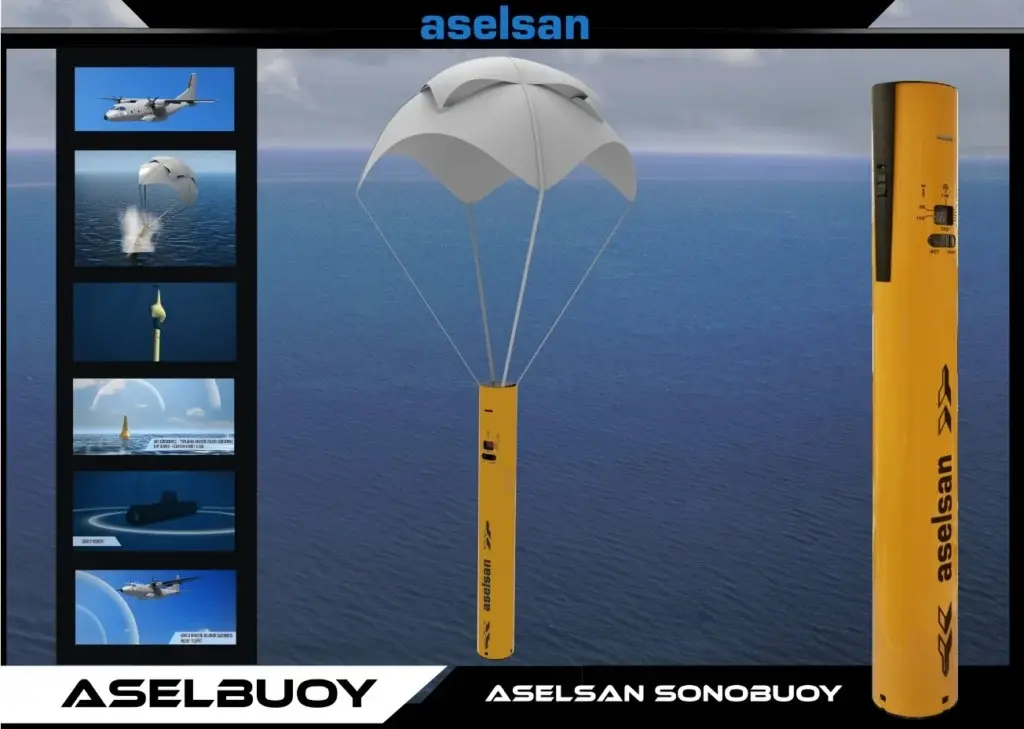 Data transmission is handled via RF communication across 96 VHF channels within the 136-173.5 MHz spectrum, providing reliable connectivity to the host vessel or aircraft.
Domestic Production Increases Strategic Autonomy
Because sonobuoys are consumable assets that are deployed in high volumes during search missions, their availability is a major factor in sustained naval readiness. Reliance on foreign suppliers for such high-consumption items presents a significant risk to national defense if supply chains are disrupted. By bringing the production of ASELBUOY P in-house, the Turkish defense industry ensures that the Naval Forces can maintain high-intensity surveillance operations without facing logistical bottlenecks. This achievement underscores the growing maturity of Turkey’s domestic defense ecosystem in developing high-tech, expendable naval warfare equipment.
How do you evaluate the strategic impact of Turkey producing its own high-tech underwater surveillance equipment? Share your thoughts on the future of domestic naval technology in the comments section below.
Your comment has been submitted,
it will be published after approval.