
Snapdragon 8 Elite Ultra Gen 6 Struggles in Early Benchmarks

The highly anticipated Snapdragon 8 Elite Ultra Gen 6 has encountered unexpected hurdles in its initial performance evaluations, as revealed by recent Geekbench 6.7 testing. Conducted on an iQOO smartphone prototype identified by model number V2606A, the testing process highlighted that despite the chipset being the first mobile processor to surpass the 5 GHz frequency threshold, it currently trails behind its predecessor, the Snapdragon 8 Elite Gen 5. While these preliminary figures have raised questions among enthusiasts and industry analysts alike, experts emphasize that the device is a pre-production engineering sample that likely lacks the necessary software optimization required to showcase its true capabilities.
- The Snapdragon 8 Elite Ultra Gen 6 processor failed to outperform the previous generation in initial benchmark scores.
- The chipset architecture features a record-breaking primary core speed exceeding 5 GHz.
- The hardware is manufactured using the advanced 2-nanometer TSMC N2P process.
- Current performance data is derived from unoptimized engineering samples rather than final commercial hardware.
Processor Architecture Reaches Unprecedented Speeds
Technically, the Snapdragon 8 Elite Ultra Gen 6 boasts a sophisticated design that theoretically positions it at the peak of mobile computing. The internal architecture consists of two primary performance cores, three auxiliary performance cores, and three power-efficient cores. Most notably, the two primary cores are clocked at 5.01 GHz, a frequency milestone that has never before been achieved in the history of mobile silicon. 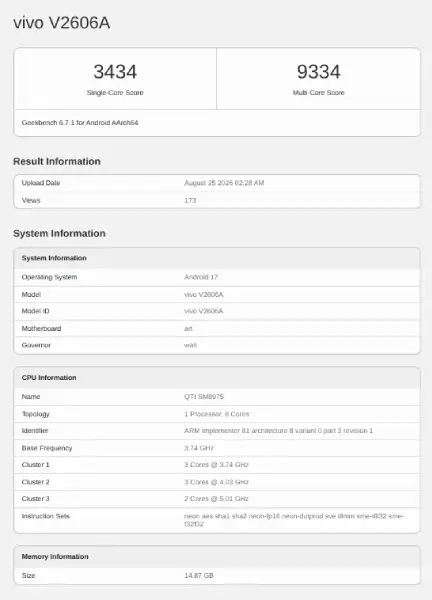
Complementing these high-speed primary cores, the auxiliary units operate at 4.03 GHz, while the efficiency-focused cores maintain a frequency of 3.74 GHz. On the graphical processing front, the Adreno 850 unit is tasked with managing demanding visual workloads, ensuring that the chip remains competitive in high-end gaming and multimedia rendering tasks.
Benchmark Tests Produce Counterintuitive Results
Despite these impressive raw clock speeds, the Geekbench 6.7 results indicate that the increased frequency does not currently translate into a proportional gain in computational power. The engineering prototype achieved 3,434 points in single-core tests and 9,334 points in multi-core tests. When placed against the current Snapdragon 8 Elite Gen 5, which recorded 3,649 and 10,682 points on an iQOO 15 device, the performance gap becomes evident. This deficit strongly suggests that the next-generation architecture is not yet fully synchronized with the operating system.
Optimization Processes Remain Crucial for Performance
Industry observers maintain that these underwhelming scores should be viewed with caution, as engineering samples often utilize final silicon but operate on incomplete power profiles. The implementation of the 2-nanometer N2P manufacturing process introduces significant complexities regarding thermal management and stability, which necessitate extensive calibration during the final stages of product development.
It is widely expected that the manufacturer is currently engaged in a comprehensive optimization cycle to ensure that the commercial versions of these devices deliver the performance expected of a flagship product. The transition to a more refined production state is likely to resolve the current discrepancies and allow the chipset to leverage its high clock speeds effectively, potentially changing the competitive landscape of the mobile processor market once the final software updates are deployed.
Given the early performance data, what are your expectations for the final version of the Snapdragon 8 Elite Ultra Gen 6? Do you believe the raw clock speed advantage will eventually outweigh current optimization concerns, or will thermal efficiency remain a challenge? Share your thoughts in the comments section below.
Your comment has been submitted,
it will be published after approval.