
Graphics Card Shipments Reach Four-Year Peak Despite Rising Prices

The global graphics card market experienced a significant surge in the second quarter of 2026, as 12.5 million add-in board (AIB) units were shipped worldwide. Despite persistent price increases across the hardware sector, this figure represents the highest shipment volume recorded in the last four years. Industry data confirms that desktop graphics card shipments grew by 10 percent sequentially and 6.6 percent year-over-year. This unexpected growth defies traditional seasonal trends, as the second quarter is historically considered a quieter period for hardware retail. Consumers appear to be prioritizing high-end components, driving market momentum forward even amidst broader economic and geopolitical uncertainties.
- Global shipments of add-in board graphics cards reached a four-year high of 12.5 million units in Q2 2026.
- NVIDIA maintains a dominant market share of approximately 90 percent after shipping 11.25 million units.
- Desktop CPU shipments experienced a decline of 10.5 percent on a quarterly basis.
- Analysts project a 2.5 percent annual contraction for the AIB market between 2025 and 2030.
NVIDIA Dominates the Market While Intel Gains Ground
NVIDIA continues to exert overwhelming control over the AIB segment, securing nearly 90 percent of the total market share. During the second quarter, the company shipped approximately 11.25 million units, marking its strongest performance in a single quarter since late 2017. 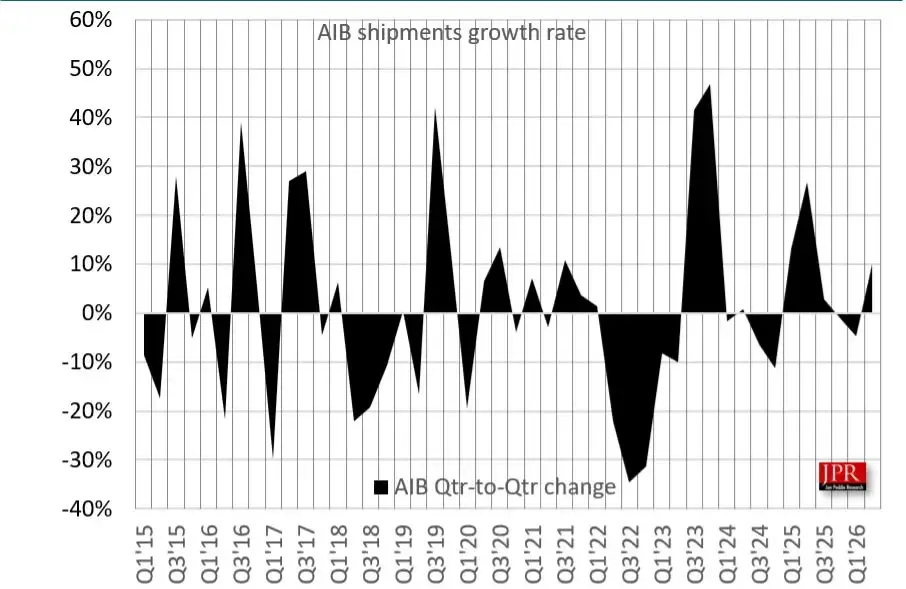 While NVIDIA remains the clear leader, the competitive landscape shows subtle shifts among other major manufacturers. AMD currently holds approximately 8 percent of the market with roughly 1 million units shipped, while Intel has successfully expanded its footprint to reach 2 percent of the market share.
When compared to the previous quarter, both NVIDIA and AMD saw marginal dips in their respective market shares, while Intel recorded a 0.3 percentage point increase. Interestingly, the attachment rate of AIB cards to desktop computers reached 89 percent, reflecting a 23-point increase over the prior quarter. This trend contrasts sharply with the broader CPU market, which saw shipment volumes drop to 14 million units, representing a 33 percent year-over-year decline.
Rising Costs Influence Consumer Behavior Patterns
The growth in graphics card shipments occurs against a backdrop of increasing memory costs and hardware price inflation. Market experts suggest that consumers are purchasing high-end cards earlier than planned to avoid potential future price hikes. 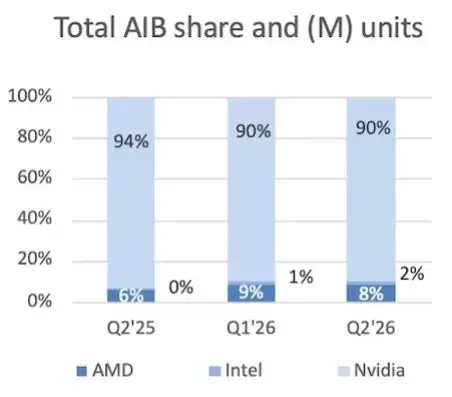 Furthermore, external factors such as regional conflicts, including the ongoing war in Iran, are placing additional pressure on hardware pricing across various product segments.
Looking toward the future, the industry faces long-term structural changes. Forecasts suggest a compound annual decline of 2.5 percent for the AIB market through 2030. Despite this projected contraction, the total number of active AIB-based graphics cards is expected to reach approximately 193 million units by the end of the decade, underscoring the enduring demand for dedicated graphical processing power in modern computing environments.
Given the current volatility in hardware costs and the shift in consumer buying habits, we would love to hear your perspective. Do you believe the upward trend in graphics card pricing will eventually dampen demand, or will gamers continue to prioritize high-end performance regardless of the cost? Share your thoughts in the comments section below.
Your comment has been submitted,
it will be published after approval.