
Samsung Galaxy A Series Leads Global Best-Selling Phones in 2026


In a significant shift for the global smartphone market, Samsung has reclaimed its position as the top manufacturer during the second quarter of 2026. According to the latest report released by Smart Analytics Global (SAG), the Samsung Galaxy A series has captured 18% of the total market share, effectively overtaking Apple. While Samsung focuses on volume, the Apple iPhone 17 series remains a powerhouse in the premium segment, securing the top three spots for individual model sales despite sitting in second place overall. This quarterly performance highlights a stark contrast in strategies between the two industry leaders as they navigate rising component costs and shifting consumer demands.
- The Samsung Galaxy A series secured an 18% global market share following an 11% year-over-year growth.
- Apple maintained its dominance in the premium sector with the iPhone 17 series, which saw a 24% annual growth.
- Budget-focused Android brands experienced significant declines in market share due to inflationary pressures.
- Huawei demonstrated a notable recovery in the Chinese market with its Changxiang series reporting a 94% growth.
Samsung Prioritizes Market Volume Over Higher Margins
Faced with escalating prices for memory and essential components, major manufacturers are adopting distinct survival strategies. Samsung has chosen to sacrifice some of its profit margins to maintain a dominant shipment volume. The Galaxy A series serves as the primary engine for this approach, with the Galaxy A17 5G emerging as a flagship of the budget segment. Other models, including the A16 4G, A56 5G, and A07 5G, have successfully capitalized on the gap left by competitors who have reduced their model variety or increased prices. By leveraging an extensive supply chain, Samsung continues to solidify its stronghold in the entry-level and mid-range markets.
Apple Captures Profits Through the Premium Segment
While Samsung targets the masses, Apple continues to thrive by focusing on its high-end consumer base. The iPhone 17 family now accounts for 16% of the global market. Specifically, the iPhone 17, iPhone 17 Pro Max, and iPhone 17 Pro are currently the three best-selling individual smartphone models worldwide. Furthermore, the more accessible iPhone 17e model has exceeded sales expectations in key regions such as Japan and the United States, proving that consumer demand for the Apple ecosystem remains resilient despite global economic challenges. 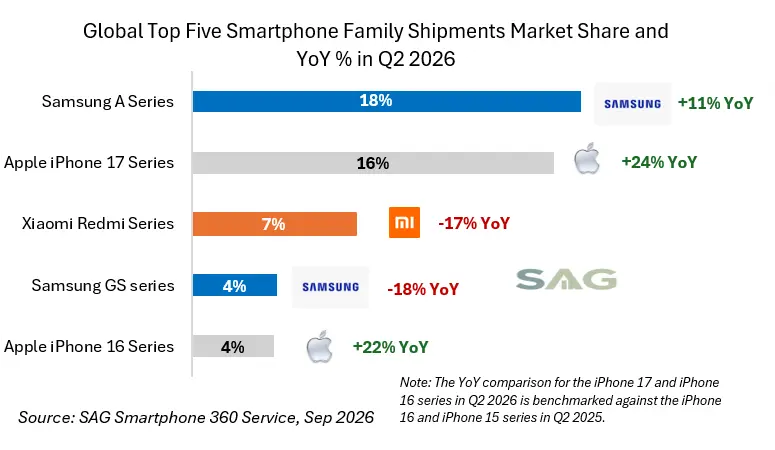
Budget Android Brands Face Severe Market Contractions
The landscape for mid-tier Android devices appears increasingly difficult. Xiaomi’s Redmi series, currently holding 7% of the market, suffered a 17% decline compared to the previous year. The trend is even more pronounced among other manufacturers: the vivo Y and OPPO A series both dropped by 18%, while the Motorola G series and Xiaomi POCO family saw contractions of 35% and 40%, respectively. These figures suggest that consumers with high price sensitivity are becoming increasingly cautious, leading to a sharp decrease in demand for budget-friendly smartphones that do not offer significant value propositions.
Market Leaders Adjust to Future Economic Pressures
As the industry moves into the second half of 2026, the focus shifts toward whether premium demand can sustain its momentum. Analysts warn that rising chip and memory costs will likely continue to inflate retail prices, putting further pressure on purchasing power in emerging markets. While Apple is expected to focus on its current series to maintain volume, the market will closely watch whether Samsung can maintain its aggressive pricing strategy without further compromising its bottom line.
Which smartphone brand do you think offers the best value for money in the current market, and will you be upgrading your device this year? Share your thoughts in the comments section below.
Your comment has been submitted,
it will be published after approval.