
Apple M5 Ultra Performance Surpasses M3 Ultra by 41 Percent


The technology industry has been buzzing following the emergence of initial Geekbench 7 benchmark results for Apple’s latest M5 Ultra chip. These performance metrics, which highlight the impressive GPU capabilities of the new silicon, provide a clear look at how the Apple M5 Ultra performance test results stack up against previous hardware generations. Integrated into the latest iteration of the Mac Studio, the M5 Ultra achieved a remarkable Metal score of 360,019, significantly outpacing the M3 Ultra, which recorded 255,009 points in the same diagnostic evaluation. This data confirms a substantial leap in graphical processing efficiency for professional users.
- The Apple M5 Ultra demonstrates a 41 percent increase in GPU performance compared to the M3 Ultra architecture.
- The chip utilizes a four-die configuration enabled by advanced UltraFusion technology to maximize throughput.
- Benchmark tests reveal a 35 percent improvement in multi-core CPU performance over the previous generation.
- The hardware supports up to 512 GB of unified memory with a bandwidth reaching 1.2 TB/s.
As the successor to the M3 series, the M5 Ultra is engineered to handle demanding creative workflows with greater ease. The test configuration observed in the Geekbench database featured a 36-core CPU setup paired with 256 GB of unified memory. This specific internal architecture consists of 12 high-efficiency cores alongside 24 performance cores, ensuring that the system balances intensive processing tasks with overall power management efficiency. 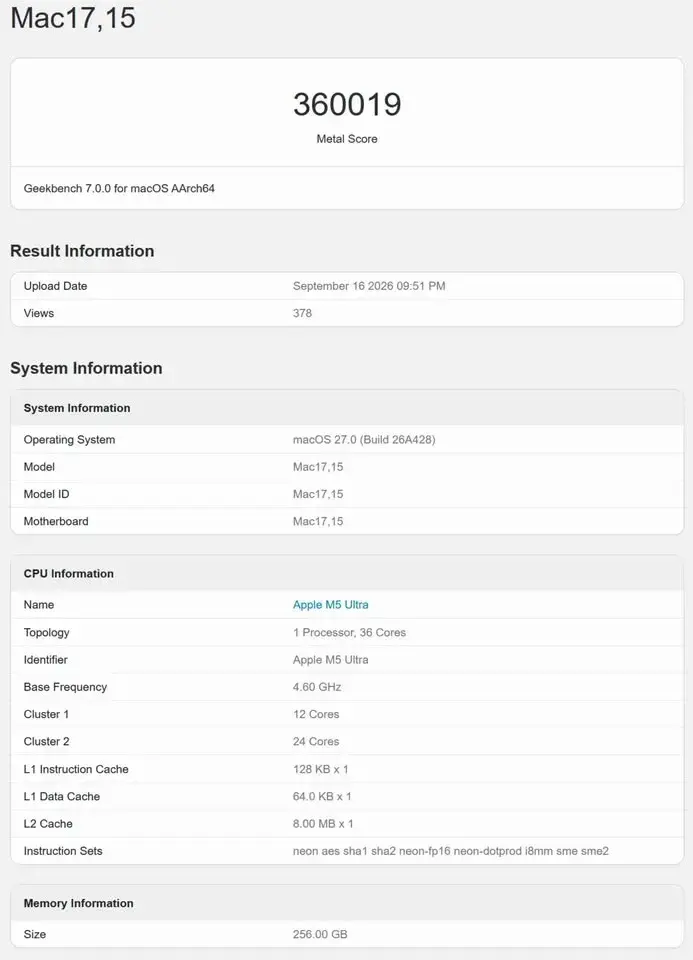
Hardware Architecture Provides New Capabilities
The M5 Ultra distinguishes itself as the first M-series processor to employ a four-die architecture through Apple’s updated UltraFusion technology. This structural change is pivotal, as it allows the chip to scale its GPU configuration up to 80 cores. Furthermore, the massive increase in memory bandwidth—now reaching 1.2 TB/s—represents a 50 percent gain over the M3 Ultra, which directly benefits data-heavy operations such as 8K video editing and real-time 3D rendering. The inclusion of Neural Accelerators within the GPU cores also suggests that the silicon is optimized to handle complex artificial intelligence and machine learning tasks with greater speed.
Benchmark Tests Confirm Significant Gains
Beyond the impressive graphical scores, the CPU performance metrics provide further evidence of a generational leap. In Geekbench 7 testing, the M5 Ultra achieved 3,774 points in single-core tests and 52,516 points in multi-core tests. When placed against the M3 Ultra’s averages of 2,920 and 39,059 respectively, the data indicates a consistent performance increase of approximately 30 to 35 percent. While these Metal scores are specific to Apple’s proprietary API, they signal a major improvement for creators who rely on macOS-optimized software. The integrated Media Engine, capable of managing up to 33 simultaneous streams of 8K ProRes 422 at 30 FPS, further solidifies the Mac Studio’s position as a premier workstation for video professionals.
Market Availability Begins Next Month
It is important to note that these figures are derived from preliminary testing and may vary based on thermal conditions and software optimization. As retail units reach users and broader testing commences, the industry expects a clearer picture of how the M5 Ultra performs across various professional software suites. The new Mac Studio, featuring both M5 Max and M5 Ultra configurations, is scheduled for retail release on September 22. As the release date approaches, the tech community continues to analyze whether this hardware represents the definitive upgrade for modern creative powerhouses.
Given the impressive benchmark scores, how do you think the M5 Ultra will change the daily workflow for video editors and 3D artists? Share your thoughts and expectations in the comments below.
Your comment has been submitted,
it will be published after approval.