
Google Gemini Removes Manual Model Selection for Free Users


Google has officially initiated a significant update for Google Gemini free users, fundamentally changing how individuals interact with the platform. Starting this week, the tech giant has removed the ability for free-tier users to manually select between different AI models. Instead, Google has implemented a mandatory “Automatic” mode that dynamically routes user prompts to the most efficient model based on the complexity of the query. This strategic shift aims to streamline the user experience by ensuring that processing power is allocated optimally, with the system utilizing Gemini 3 models to handle various tasks ranging from simple information retrieval to complex reasoning.
- Google has eliminated manual model selection for all free-tier Gemini users.
- The new automatic system routes prompts to specific models based on the complexity of the request.
- New “effort levels” have been introduced to replace previous extended processing options.
- Future updates will likely restrict model access for Google AI Plus subscribers as well.
Automatic Model Selection Ensures Efficiency
The core objective of this transition is to improve the overall performance and fluidity of the Gemini experience. Under the new system, simple or standard prompts are typically routed to the Flash-Lite model, which Google identifies as its fastest engine. For more intricate tasks requiring deeper logical processing, the system automatically escalates the request to the more powerful Flash or Pro models. 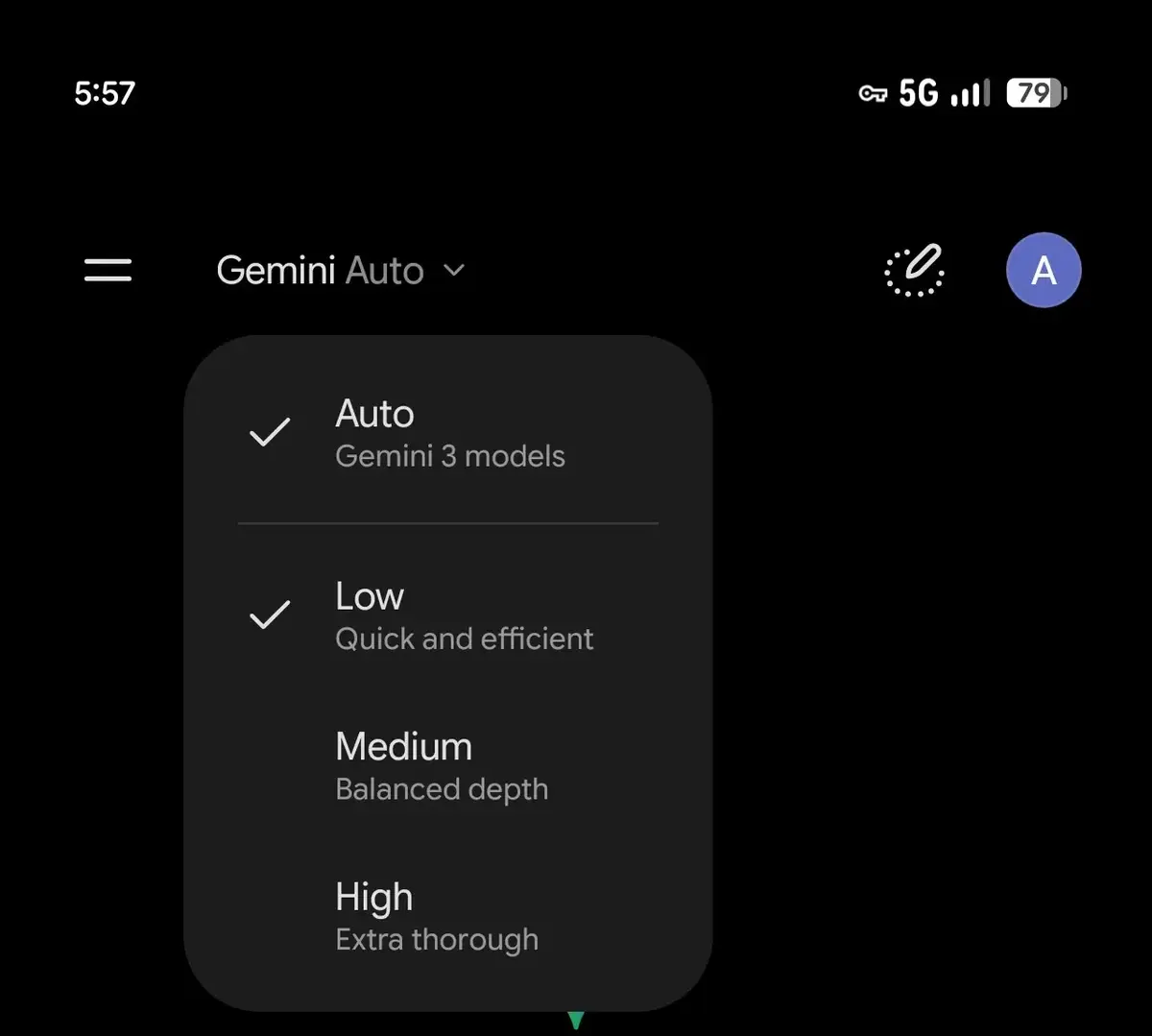
If a user chooses to override or disable these smart routing features, the system defaults all interactions to the Flash-Lite model. By standardizing this process, Google aims to reduce the technical burden on users, allowing them to receive high-quality outputs without needing to manage model settings. Documentation indicates that this infrastructure relies on the Flash-Lite 3.5 architecture to maintain speed and reliability across a wide range of user interactions.
Effort Levels Provide New Control
In addition to the automatic routing, Google has introduced a new control mechanism known as “effort levels” to replace the legacy “Extended” mode. This feature offers users three distinct tiers—Low, Medium, and High—which align with the thinking capabilities previously seen in Google AI Studio and Antigravity platforms. This structure provides a more nuanced approach to how much “thinking” the AI performs before generating a response.
The Low setting is optimized for quick, concise interactions, while the Medium setting acts as a balanced middle ground for general queries. The High setting is specifically intended for users who require comprehensive, detailed, and analytical responses. These tiers are currently being rolled out across various subscription types. Furthermore, reports suggest that Google is preparing to implement similar limitations for AI Plus users, where access may soon be restricted to specific Flash and Flash-Lite model variations, signaling a broader move toward a more rigid model governance structure across the entire ecosystem.
How do you feel about losing the ability to manually select your preferred Gemini model, and will these new effort levels impact your daily workflow? Share your thoughts and experiences in the comments section below.
Your comment has been submitted,
it will be published after approval.