
Meta Launches Muse Wonder AI Models to Challenge Industry Leaders

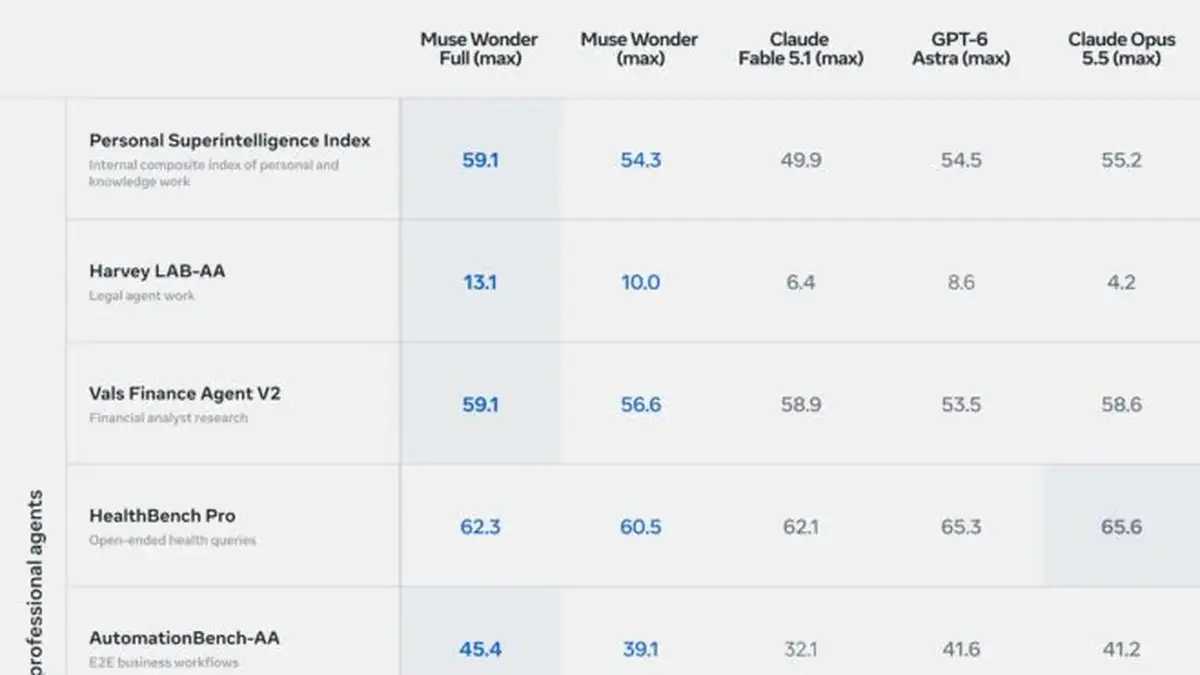
Meta has officially unveiled its latest advancement in artificial intelligence, introducing the Muse Wonder and Muse Wonder Full models to the global technology market. Announced today, these new iterations succeed the Muse Spark 1.3 version, representing a major leap in Meta’s AI capabilities. According to data released by CEO Mark Zuckerberg, the Muse Wonder series outperforms prominent industry competitors, including Claude Fable 5.1, GPT-6 Astra, and Claude Opus 5.5, across numerous benchmarking categories. This strategic release positions Meta as a primary contender in the high-performance AI landscape, specifically targeting complex coding tasks and sophisticated problem-solving requirements for professional developers and enterprises.
- The Muse Wonder models achieve the highest performance levels in coding and complex logic tasks recorded by Meta to date.
- These systems support a massive 1 million token context window capable of processing multi-modal data including text, imagery, audio, and video.
- Integrated Active Memory and Active Focus technologies enable AI agents to maintain long-term information retention and autonomous reasoning capabilities.
New AI Models Offer Advanced Personal Agent Capabilities
Meta has designed the Muse Wonder family to function as more than just a standard processing tool, focusing heavily on enhancing the user experience through functional intelligence. A standout feature, Active Memory, allows the AI to retain critical information from previous interactions. By recalling specific context from long-term projects, the model provides more consistent and relevant responses to the user. This persistent memory architecture transforms the AI from a simple query-answer machine into a dedicated long-term assistant.
Furthermore, the introduction of Active Focus introduces a sophisticated reasoning mechanism that allows the model to prioritize complex tasks. If a specific problem-solving approach fails, the system is designed to autonomously test alternative strategies. It can also proactively request clarification or confirmation from the user when necessary. This autonomous behavior marks a shift toward AI acting as a collaborative partner rather than a mere passive executor of commands.
Technical Specifications Push Performance Boundaries
The technical architecture of the Muse Wonder and Muse Wonder Full models is defined by a massive 1 million token context window. This capacity allows users to analyze extensive documents, lengthy video files, or massive datasets within a single session. While the models are inherently multi-modal and can ingest various data formats, current output capabilities are restricted to text-based generation.
The company emphasizes that these models were built with a specific focus on optimizing software development workflows, aiming to resolve common bottlenecks faced by programmers. Industry analysts suggest that the deployment of these models could signal the beginning of a new era for AI-driven application development. By streamlining complex data analysis, Meta aims to set a new standard for corporate and technical efficiency in the software industry.
What are your thoughts on Meta’s new Muse Wonder series and its potential impact on the competitive AI landscape? We invite you to share your perspectives or predictions on whether these models will shift the current market balance in the comments section below.
Your comment has been submitted,
it will be published after approval.