
Sony’s New PSP 3 Could Rival PS5 Performance


Sony is currently generating significant buzz within the gaming industry as reports surface regarding the development of its next-generation handheld console, the PSP 3. Leaked technical specifications suggest that Sony aims to bridge the gap between portable devices and home consoles, potentially delivering performance levels comparable to the PlayStation 5. By focusing on advanced graphical processing capabilities and sophisticated artificial intelligence scaling, the company intends to redefine the standard for mobile gaming. While official announcements remain pending, industry insiders indicate that the hardware architecture will prioritize extreme efficiency, allowing for a desktop-quality experience in a compact, portable form factor.
- The PSP 3 will reportedly utilize the advanced RDNA 5 graphics architecture for enhanced efficiency.
- Sony plans to integrate proprietary PSSR hardware to facilitate AI-driven image upscaling.
- The device aims to challenge current portable console market leaders by offering high-end performance.
RDNA 5 Architecture Redefines Gaming Performance
At the core of the upcoming PSP 3 lies the cutting-edge RDNA 5 graphics architecture, which serves as the primary driver for the device’s elevated capabilities. Engineers at Sony have focused on solving the traditional mobile limitations of thermal management and battery drain by implementing this highly efficient architecture. By balancing high frame rates with energy conservation, this hardware ensures that even graphically demanding titles remain smooth and responsive during mobile play sessions.
The technical flexibility afforded by the RDNA 5 framework allows developers to render complex, high-fidelity environments on a handheld screen. This shift implies that gamers will no longer need to sacrifice visual quality or technical complexity when moving away from a stationary console setup. The integration of this architecture confirms that Sony is committed to establishing a new benchmark for power-efficient portable computing.
Custom PSSR Hardware Enhances Visual Fidelity
Sony is expected to introduce its proprietary PlayStation Spectral Super Resolution (PSSR) technology to the handheld market via the PSP 3. This specialized hardware unit leverages artificial intelligence to upscale imagery, producing high-resolution visuals without placing excessive strain on the core processor. This advancement is particularly significant for maintaining image clarity and sharpness on smaller screens, where pixel density and detail are often compromised.
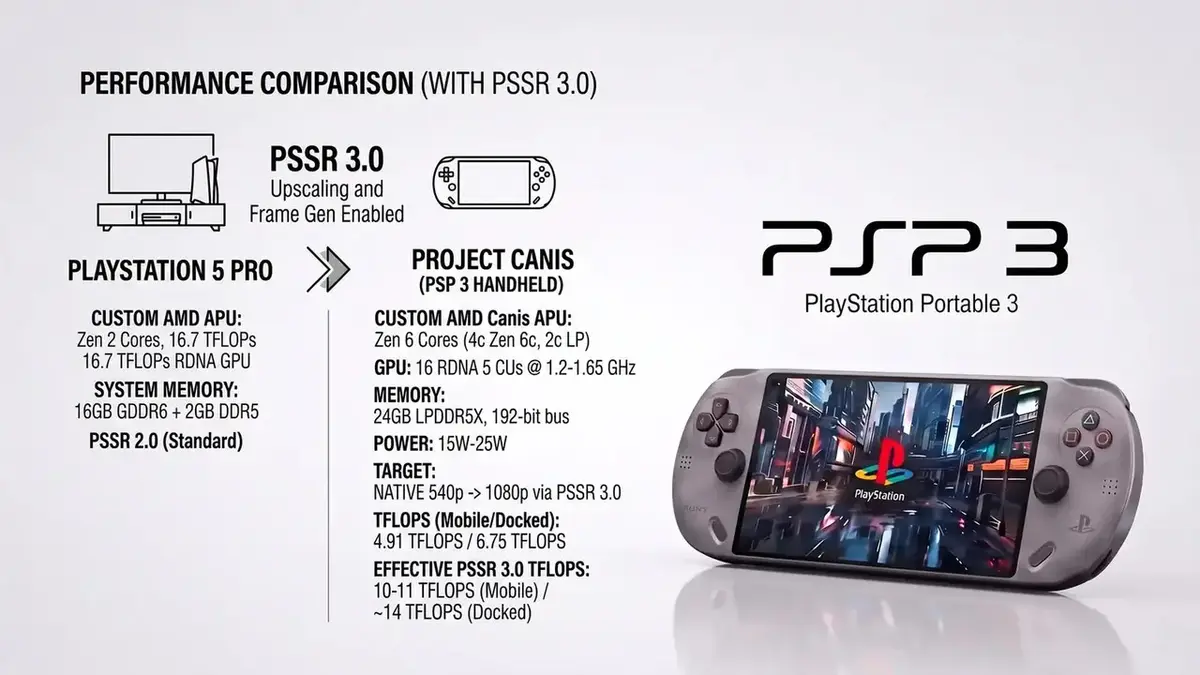
With the implementation of PSSR, the lighting and shadowing effects in games will be rendered with increased naturalism and depth. By optimizing the usage of hardware resources, this technology effectively extends battery life while simultaneously delivering a premium visual experience. Sony’s expertise in harmonizing software and hardware development could fundamentally alter the existing expectations for mobile gaming devices.
Market Expectations Continue to Rise
Following these technical disclosures, industry analysts and enthusiasts are eagerly awaiting a formal launch date from Sony. The disclosed specifications have propelled consumer expectations to new heights, signaling a potential shift in the competitive landscape of the handheld gaming market. As the sector continues to expand, it is widely anticipated that Sony’s high-performance solution will capture a significant share of the market.
The critical factor remains how quickly developers will adapt to this new architecture and how rapidly the game library will expand to support such advanced hardware. The industry is closely monitoring how these technical advancements will influence the future of interactive entertainment and the hardware ecosystem at large.
How do you think the PSP 3 will compare to current handheld devices, and which technical features are you most excited to see in action? Share your thoughts and expectations in the comments section below.
Your comment has been submitted,
it will be published after approval.