
Apple vs OpenAI Trade Secret Lawsuit Trial Set for 2027

A high-stakes legal battle has officially been scheduled as the trade secret lawsuit between Apple and OpenAI is set to head to trial on July 19, 2027. Presiding Judge Edward Davila has finalized the court calendar, marking a significant development in the ongoing dispute where Apple alleges that OpenAI illicitly utilized proprietary technology and confidential internal data to advance its consumer hardware initiatives. The tech giant claims these sensitive trade secrets were leaked by former employees who transitioned to OpenAI, providing the artificial intelligence company with an unfair competitive advantage in the rapidly evolving technology sector.
- Judge Edward Davila has scheduled the official court trial to commence on July 19, 2027.
- Apple alleges that OpenAI leveraged stolen internal product data to gain an unfair market advantage.
- The court has granted Apple permission to conduct an expanded discovery process to secure additional evidence.
- Both parties are mandated to hold a settlement conference in June 2027 before the final trial begins.
The core of the litigation centers on allegations that OpenAI gained unauthorized access to confidential project information. Apple contends that these actions represent a direct violation of trade secret protections and has sought to recover damages and hold the organization accountable. By securing judicial approval for an accelerated and expanded discovery process, Apple aims to bolster its evidentiary portfolio before the trial commences. This procedural victory allows the company to compel the production of documents that were previously inaccessible, potentially shifting the momentum of the legal proceedings significantly.
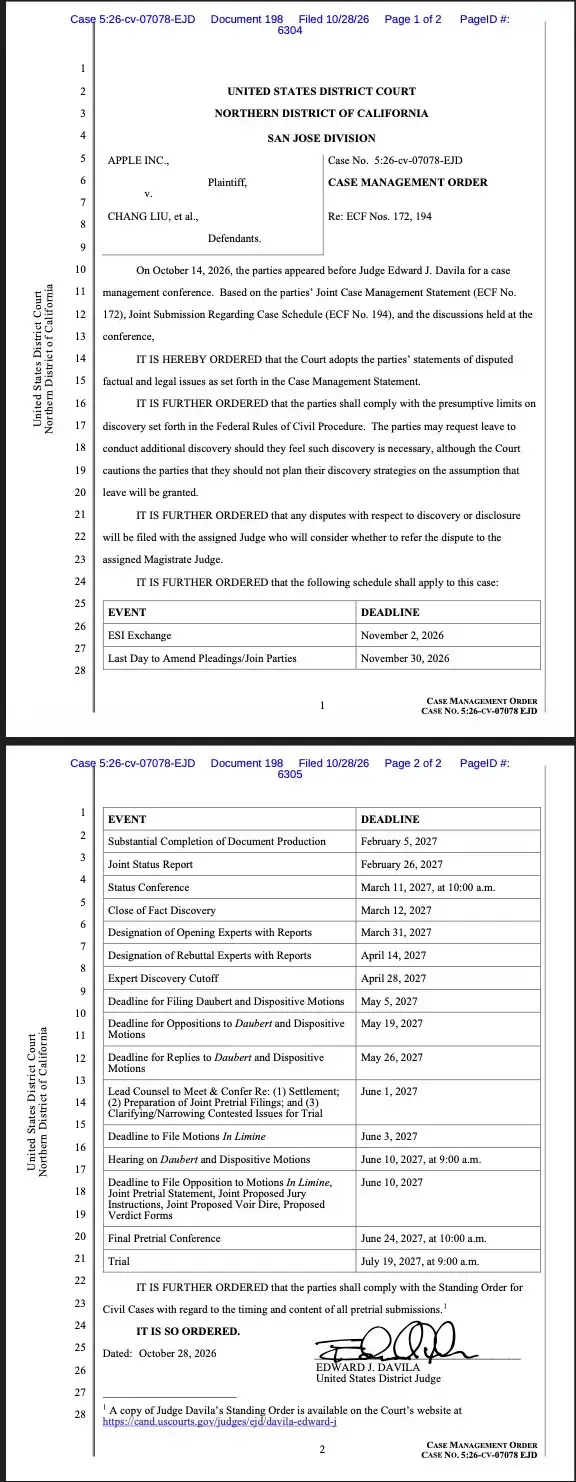
The Court Establishes a Detailed Timeline
The judicial roadmap provided by Judge Davila outlines several critical milestones that both companies must navigate over the coming years. The exchange of Electronically Stored Information (ESI) is slated to begin on November 2, 2026, marking the start of a rigorous documentary review phase. Following this, the parties are expected to reach a major deadline for discovery and document submission by February 5, 2027. A status conference is further scheduled for March 11, 2027, to ensure that both legal teams remain on track with their respective preparations.
Legal Experts Monitor the Settlement Potential
As the case progresses, the court has mandated a specific window for expert witness reports and testimony, which will be finalized by late April 2027. Following these filings, both parties will engage in Daubert and dispositive motions to determine the admissibility of the evidence and the potential scope of the trial. A notable inclusion in the calendar is the mandatory settlement meeting, which is set for June 1, 2027. During this meeting, lead attorneys from both Apple and OpenAI will convene to explore whether a voluntary resolution is possible.
While the prospect of an out-of-court settlement remains a possibility, legal observers note that such meetings are standard protocol in federal litigation rather than an indication of a pending agreement. The remainder of June 2027 will be dedicated to final pretrial conferences and the formulation of jury instructions. As the industry watches this case closely, the outcome will likely set a major precedent for how trade secrets are protected in the age of rapid artificial intelligence development.
The ongoing conflict between Apple and OpenAI is shaping up to be one of the most consequential legal battles in modern tech history. What are your thoughts on how this trial might reshape trade secret protections in the AI sector? We invite you to share your perspectives in the comments section below.
Your comment has been submitted,
it will be published after approval.