
Mars Meteorite Teghaza 001 Is Over 4.1 Billion Years Old

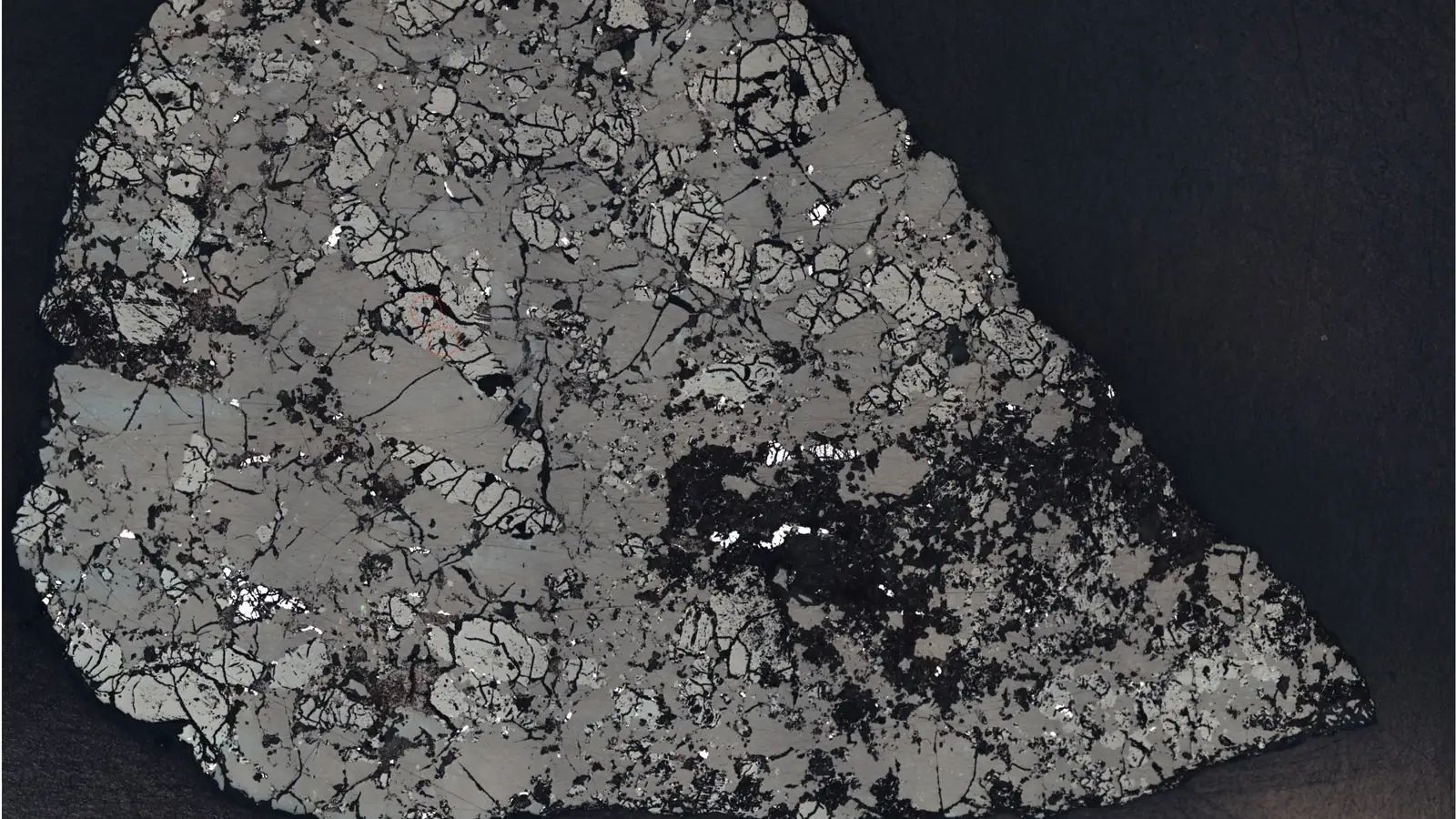
A rose-colored Mars meteorite found in the Sahara Desert in 2022 formed more than 4.1 billion years ago, making it one of the oldest pieces of the Red Planet ever found on Earth. The rock, named Teghaza 001, was described in a NASA-funded study published in Science on October 29, 2026, and it carries chemical traces of water moving through the ancient Martian crust.
The meteorite weighs about 800 grams (nearly 2 pounds) and is named after the Teghaza salt plain in Mali, where it was discovered. It is one of roughly 435 known meteorites from Mars, according to NASA’s announcement.
How Old Is the Teghaza 001 Mars Meteorite?
A team led by Yang Liu of NASA’s Jet Propulsion Laboratory found zircon crystals inside the rock. Zircon lets geologists date when a rock formed and when it was later changed. The results showed that Teghaza 001 was altered by Martian water around 4.1 billion years ago, which means the rock itself is even older.
Caltech coauthor Francois Tissot’s lab used an in-situ rubidium-strontium dating method on a piece smaller than a fingernail, analyzing single mineral grains instead of dissolving the sample. Tissot said, “Right now, we are one of very few labs in the world able to perform this kind of age-dating, and the first to date such an ancient Martian meteorite.”
Researchers at the University of New Mexico had first confirmed the rock came from Mars by matching its oxygen isotopes to other Martian meteorites. Liu said, “One of the paper’s reviewers called it a Rosetta Stone for Mars.”
Why Scientists Call It a Rare Window Into Early Mars
Teghaza 001 is one of only three Martian meteorites this ancient. The famous ALH84001 is a similar age but is made almost entirely of a single mineral, while “Black Beauty” is about 2.1 billion years old. Teghaza 001 instead holds a mix of volcanic minerals that record how the crust cooled from magma and was then altered by subsurface water.
Its mineralogy matches what the Mars Reconnaissance Orbiter has seen in the cratered southern highlands, and the team identified 13 possible source locations on the planet. The full findings are in the Science paper, and a separate Science Advances study from June detailed the rock’s water content.
Second author Lee Saper, now at NASA’s Ames Research Center, said, “This is really our first piece of Martian crust from a part of Mars we’ve never had a sample of before.”
What It Means for Mars Exploration
Martian meteorites are the only rocks from Mars that scientists can study in Earth labs today, since no sample has been returned yet. Teghaza 001 adds evidence for a more dynamic water cycle on young Mars, a key question in the search for past habitability that we covered in NASA’s earlier hunt for signs of life on Mars.
Interest in Mars is also growing on the launch side, with SpaceX preparing Starship Flight 15, the vehicle it plans to use for future Mars missions.
NASA’s nearer goal remains the Moon, and our guide to the Artemis 3 launch date explains when astronauts are expected to return there. “We’ve only scratched the surface,” Liu said of Teghaza 001.
Your comment has been submitted,
it will be published after approval.