

AMD FSR Redstone technology has been officially introduced to the technology world after a long wait, according to an announcement by the processor giant. This new architecture, aiming to take graphics quality and performance to the next level in the gaming world, is particularly noteworthy for its AI-powered capabilities.
What does AMD FSR Redstone offer?
With the FSR 3.1.4 update, which AMD had been working on for some time and which fixed some bugs, they were actually laying the groundwork for a much bigger step. The company finally unveiled its new infrastructure, developed specifically for the RX 9000 series graphics cards and named “Redstone.” This new technology was first tested in the latest installment of the popular game series, Call of Duty: Black Ops 7.
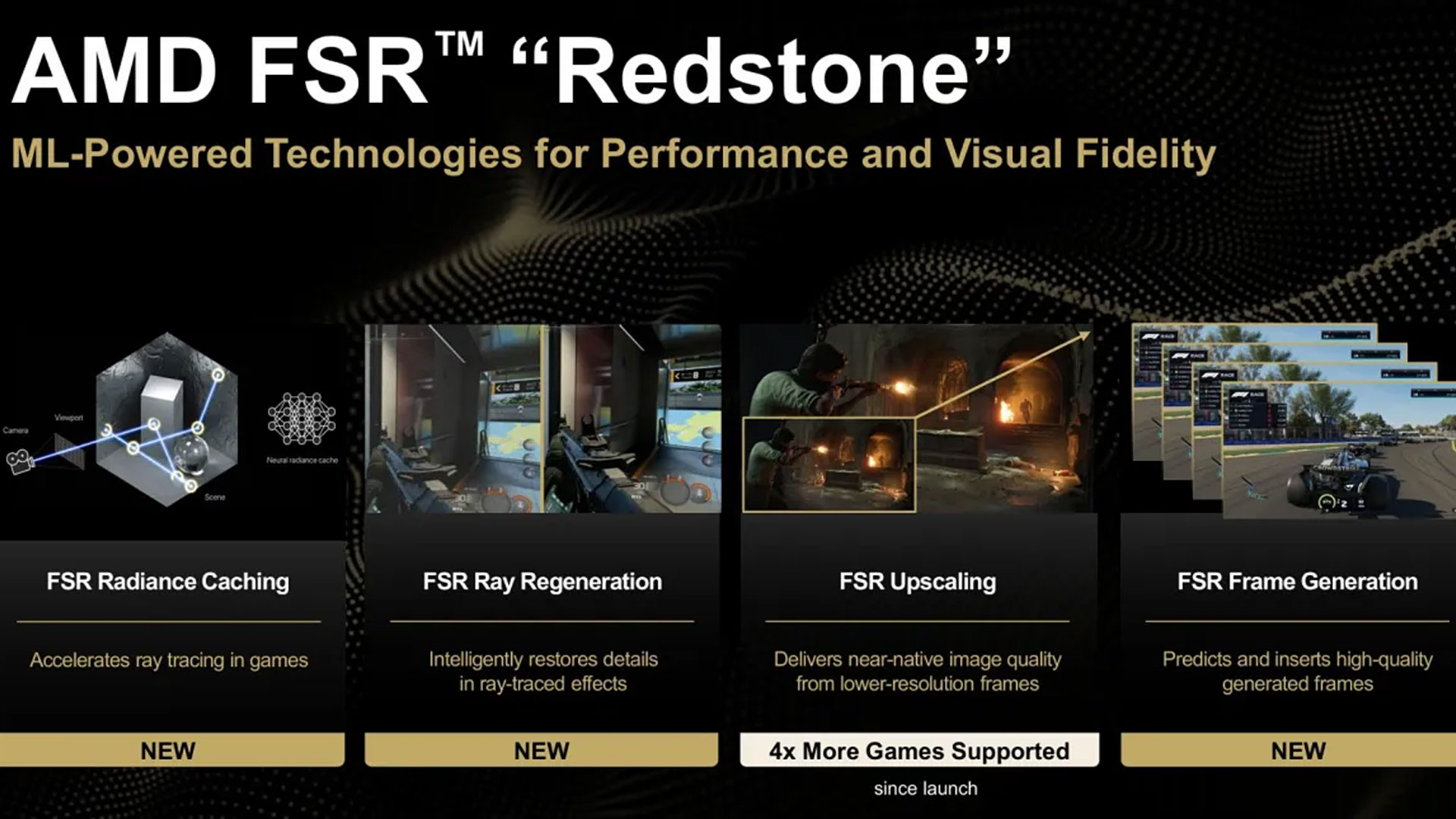
Changing its naming strategy in this new era, AMD now calls the FSR 4 technology, used in over 200 games, “AMD FSR Upscaling.” AMD FSR Redstone is positioned as an umbrella brand encompassing all of the company’s new generation graphics upscaling technologies. This move is seen as one of the most strategic steps the company has taken to strengthen its hand against its arch-rival Nvidia.
AMD FSR Redstone promotional image
According to official statements, the Redstone architecture is built on four core technologies:
- Neural Radiance Caching: Uses deep learning algorithms to accelerate real-time light calculations. Light data in the scene is cached, preventing repeated calculations.
- Machine Learning Ray Regeneration: Completes missing or lost rays during ray tracing using artificial intelligence. This improves image quality and prevents performance loss.
- Machine Learning Super Resolution: Analyzes low-resolution images and makes them much clearer and higher resolution.
- Machine Learning Frame Generation: Increases fluidity (FPS) in games by adding new frames generated with artificial intelligence between existing frames. More realistic lighting with artificial intelligence
- Among these technologies, “Ray Regeneration” is particularly noteworthy. This feature, which directly competes with Nvidia’s similar technology, is based on the principle of the graphics card predicting missing data instead of calculating all rays individually. This allows gamers to experience much more realistic lighting and shadow effects without straining their systems. RX 9000 series users, in particular, will benefit from the advantages of FSR 4 technology, achieving significantly sharper images.
So, what are your thoughts on AMD FSR Redstone? Share your opinions in the comments!