
AMD Releases Critical Updates for Ryzen TPM Security Flaws


AMD has officially released urgent security updates to address two significant vulnerabilities affecting the Trusted Platform Module (TPM) 2.0 implementation in its Ryzen processor lineups. Discovered by Intel security researchers and reported to the Trusted Computing Group, these flaws, tracked as CVE-2026-6726 and CVE-2026-6727, prompted AMD to distribute firmware fixes to motherboard manufacturers several weeks ago. The company issued a formal security bulletin on August 11, detailing the risks posed to a wide range of hardware, including processors from the Ryzen 3000 series through the latest Ryzen 9000 series, as well as various mobile and embedded chips.
- The vulnerabilities expose Ryzen processors to potential unauthorized TPM credential access and data decryption.
- AMD has provided firmware updates to motherboard manufacturers since May to mitigate these security risks.
- Users across all affected Ryzen generations should install the latest BIOS updates from their motherboard support pages.
Security Vulnerabilities Present Specific Risks
The first identified vulnerability, CVE-2026-6726, creates a scenario where a local attacker possessing elevated system privileges can obtain credentials for a fake TPM key. This manipulation allows the malicious actor to effectively impersonate legitimate TPM verifications, bypassing standard security protocols. 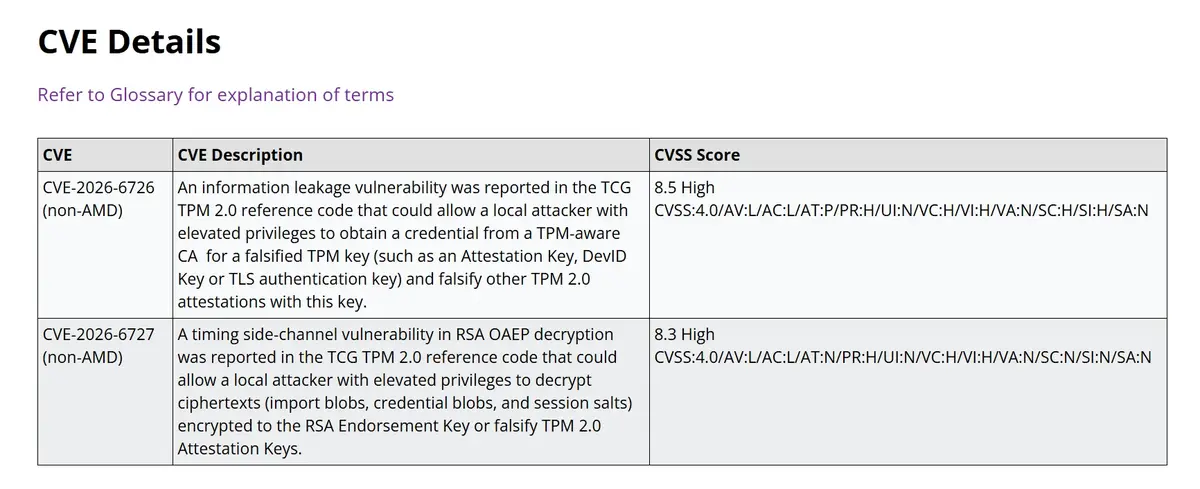
Meanwhile, CVE-2026-6727 carries a CVSS 4.0 severity score of 8.5. This flaw exploits a RSA OAEP timing side-channel, which may lead to the exposure of encrypted TPM data. Furthermore, this specific vulnerability provides the necessary conditions for an attacker to generate unauthorized validation keys, severely undermining the integrity of the hardware-based security layer.
The impact of these vulnerabilities spans nearly all modern Ryzen processors, including the Threadripper series and Ryzen Z1 and Z2 portable gaming chips.
Manufacturers Distribute Necessary BIOS Updates
AMD began coordinating the rollout of corrective measures back in May to ensure that system integrators and motherboard vendors had ample time to integrate the patches. For older Ryzen 3000 systems, the fix is bundled within the ComboAM4PI 1.0.0.11 firmware, while Ryzen 4000 and 5000 users require the ComboAM4v2PI 1.2.0.12 update.
Owners of more recent hardware, specifically the Ryzen 7000, 8000, and 9000 series, should look for the latest ComboAM5PI versions. Many of these AGESA updates have already been integrated into official BIOS releases by major vendors. For instance, ASUS provided updates for certain X870 motherboards as early as June, while MSI and ASRock followed suit throughout July with their respective Patch A releases.
Failure to update your system firmware leaves your machine vulnerable to sophisticated local attacks targeting TPM credentials.
Users Should Prioritize System Security Updates
Maintaining a secure computing environment requires proactive management of hardware firmware. Because these updates are applied at the motherboard level, the responsibility falls on the end-user to verify that their specific BIOS version includes these critical patches. Users should visit the official support portals of their motherboard manufacturers to verify if a recent update is available for their specific model.
Have you already checked your motherboard manufacturer’s website for the latest BIOS update, or are you waiting for more information before patching your system? Share your thoughts and update status in the comments section below.
Your comment has been submitted,
it will be published after approval.