

AMD has officially announced the Radeon AI PRO R9700S, a new graphics card designed for workstations that stands out for its silent operation. Joining the R9000 series, this new card aims to improve AI performance, particularly at the enterprise level. Its most notable feature is its passive cooling design, which completely eliminates the fans. This unique structure allows the card to operate completely silently even in demanding multi-GPU setups.
Silent power for AI: AMD Radeon AI PRO R9700S
In terms of specifications, the R9700S retains the same Navi 48 RDNA4 configuration as the standard R9700 model. The card features 64 compute units and 4096 stream processors. Equipped with 32 GB of GDDR6 memory, critical for AI workloads, the model operates on a 256-bit bus. This hardware power allows the card to reach clock speeds of 2920 MHz and deliver a peak FP32 computing performance of 47.8 TFLOPS.
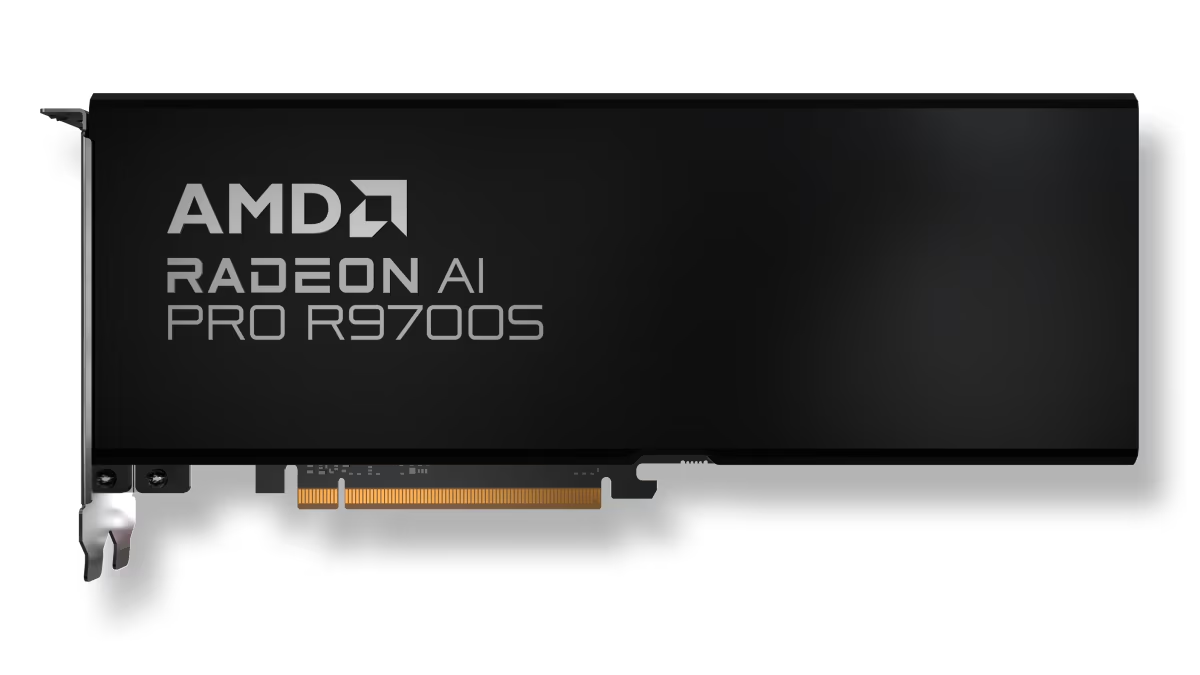
The “S” in the model name indicates the card’s silent design. Instead of the blower-type coolers seen in previous models, this card relies entirely on system airflow for cooling. Despite having a 300W TDP, it lacks an active fan and draws power via a single 12V-2×6 connector. PCIe 5.0 x16 support also provides high bandwidth on compatible platforms.
AMD also introduced the lower-spec R9600D model with this launch. However, the R9700S promises significantly higher throughput, especially for demanding tasks like productive AI and training large language models. Both cards support Linux ECC memory options and are fully compatible with AMD’s ROCm software. This allows businesses to offload demanding workloads from the CPU to GPU accelerators.
One of the first examples in the industry, the Elsa Veluga-D workstation, uses this card. However, the fact that such a high-performance chip operates solely with passive cooling raises questions about thermal management. In systems using multiple units, airflow needs to be very well planned. So, do you think high-performance hardware with no fans and passive cooling can be efficient in the long run without experiencing overheating problems?