
AMD Zen 5 Processors Power Next-Generation AI Agent Workloads

The era of simple text-based artificial intelligence is fading as the industry shifts toward autonomous AI agents capable of executing complex real-world tasks. AMD Zen 5 CPU architecture is leading this transformation by providing the necessary computational backbone for modern agentic workflows. Unlike traditional models that merely generate text responses, these new systems manage file operations, software compilation, and simultaneous tool execution. As AI evolves, the speed of these systems is no longer defined solely by GPU token throughput but by the client processor’s ability to coordinate these intensive tasks. Industry benchmarks indicate that hardware like the AMD Ryzen AI Max+ is setting new standards for local AI efficiency.
- The shift toward AI agents requires CPUs to handle file parsing, code compilation, and multi-agent coordination.
- Modern processors such as the AMD Ryzen AI Max+ deliver up to six times higher performance compared to older hardware generations.
- Local CPU capacity acts as the primary bottleneck for autonomous workflows regardless of cloud-based GPU power.
The AI Paradigm Shifts Toward Complex Execution
Interacting with AI has moved beyond simple queries into the realm of functional automation. When a user requests an AI to manage tax filings, the system must perform a sequence of actions: accessing secure documents, analyzing complex datasets, performing financial calculations, and validating results through local software. This cycle forces the model to make constant decisions that place a significant burden on the host computer’s processor.
The efficiency of modern AI agents depends directly on the hardware capacity of the client machine.
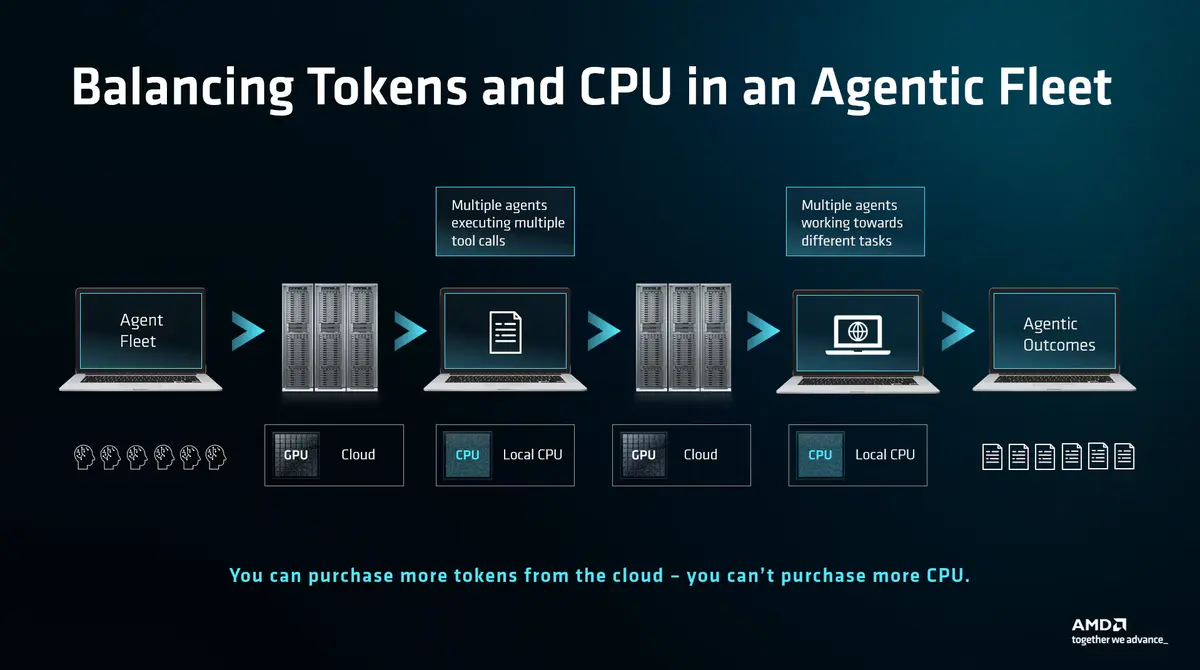
Running Python scripts, scanning project directories, and integrating local software environments require consistent CPU power. If an advanced AI model capable of rapid decision-making encounters a hardware bottleneck, its overall productivity collapses. Even with GPU or NPU acceleration for inference, the coordination of background tasks remains a CPU-bound challenge.
Local Processing Speed Defines Overall Performance
In scenarios involving complex multi-agent systems, the computer must coordinate dozens of sub-tasks in parallel. Without a robust CPU architecture, the system fails to achieve maximum efficiency during tasks like database querying or software compilation. The shift from a single-model approach to a swarm of autonomous agents necessitates a significant upgrade in hardware throughput.
Advanced CPU architectures are now essential for managing high-density parallel AI workloads.
Recent tests using ChatGPT 5.5 High-based agents for developer tasks—such as static code analysis and JSON processing—highlight the importance of the host processor. Devices equipped with the AMD Ryzen AI Max+ demonstrate a significant performance lead over older systems, providing the necessary bandwidth to support these demanding environments.
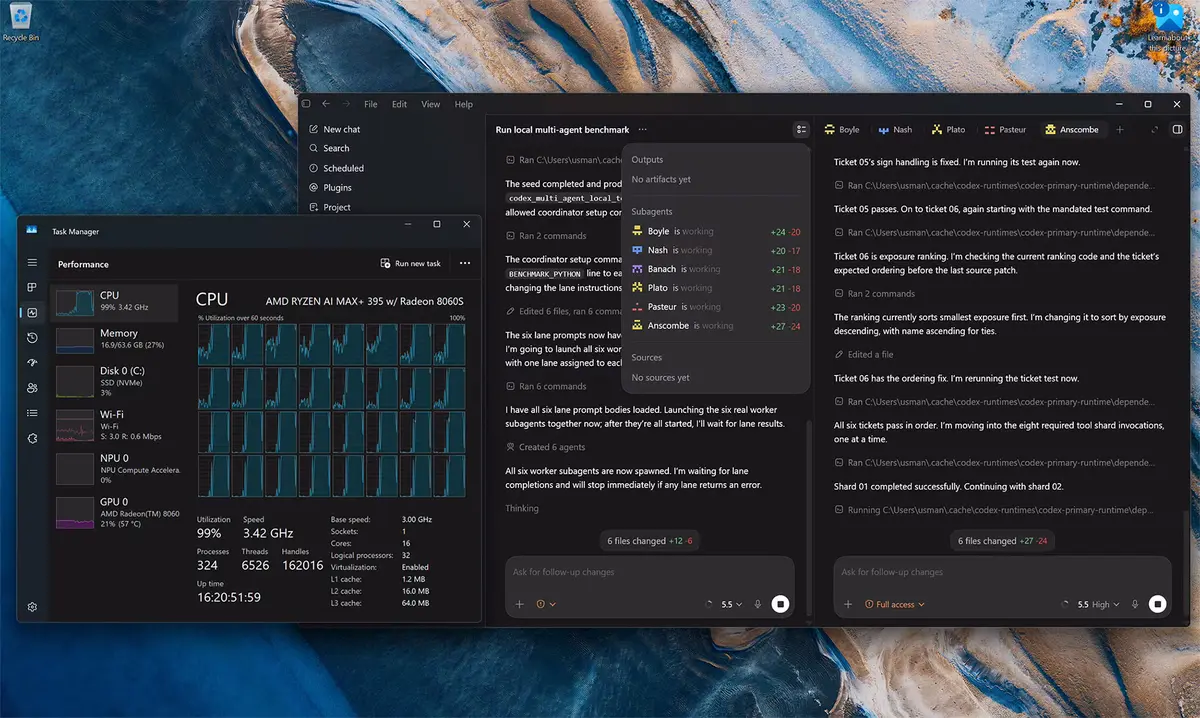
This disparity proves that local hardware performance is the ultimate arbiter of task completion speed in the professional sector. As AI agents become more integrated into daily workflows, the importance of the CPU architecture will only continue to grow. Users must prioritize modern processing power to keep pace with the rapidly evolving demands of autonomous software agents.
How do you expect the integration of autonomous AI agents to change your daily workflow, and are you planning a hardware upgrade to keep up with these new demands? Share your thoughts in the comments section below.
Your comment has been submitted,
it will be published after approval.