
AMD Zen 6 Architecture Delivers 25 Percent Performance Boost


AMD’s upcoming Zen 6 architecture has surfaced in the Geekbench database, signaling a significant leap in computing power for the next generation of processors. The benchmark results for the 256-core EPYC 9996 processor, codenamed Venice, reveal that the new architecture achieves an IPC (instructions per cycle) improvement of up to 25 percent compared to the current Zen 5 generation. This development, captured through early server-grade silicon testing, provides a clear glimpse into how AMD intends to push the boundaries of data center performance and efficiency in the near future.
- The Zen 6-based EPYC 9996 processor features a massive configuration of 256 cores and 512 threads.
- Benchmark tests demonstrate a 25 percent increase in IPC performance when compared to Zen 5 architecture.
- Early findings indicate that Zen 6 cores maintain high performance even at significantly reduced clock speeds.
- The upcoming Olympic Ridge desktop processors will utilize full-sized Zen 6 cores to maximize consumer performance.
Zen 6 Demonstrates Efficiency at Lower Clock Speeds
The Geekbench 6 results for the EPYC 9996 are particularly notable because of the aggressive efficiency demonstrated by the chip. Running at a clock speed of only 4.12 GHz, the processor managed a single-core score of 2,847. When compared to the existing EPYC 4545P model, which uses the Zen 5 architecture and boosts up to 5.47 GHz to achieve a score of 3,064, the capability of the new architecture becomes apparent. 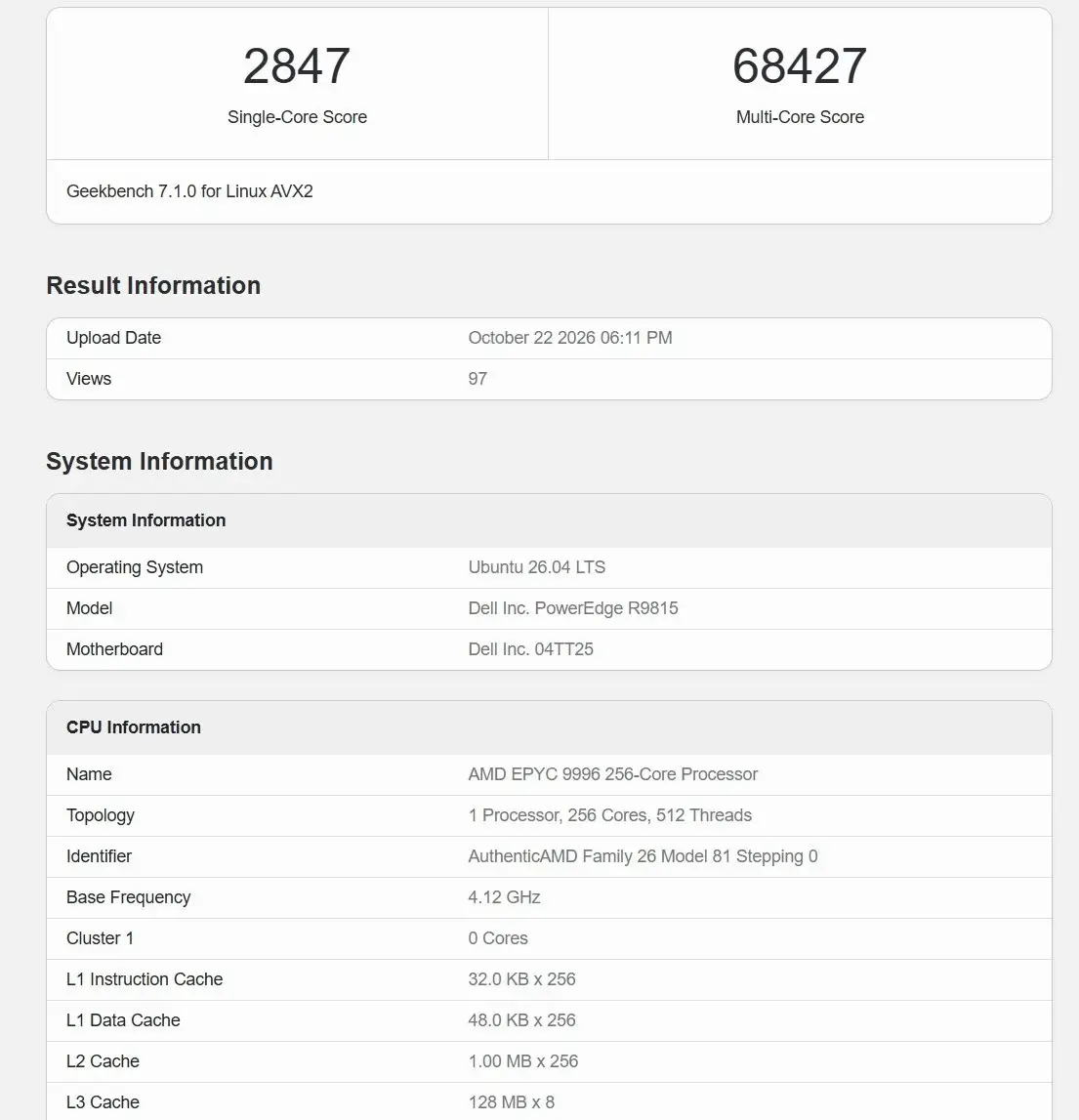 The ability of the Zen 6 core to nearly match the performance of a much higher-clocked predecessor at a significantly lower frequency highlights a major architectural optimization.
Architectural Improvements Reveal Significant IPC Gains
To further validate these improvements, analysts conducted a controlled comparison by locking a Ryzen 7 9700X, based on the Zen 5 architecture, to a fixed frequency of 4.1 GHz. Under these identical conditions, the Zen 6C core outperformed the Zen 5 desktop chip by approximately 16.5 percent in single-threaded tasks. When all architectural adjustments and efficiency metrics are normalized, the total IPC gain reaches the 25 percent threshold. This comparison confirms that the underlying design of Zen 6 is fundamentally more capable than the iteration currently in market circulation.
Desktop Users Anticipate Major Performance Upgrades
While the initial leaks involve the EPYC 9996, which utilizes the power-efficient Zen 6C cores, the consumer market will receive the standard, full-sized Zen 6 cores under the Olympic Ridge codename. Because these desktop variants are designed to operate at much higher clock speeds than server-grade silicon, the performance ceiling for everyday users is expected to be substantially higher. With potential increases in core counts and enhanced 3D V-Cache designs, the next generation of Ryzen processors promises to be a transformative upgrade for the AM5 platform. Enthusiasts can expect that these architectural refinements will lead to significant improvements in both gaming and productivity workloads, further solidifying AMD’s competitive position against rival architectures.
How do you think these architectural gains will impact your next PC build or server upgrade? Share your thoughts on the potential of the Zen 6 architecture in the comments section below.
Your comment has been submitted,
it will be published after approval.