
Android 17 Update Adds Official LHDC v5 Support

Google has quietly introduced support for the LHDC v5 audio codec to its Pixel smartphone lineup as part of the recently released Android 17 update. While the inclusion of this high-definition audio standard was not explicitly highlighted in official Android 17 release notes, observant users who participated in the beta testing phase first identified the addition. Now that the stable version of the operating system is rolling out to the public, Pixel users can leverage this advanced codec to achieve superior wireless audio transmission. This implementation aims to significantly elevate the wireless listening experience by providing higher bitrates and reduced latency for compatible devices.
- Android 17 officially integrates LHDC v5 codec support for Google Pixel smartphones.
- Users must enable the feature manually via the developer settings menu.
- The codec provides a sampling rate of 96kHz and a variable bitrate reaching 900Kbps.
- Lower latency levels of approximately 80ms improve synchronization for media playback.
How Users Enable the LHDC v5 Feature
Accessing the enhanced audio capabilities requires a few specific steps, as the feature is managed within the hidden developer settings of the Android operating system. To begin, navigate to the system settings and locate the About Phone section. By tapping the Build Number entry seven times consecutively, you will unlock the developer mode on your Pixel device. 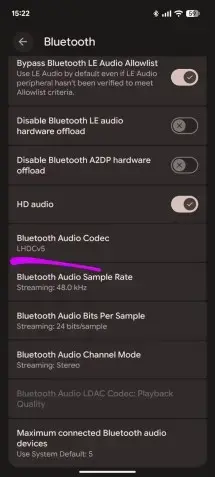
Once developer mode is active, navigate to the System menu to find the Developer Options. Within this section, locate the Bluetooth Audio Codec settings, where you can manually select LHDC v5 from the list of available protocols. Enabling this setting ensures that your phone prioritizes the high-resolution codec when connected to a compatible pair of wireless headphones, resulting in a cleaner and more detailed sound profile.
Pixel users now enjoy audio quality that approaches studio-grade standards through wireless connections.
Requirements for High-Quality Audio Are Defined
Achieving the full potential of the LHDC v5 technology involves more than just updating the smartphone software. Because the codec relies on a handshake between the source and the output device, your wireless earbuds or headphones must also support the LHDC v5 standard. Popular hardware options, such as the Nothing Ear (2) and OnePlus Buds 4, have already offered compatibility with this technology for some time.
Furthermore, to truly appreciate the difference in audio fidelity, users are encouraged to stream content from platforms that provide lossless audio options, such as Apple Music or high-fidelity tiers of other streaming services. The codec also serves a functional purpose beyond pure audio quality; by maintaining a low latency of approximately 80ms, it effectively minimizes the synchronization delays often encountered during mobile gaming or video streaming sessions.
Low latency and high bitrates define a new benchmark for the wireless audio landscape.
Do you believe the rapid evolution of high-fidelity wireless audio codecs will finally lead to the total obsolescence of wired headphones? We invite you to share your thoughts on the new LHDC v5 support and your preferred audio equipment in the comments section below.
Your comment has been submitted,
it will be published after approval.