
The rivalry between Android and iOS evolves into a different dimension every year. Until now, tech giants have clashed over camera capabilities, processing power, battery life, and recently, AI features. However, browser performance—one of the cornerstones of user experience and the area we interact with most daily—has long been overlooked.
According to the latest official data, the balance of power in this critical front has shifted completely. Apple’s closed ecosystem, long praised for the fluidity and stability of its Safari browser, has been forced to surrender its performance leadership to its arch-rival.
Recent test results shared by Google on the official Chromium Blog reveal that the Android operating system has officially overtaken the iOS platform in mobile web speed. While the hardware-software synergy of iOS was once the industry standard, Google’s quiet optimizations within the Android core have not only closed the gap but created a significant lead. Engineers attribute this success to the seamless “vertical integration” between powerful hardware, the updated Android OS, and the Chrome browser engine.
What Do Speedometer and LoadLine Tests Reveal?
To impartially measure internet performance on mobile devices, two industry-standard benchmark tools are utilized: Speedometer and LoadLine. Independent data shared by Google indicates that flagship Android devices are literally overshadowing the iOS ecosystem in both rigorous tests.
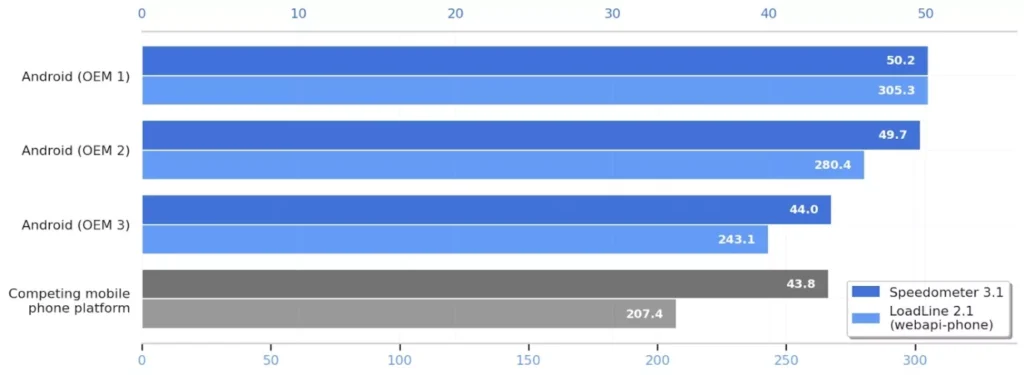
- Speedometer: This test simulates physical user interactions on websites. It focuses on the smoothness of scrolling, the instantaneous response when tapping menus or buttons, and the overall “feel” of the browser.
- LoadLine: This measures raw page loading speeds in milliseconds. For today’s users who demand instant access, the ability of a heavy webpage to appear in fractions of a second is vital, and according to the tests, Android is now the sole ruler of this domain.
A Striking 47% Performance Gap
The most compelling point of the report is the massive margin of the difference. Official data proves that high-end Android smartphones achieve scores up to 47% higher than the rival platform. While Google elegantly uses the phrase “a competing mobile platform” in its reports, it is widely understood that the benchmarks were conducted between three powerful Android devices and the market-dominating iPhone models.
Google is increasing its collaboration with other Android manufacturers to ensure these software optimizations are not limited to Stock Android but are woven into general hardware architectures. This shift in leadership for such a fundamental smartphone function will likely force Apple to issue an urgent performance update for iOS and Safari in the near future.
The escalation of this web performance war ultimately benefits the end-user with a faster and smoother internet experience. Have you noticed a difference in browsing speed between the latest Android flagships and iPhones? Share your experiences in the comments!
Would you like me to research the specific V8 engine optimizations Google implemented for Android or provide a technical breakdown of how LoadLine benchmarks differ from traditional speed tests?