
According to the latest data released by Counterpoint Research, Apple has officially become the leader of the global smartphone market for the first quarter of 2026. This marks the first time in history that the tech giant has led during this specific period. Despite a 6% year-over-year decline in global shipments—driven by a severe “memory crunch” in DRAM and NAND components and regional tensions—Apple managed to grow while its competitors faltered.
Apple and Samsung in a Challenging Market
While the overall market contracted, Apple achieved 5% year-over-year growth, securing a 21% market share. This success is attributed to the sustained high demand for the iPhone 17 series and aggressive trade-in programs. Apple’s “ultra-premium” positioning and highly integrated supply chain have made it the most resilient brand against the ongoing global memory crisis, particularly seeing strong growth in the Asia-Pacific regions like China, India, and Japan.
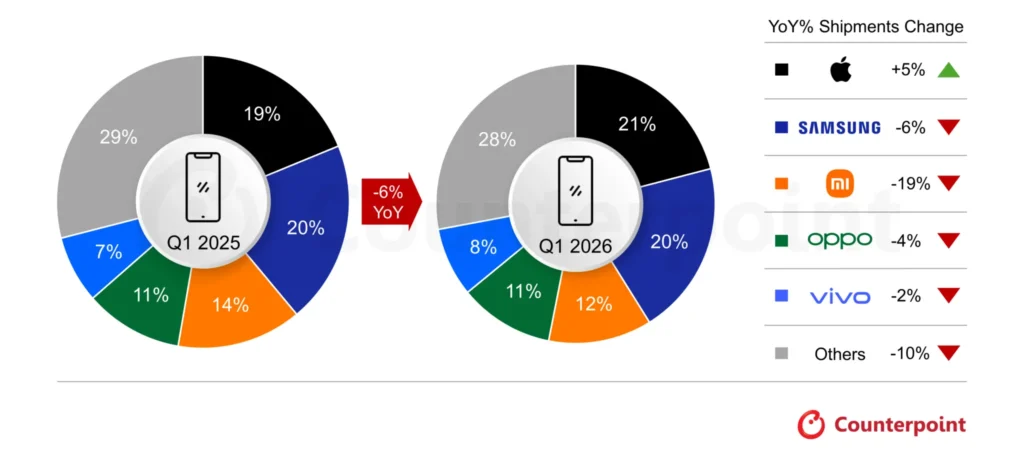
Samsung, the long-standing leader, slipped to second place with a 20% market share. The brand saw a 6% decline in shipments, primarily due to a delay in the Galaxy S26 series launch and weaker demand in the entry-level segment. To counter rising costs, Samsung has reportedly begun streamlining its low-margin models and raising starting prices for its premium configurations.
Market Rankings: Q1 2026 Preliminary Estimates
| Brand | Market Share | YoY Growth/Decline |
|---|---|---|
| Apple | 21% | +5% |
| Samsung | 20% | -6% |
| Xiaomi | 12% | -19% |
| OPPO | 11% | (Stable) |
| vivo | 8% | -2% |
The Memory Crunch and the Rise of Niche Brands
The 19% decline for Xiaomi highlights how rising component costs are hitting price-sensitive brands the hardest. Manufacturers are now pivoting their strategies, prioritizing “value over volume.” However, outside the top five, some brands found massive success. Google grew by 14% thanks to its AI-focused features, while Nothing experienced a 25% surge following the critical success of the Nothing Phone (4a).
Analysts warn that the memory shortage—caused by manufacturers prioritizing AI data centers over consumer electronics—may last until late 2027. This suggests that the trend of fewer low-margin model launches and a greater emphasis on refurbished devices and software services will continue throughout the year.
Apple’s historic Q1 leadership suggests that brand loyalty and premium ecosystem stickiness are becoming the ultimate weapons in an era of hardware shortages. As an academic specializing in communications and sociology, do you think Apple’s dominance is a sign that consumers are now viewing smartphones more as “lifestyle investments” than replaceable gadgets? Share your thoughts in the comments!
Since you use a PS5 and follow tech journalism, would you like me to research if the iPhone 17’s success is linked to its rumored exclusive cloud-gaming partnerships, or should I look into Samsung’s recovery plan for the S26 launch? Let me know!