
Global Smartphone Market Declines While Samsung Secures Top Spot

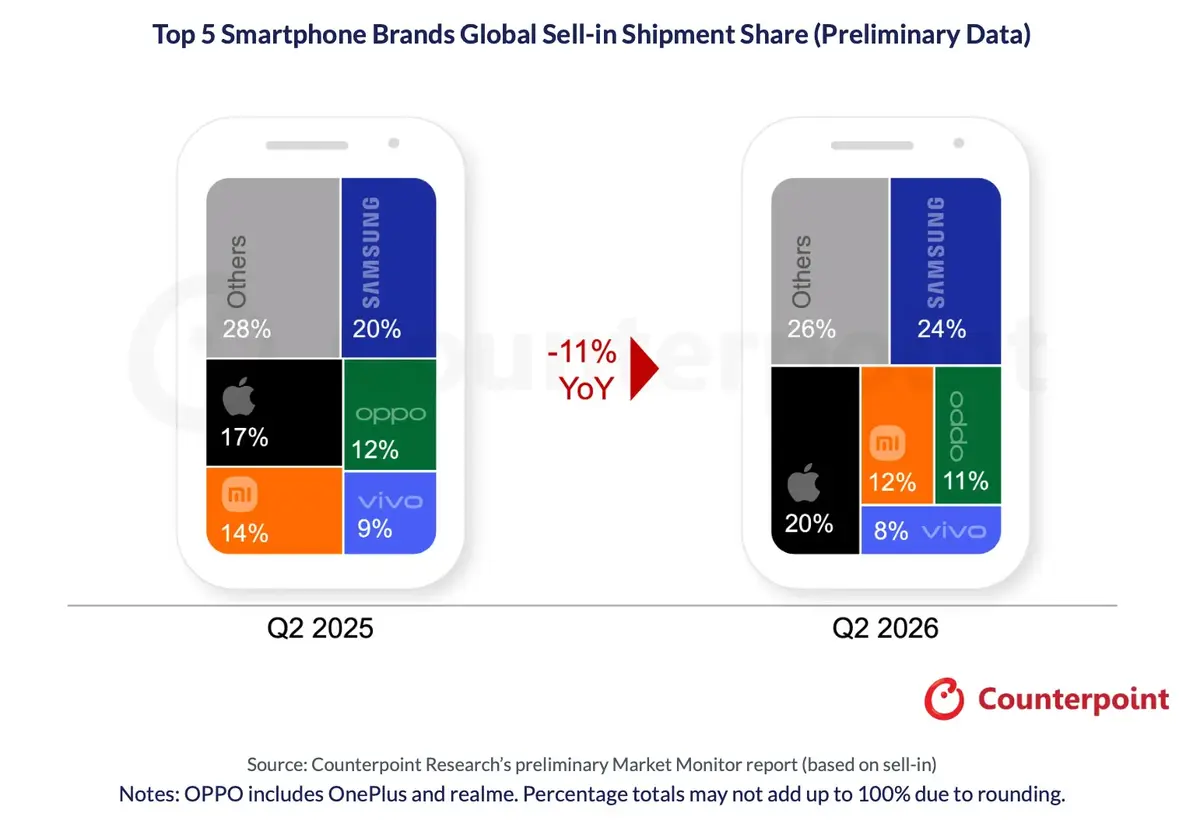
In the second quarter of 2026, the global smartphone market faced its most challenging period since 2013, driven by a convergence of rising memory component costs and severe supply chain disruptions. According to the latest data released by Counterpoint Research, total global smartphone shipments experienced a significant downturn during this quarter. Despite the broader industry contraction, Samsung solidified its position as the market leader by capturing nearly a quarter of the global share. Meanwhile, Apple demonstrated resilience by increasing its iPhone shipments by 3% year-over-year, effectively claiming a record 20% market share as the industry grapples with ongoing economic headwinds.
- The global smartphone market experienced an 11% decline in total shipments during the second quarter of 2026.
- Samsung reclaimed the top position in the market due to strong performance of the Galaxy S26 series.
- Apple maintained growth by securing a 20% market share while avoiding price hikes on its latest hardware.
- Analysts project that the ongoing memory component crisis will persist until 2027, potentially leading to a 14% annual decline in shipments.
Market Leaders Expand Share Amidst Industry Contraction
The Counterpoint Research report highlights a paradoxical trend where the industry’s largest players are emerging stronger from the current crisis. While total shipments plummeted by 11%, both Apple and Samsung managed to grow their footprint. Samsung expanded its market share by 4 percentage points, whereas Apple gained 3 percentage points. In contrast, other major manufacturers faced difficulties; Xiaomi saw a 2-point drop, OPPO fell by 1 point, and the collective share of smaller manufacturers slipped from 28% to 26%.
Apple remains the only major manufacturer that refrained from raising device prices despite mounting hardware costs.
Apple’s growth trajectory is largely propelled by the consistent demand for the iPhone 17 series. Although the company faced a slight dip in Chinese shipments due to the subdued performance of the 618 shopping festival, its overall momentum remains robust. Simultaneously, memory supply constraints have forced manufacturers to prioritize production lines for newer models, which has inadvertently slowed down interest in older iPhone iterations.
Samsung Reclaims Dominance in the Global Arena
Although Apple momentarily led the market in the first quarter, Samsung successfully recaptured the top spot in the second quarter. The South Korean tech giant leveraged high consumer interest in its new Galaxy S26 lineup, combined with widespread global availability and aggressive promotional strategies. These tactical decisions allowed the company to outpace its competitors and solidify its position as the singular leader in the smartphone landscape.
Memory Shortages Prolong Industry Challenges
Industry analysts have painted a concerning outlook for the near future, citing the relentless rise in prices for DRAM and NAND memory chips. These components serve as the foundational building blocks for modern smartphones, and their scarcity places immense pressure on manufacturers, particularly those operating with lower profit margins in the entry and mid-level segments.
The ongoing memory crisis is expected to impact the global market until at least 2027.
Projections for the remainder of 2026 indicate a potential 14% overall drop in global shipments. To mitigate these financial pressures, manufacturers are likely to phase out low-margin models and restrict storage configurations. Furthermore, the market may see a shift toward promoting refurbished devices as consumers become increasingly price-sensitive.
As rising hardware costs continue to shape the industry, we invite you to share your thoughts in the comments section below: Are you more likely to purchase a brand-new flagship phone or switch to a refurbished model given the current price trends?
Your comment has been submitted,
it will be published after approval.