
Google Pixel 11 Tensor G6 Performance Disappoints in Initial Tests

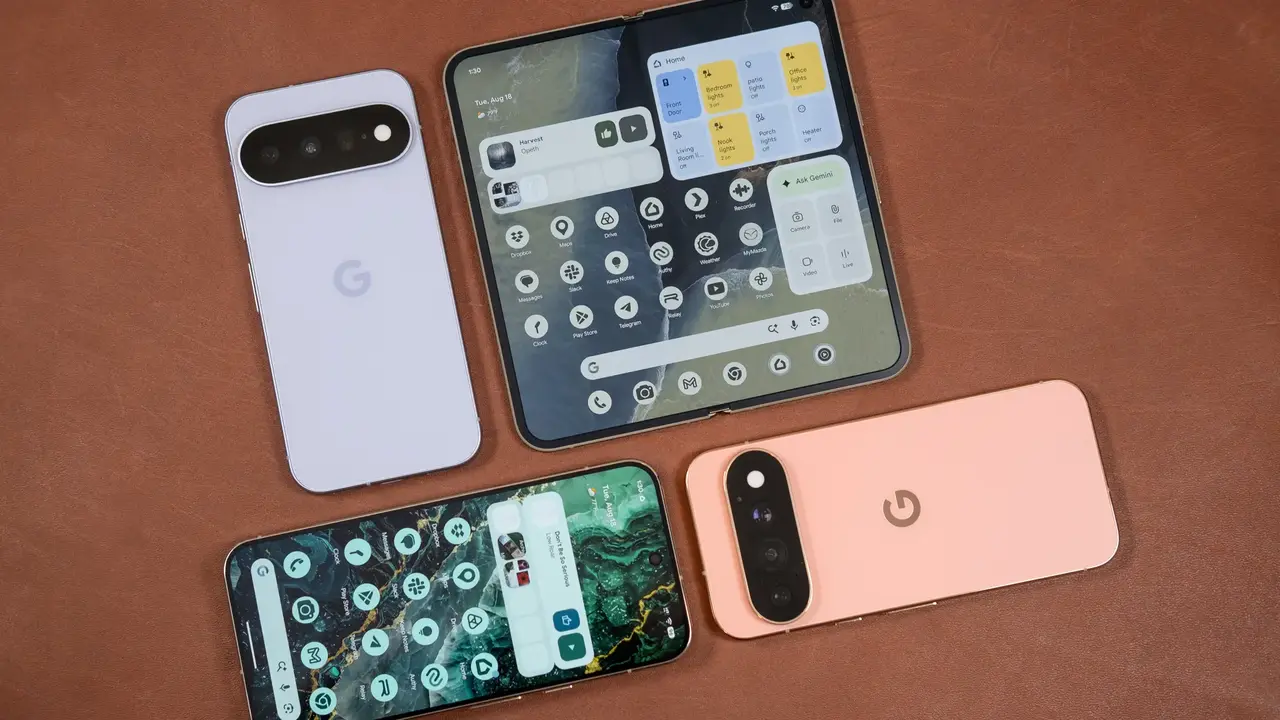
Google has officially launched its highly anticipated Pixel 11 flagship series in global markets, featuring the new proprietary Tensor G6 processor. However, early performance benchmarks for the Google Pixel 11 indicate that the custom silicon is falling significantly behind the industry’s leading hardware. While the device was expected to challenge the current generation of premium smartphones, initial data suggests that the Tensor G6 struggles to maintain competitive speeds when measured against rivals like the Snapdragon 8 Elite Gen 5. This performance gap has raised serious questions among analysts and tech enthusiasts regarding Google’s long-term hardware strategy and its ability to keep pace with top-tier competitors.
- The Tensor G6 chipset recorded an AnTuTu benchmark score of 1.86 million, trailing far behind competitor scores reaching 4 million.
- Benchmark data confirms that the new processor provides only a 25 percent improvement in performance compared to the previous Tensor G5 generation.
- Testing reveals that the device achieves less than half the graphical performance of the Snapdragon 8 Elite Gen 5 in 3DMark assessments.
- The Tensor G6 hardware fails to reach the high-end processing speeds required for modern flagship device competition.
Pixel 11 Performance Benchmarks Reveal Significant Deficiencies
The internal architecture of the Tensor G6 consists of one Cortex-C1 Ultra core paired with six Cortex-C1 Pro cores, supported by a PowerVR CXTP-48-1536 graphics unit. Despite these specifications appearing robust on paper, real-world usage and synthetic testing platforms demonstrate that the hardware platform faces substantial efficiency hurdles. 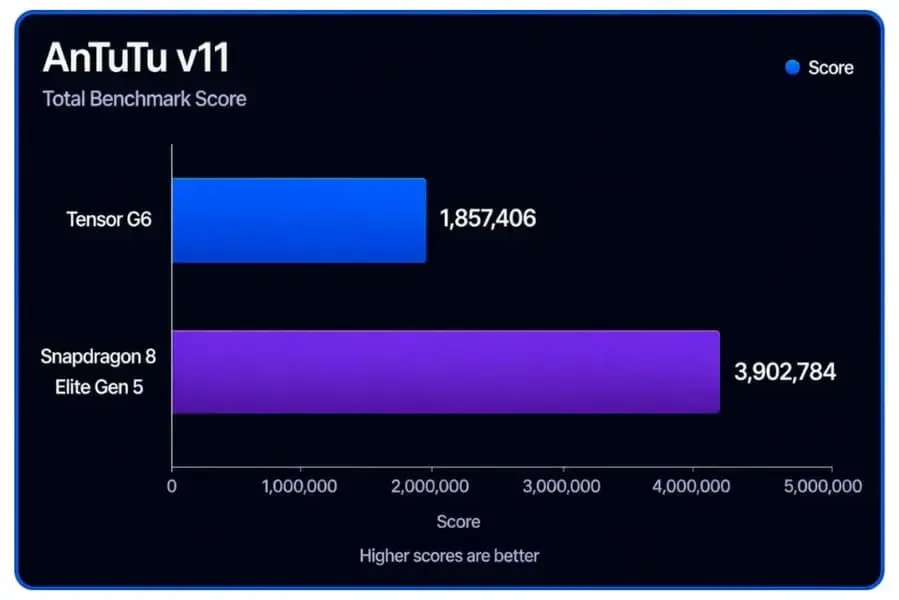 In the highly anticipated AnTuTu benchmarks, the device achieved a score of approximately 1.86 million, a figure that is nearly half of what competing devices from Qualcomm and MediaTek are currently delivering.
The Tensor G6 processor lags behind the current standard for raw power in the mobile market.
Progress Remains Limited Compared to Previous Generations
Although the transition from the Tensor G5 to the G6 offers a measured 25 percent increase in general efficiency, this growth remains insufficient to satisfy current flagship performance standards. 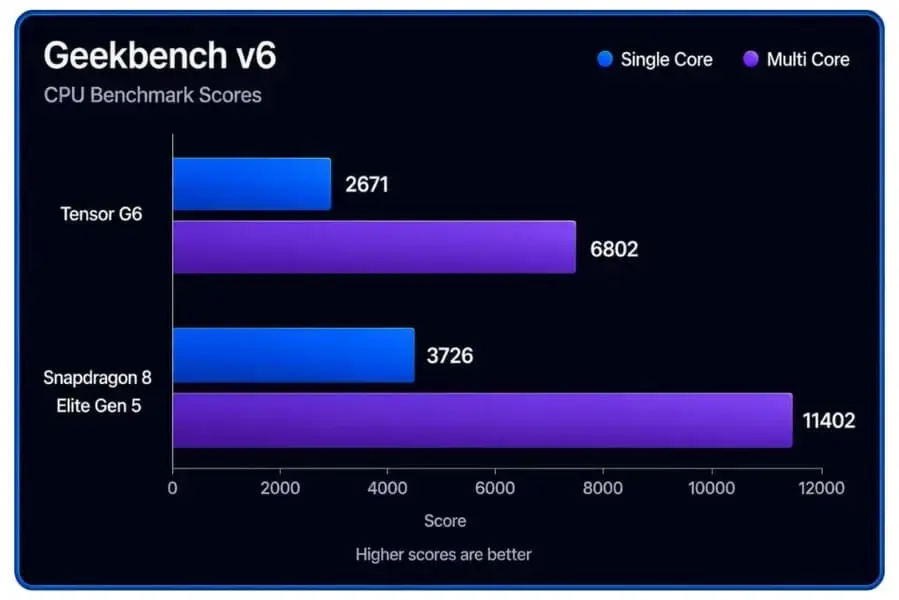 Geekbench testing highlights this gap, with the device recording 2670 in single-core and 6800 in multi-core metrics. These results indicate that the Pixel 11 is not capable of matching the high-speed processing capabilities found in other contemporary high-end smartphones available in the market today.
The device struggles to maintain competitive speeds during graphics-intensive computational tasks.
Graphics Capabilities Fail to Meet Consumer Expectations
The limitations of the Tensor G6 become particularly evident when evaluating gaming performance and graphical processing power through 3DMark Wild Life tests. The Google-designed silicon managed a score of 3386, whereas the Snapdragon 8 Elite Gen 5 outperformed it with a score of 7738. 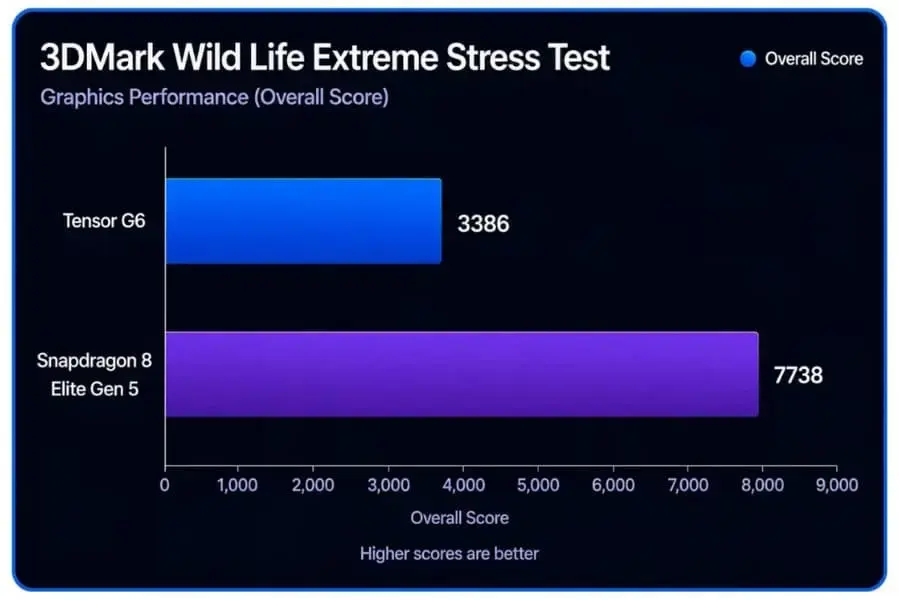 This stark contrast suggests that the graphical leap from the previous generation is negligible, serving as a concerning indicator for users who prioritize mobile gaming and high-fidelity visual experiences on their flagship devices.
Given these findings, do you believe Google should pivot its strategy to prioritize raw hardware performance, or should the company continue to focus exclusively on software optimization? We invite you to share your thoughts and experiences with the new Pixel 11 in the comments section below.
Your comment has been submitted,
it will be published after approval.