
Google Play Introduces New Alternative Payment and Commission Structure


Google has officially announced a significant overhaul of its Google Play Store business model, introducing new policies that allow for alternative payment systems and reduced commission fees. Starting June 30, 2026, these changes will initially roll out in the United States, the United Kingdom, and the European Economic Area. By separating service fees from billing costs, the tech giant aims to provide developers with greater flexibility while enhancing the overall user experience. This strategic shift follows ongoing global antitrust scrutiny and is expected to reshape the mobile application landscape for developers and users alike.
- Google will separate service fees from billing costs to allow developers to integrate their own payment infrastructures or direct users to external websites.
- The company will implement a 10% service fee for the first $1 million in annual revenue and for all auto-renewing subscriptions.
- New commission rates for transactions exceeding $1 million will depend on whether the application was installed before or after the policy update.
- Two new programs, Games Level Up and Apps Experience, will provide further commission incentives for developers who optimize their applications for diverse hardware.
Service Fees and Billing Charges are Now Separated
The global digital marketplace is undergoing a transformation as Google responds to regulatory pressure and market demands. By decoupling the service fee from the billing fee, Google is moving away from its previous rigid payment structure. 
Under the new policy, developers can choose to utilize Google Play’s secure billing infrastructure or integrate their own third-party payment solutions. This choice offers developers the freedom to manage their own checkout experiences, provided they remain compliant with Google’s user experience guidelines.
Developers will avoid the 5% billing fee if they utilize their own payment processing systems or redirect users to their personal websites.
New and Existing App Installations Affect Commission Rates
The commission structure for earnings surpassing $1 million annually will vary based on user acquisition history. Google has established two distinct categories to manage this transition. For new installations occurring after the policy launch, the standard service fee is set at 20%. Conversely, for existing applications already installed on devices, the fee remains lower at 15%.
Regardless of the payment method chosen, the initial $1 million in annual revenue remains subject to a reduced 10% service fee. {{WP_IMAGE_2}} This tier also applies universally to all auto-renewing subscription models, providing a more predictable financial outlook for developers focused on recurring revenue.
Ecosystem Growth Programs are Launched by Google
Beyond restructuring fees, Google is actively incentivizing developers to optimize their content for a wider range of devices. The newly introduced Games Level Up and Apps Experience programs reward developers who enhance their applications for tablets, foldable devices, and smart TVs. 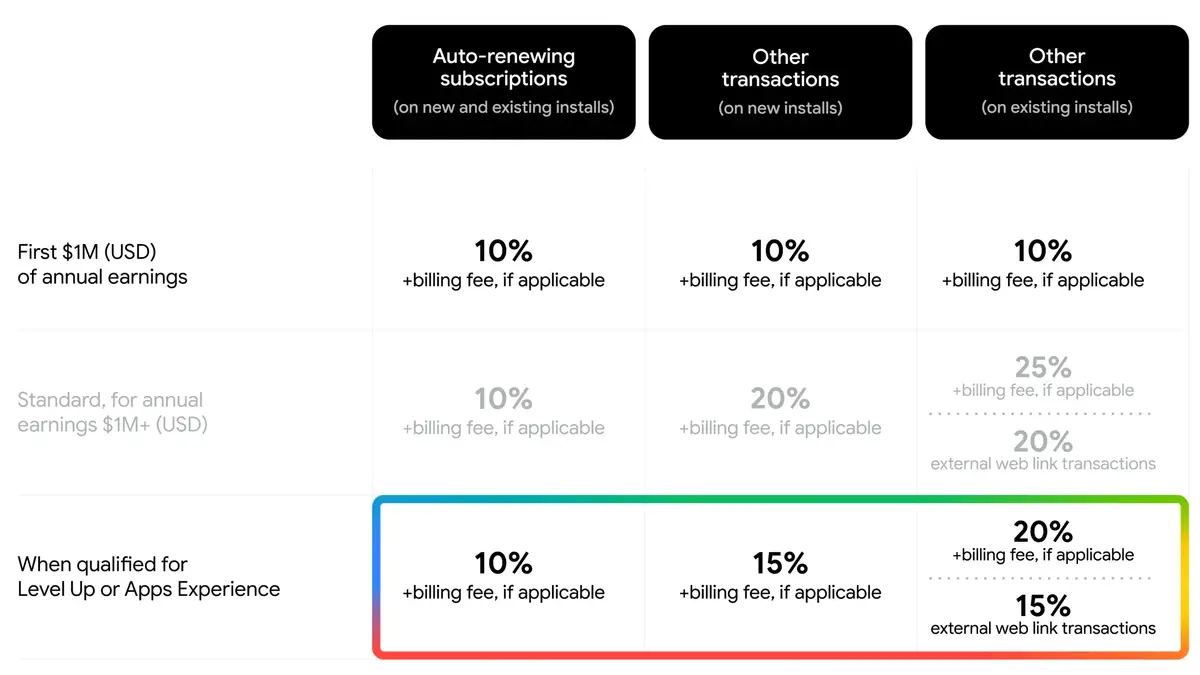
Eligible developers will gain access to exclusive, lower commission rates starting from September 30, 2026.
Global Rollout Schedules are Determined by Legal Compliance
Implementing such a fundamental change requires careful coordination with local regulations across different jurisdictions. Google intends to manage this process through a staggered timeline, beginning with the initial three regions and expanding to other markets as legal frameworks are satisfied. This move is widely regarded as a significant victory for the developer community, as it addresses long-standing grievances regarding high commission rates and lack of payment autonomy. By fostering a more open ecosystem, Google hopes to maintain its competitive edge while satisfying the requirements of global regulators.
How do you think these changes to the Google Play Store commission structure will affect the variety and pricing of applications you use daily? Share your thoughts in the comments below.
Your comment has been submitted,
it will be published after approval.