
Google’s Android Bench Tests Reveal Claude and GPT Models Outperform Gemini

Google has officially updated its Android Bench evaluation framework on October 26, revealing that its own Gemini 4 Argon model currently trails behind top-tier competitors like Claude and GPT in specialized coding tasks. Designed to assist developers in navigating the complex landscape of AI-powered programming, the Android Bench platform provides a rigorous assessment of model performance and cost-efficiency. While Google’s latest model was included in this recent evaluation, the findings indicate that Anthropic’s Claude and OpenAI’s GPT variants maintain a competitive edge, prompting a broader industry discussion regarding the efficacy of Gemini 4 Argon in real-world Android development environments.
- Claude Sonnet 5.5 currently leads the industry rankings with a 40 percent success rate in Android-specific coding benchmarks.
- OpenAI’s GPT-6.1 Sol model offers a significant economic advantage for developers due to its considerably lower operational costs compared to premium Claude versions.
- Google’s Gemini 4 Argon model ranked fifth in the latest assessment, demonstrating a 21.3 percent success rate in the tested development tasks.
- The updated Android Bench platform now incorporates comprehensive cost metrics to help developers balance performance against project budgets.
Claude and GPT Models Lead the Rankings
The latest iteration of Android Bench highlights the dominance of established AI models in technical coding scenarios. According to the data released in late October, Anthropic’s Claude Sonnet 5.5 has secured the top position, boasting a 40 percent success rate and an 80.9 percent completion rate. Its sibling, Claude Opus 5.5, follows closely, maintaining a strong performance trajectory since its inclusion in the testing suite earlier this month.
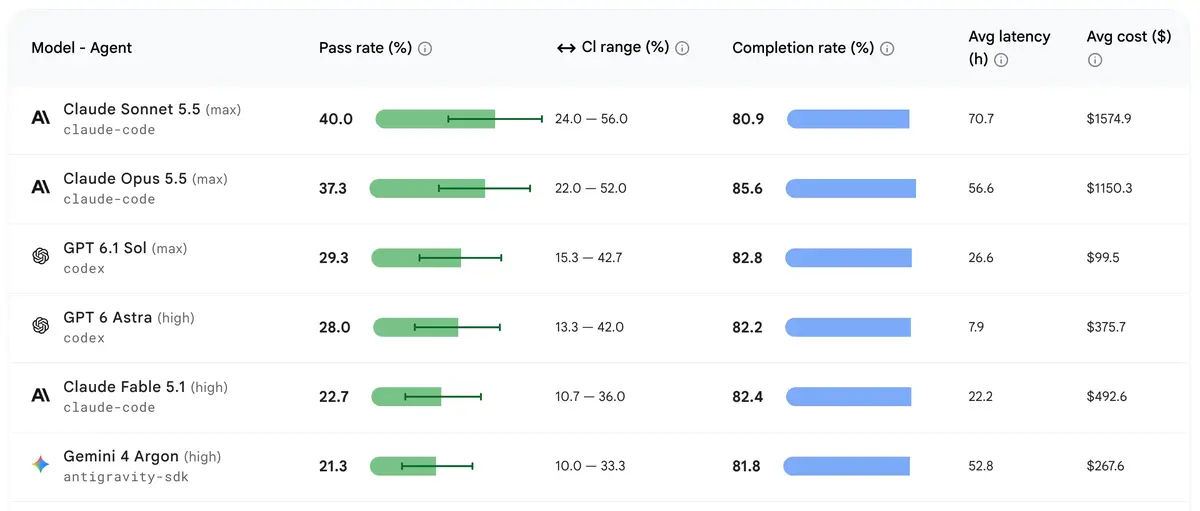
OpenAI’s contributions remain equally formidable. The GPT-6.1 Sol model achieved a 29.3 percent success rate paired with an impressive 82.8 percent completion rate. Perhaps most importantly for corporate developers, the GPT-6.1 Sol model presents a highly economical profile, costing roughly 99.50 dollars per session. This price point contrasts sharply with the premium tier of Claude models, which can reach costs as high as 1,574.90 dollars, making the GPT variant a compelling choice for budget-conscious engineering teams.
Gemini 4 Argon Struggles to Match Competitors
Google’s internal efforts have faced scrutiny following the performance of its Gemini 4 Argon model. Ranking fifth in the latest evaluation, the model recorded a 21.3 percent success rate and an 81.8 percent completion rate. With an average operational cost of 267.70 dollars, the model sits behind several competitors in terms of both raw output quality and cost-effectiveness. This performance has generated significant debate among developers who monitor these benchmarks closely.
Although early reports suggested that Gemini 4 Argon might face challenges with specific, complex coding tasks, Google continues to defend the model’s underlying architecture and capabilities. The company maintains that its internal benchmarks are essential for iterative improvements, even when initial outcomes underperform compared to industry frontrunners.
Developers Prioritize Cost and Performance Metrics
The integration of detailed cost data into the Android Bench platform represents a strategic shift in how developers select tools for their workflows. By providing transparency regarding both the technical success rate and the financial impact of using specific models, Google is empowering engineers to make more informed decisions. The goal is to move beyond mere capability and address the practicalities of long-term software development cycles.
As AI continues to reshape the Android development ecosystem, the reliance on transparent, task-specific metrics becomes increasingly vital. While current results favor specific configurations of Claude and GPT, the rapid evolution of these technologies ensures that the ranking landscape remains fluid. Future updates to the benchmark will likely determine whether Google’s Gemini 4 Argon can close the performance gap or if third-party models will solidify their current leadership positions.
We are curious to hear your perspective on the current state of AI-assisted coding tools; which model do you find most reliable for your own Android development projects and do you prioritize lower costs or higher success rates?
Your comment has been submitted,
it will be published after approval.