
Intel’s revolutionary hardware announcements in industrial computing and edge computing have begun. While we have grown accustomed to the hybrid architecture approach combining Performance (P) and Efficiency (E) cores in the consumer market, Intel is changing the rules specifically for the needs of industrial AI processes and mission-critical tasks. To eliminate latency and maximize stability, the company officially introduced the new Intel Core Series 2 processor family, consisting entirely of Performance (P) cores.
What Does the Intel Core Series 2 Offer?
Pure Power Driven by the Bartlett Lake Architecture
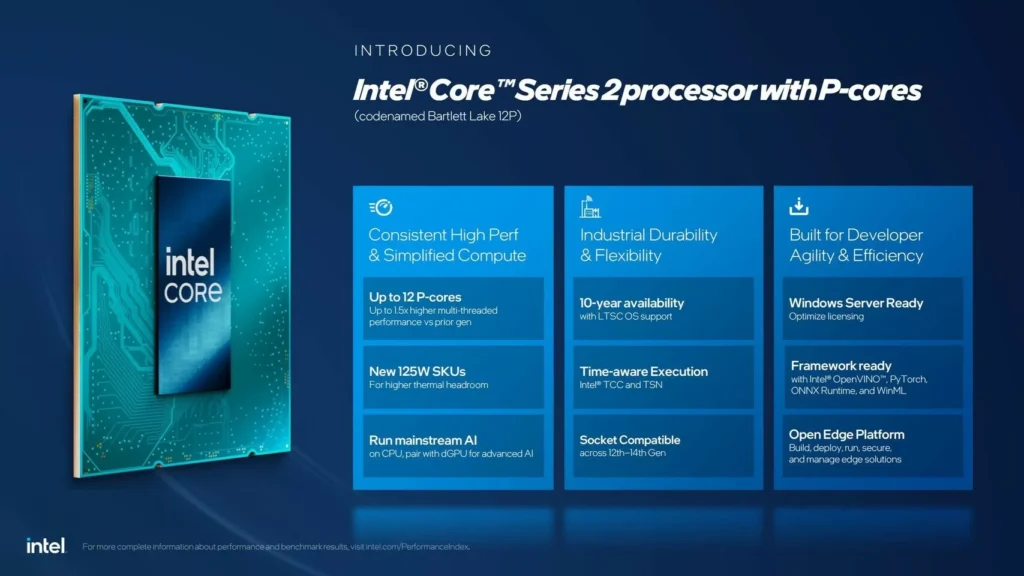
Developed under the codename “Bartlett Lake” and designed specifically for “Edge AI” systems, these new processors focus on minimizing internal latency. This P-Core-only structure, which eliminates task switching between different core types, offers impressive hardware specifications:
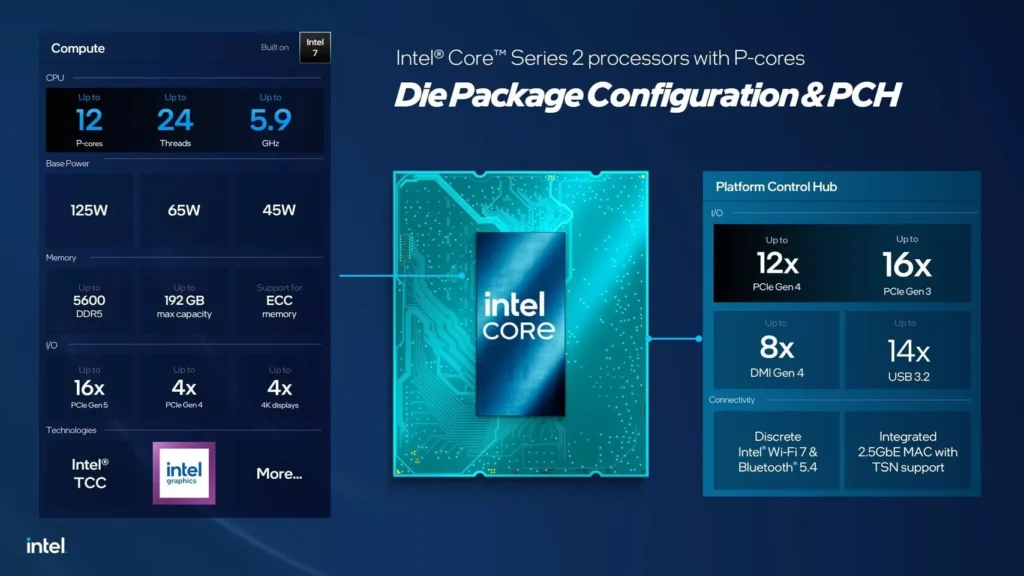
- Cores and Threads: Scalable up to 12 cores and 24 threads, these processors can reach massive peak clock speeds of 5.9 GHz.
- Memory and Capacity: Supports up to 192 GB of system memory with the DDR5-5600 standard, including ECC (Error Correction Code) support.
- Design and Power: The devices maintain the familiar LGA1700 socket structure and come with Processor Base Power (PBP) options of 45W, 65W, and 125W depending on project needs.
- Connectivity: Systems feature Wi-Fi 7 and 2.5 Gigabit LAN integration to meet industrial standards. Supported chipsets include Q670E, R680E, Q670, W680, H610, and H610E.
Performance Metrics That Stand Out in Competition
In fields like industrial automation or concurrent data analytics, “predictable response time” is often more critical than raw speed. According to comparative test results shared in Intel’s official presentation, this P-core family establishes a clear lead over the AMD Ryzen 7 9700X. The Core Series 2 processors offer:
- Up to 4.4x reduction in maximum PCIe latency,
- Up to 2.5x improvement in deterministic (predictable) response time,
- Up to 3.8x increase in deterministic processing performance,
- Up to 1.5x higher power in multi-threaded performance.
New AI Suite for Health and Life Sciences
Intel is expanding not just its hardware, but its software vision to make this hardware smarter in the field. Introduced alongside the hardware launch, the 6th edge AI software package, “Health & Life Sciences Edge AI Suite,” focuses directly on patient monitoring technologies.
This specialized suite allows medical device manufacturers (OEMs and ODMs) to process patient data on-device without sending it to the cloud. Real-time AI workloads utilizing the local power of the processors include critical capabilities such as AI-based ECG arrhythmia detection, contactless remote photoplethysmography (measuring blood volume changes), and anonymized 3D patient monitoring.
For engineers and tech manufacturers, the good news is that there is no need to wait; both the newly announced P-core Core Series 2 family and edge systems featuring Core Ultra Series 3 hardware are available for purchase as of now.