

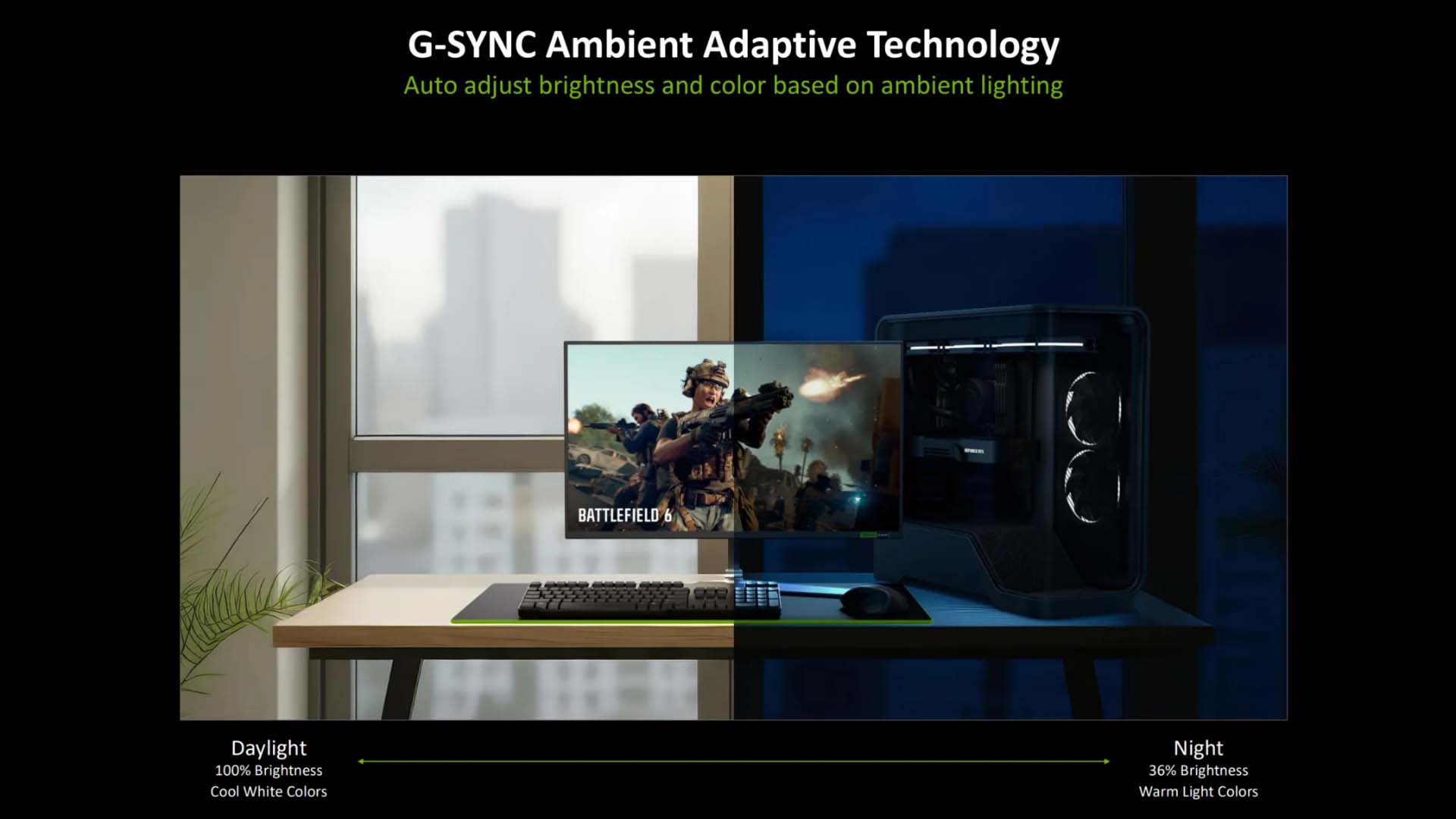
Nvidia has just pulled back the curtain on its revolutionary new line of G-Sync Pulsar monitors at CES 2026, promising to fundamentally change the gaming experience. These next-generation displays automatically adjust their brightness and color temperature based on ambient light, delivering both a more comfortable and a smoother gaming performance.
How Do G-Sync Pulsar Monitors Work?
At the heart of these new models lies an intelligent system called “G-Sync Ambient Adaptive Technology.” Thanks to a special light sensor integrated into the monitors, the device continuously analyzes the lighting conditions of its environment. This allows it to increase brightness in a well-lit room or decrease it and use warmer color tones in a dim setting, significantly reducing eye strain. Consequently, this dynamic adjustment offers immense comfort, especially during long gaming sessions.
The foundations for Pulsar technology were actually laid at CES 2024. This technology brings together two critical components: Adaptive Overdrive and Pulse Modulation. According to Nvidia, Adaptive Overdrive dynamically adjusts the speed at which pixels change color, while Pulse Modulation controls the monitor’s brightness and duration at an electrical level.
Say Goodbye to Blur: Crystal-Clear Visuals
The combination of these two technologies minimizes motion blur, which is particularly noticeable in fast-paced gaming scenes. As a result, gamers get a much sharper, clearer, and more fluid image quality. This also provides a competitive edge, allowing for quicker reaction times in demanding games.
Nvidia has announced that these advanced monitors will be available with a starting price of $599 internationally.
So, what are your thoughts on Nvidia’s new G-Sync Pulsar technology? Share your opinions with us in the comments!