
Samsung Foundry is at a critical threshold to leave behind the production problems it has experienced in recent years. The company, which lost Qualcomm due to the low yield rate crisis in 2022, lost its major customer to its competitor due to TSMC’s 70% rate compared to 35% yield rate at that time.
This situation damaged Samsung’s reliability in chip production and weakened its position in the sector. Today, Samsung Foundry is trying to rise again with the 2nm production process.
Samsung may enter a new era in the sector with its 2nm move
Last year, the production problems experienced by Samsung with Exynos 2500 processors disrupted the planned strategy in the Galaxy S25 series. While the company wanted to launch the Galaxy S25 and S25+ models largely with its own Exynos processor, it had to turn to Qualcomm’s Snapdragon 8 Elite for Galaxy chip due to insufficient production. This sudden change created an unexpected additional cost of $400 million for Samsung.
A similar risk applies to next year’s Galaxy S26 and Galaxy S26+ models. Samsung wants to use the next-generation Exynos 2600 processor in these models. However, this depends on Samsung Foundry being able to produce a sufficient number of processors with its 2nm process technology.
A foundry’s yield rate refers to the percentage of defect-free chips obtained from the silicon wafers in production. A yield rate of 70% is generally targeted before mass production is started. Production processes below this level mean higher costs and limited product output.
Samsung Foundry’s current 2nm production process has reached a yield rate of 40%. This rate is expected to approach the industry standard of 70% by the end of the year. If this success is achieved, Samsung Foundry will once again have the chance to become an alternative to TSMC not only for its own smartphones but also in the global chip market.
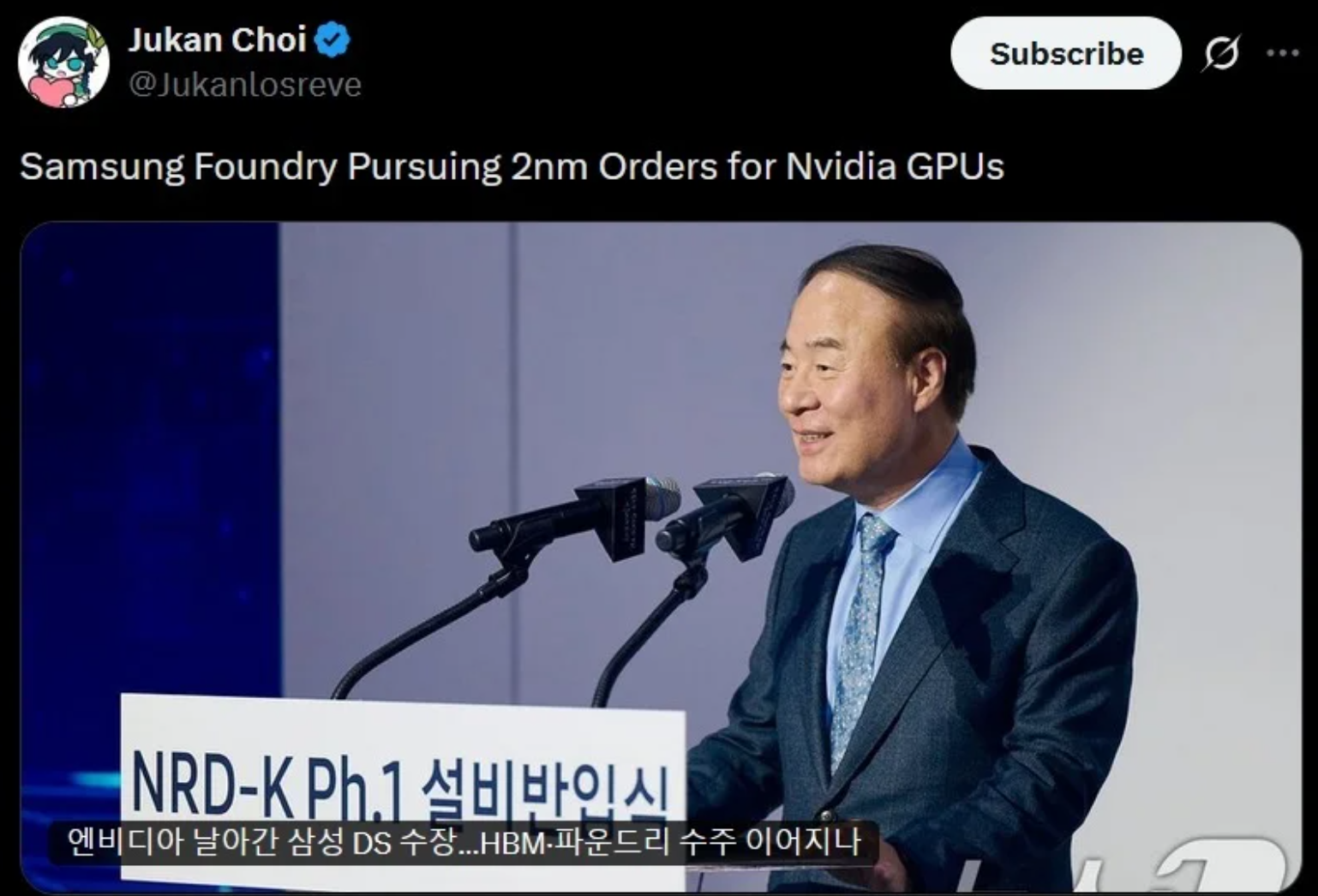
One of the most important developments that draws attention at this point is the possibility of producing Nvidia’s next-generation GPUs. According to a new report from South Korea, Samsung Foundry is one of the leading candidates for a 2nm GPU order from Nvidia.
GPUs, which stand out as artificial intelligence accelerators, can process artificial intelligence and machine learning workloads much faster than CPUs thanks to their parallel processing capabilities. This makes it vital for Nvidia to choose the foundry that can provide the most efficient and high-quality production.
If Samsung wins this job, its perception in the industry could change not only in terms of chip production capacity, but also in terms of reliability and technical competence. As of the first quarter of 2025, Samsung Foundry’s global market share was 7.7%, while TSMC’s market share was recorded as 67.6%. The potential collaboration with Nvidia is considered an important step towards closing this gap.
Samsung Foundry may already be on the rise. The company has already produced the Nvidia-designed Tegra T239 processor. This chip powers the Nintendo Switch 2 game console, and the fact that this work, which was acquired from TSMC, was implemented by Samsung with the 8nm Deep Ultraviolet (DUV) production process shows that the competition can be reshaped.
Samsung Foundry’s ability to regain confidence in chip production is of great importance for both mobile devices and artificial intelligence hardware. The efficiency rate that the company will reach in 2nm technology and the collaborations that will be established with major brands such as Nvidia have the potential to affect the dynamics of not only Samsung but the entire semiconductor sector.