
Smartphone Chip Market Faces 15 Percent Decline in 2026

The global smartphone chip market experienced a significant downturn during the first half of 2026, as reported by Counterpoint Research. Industry data indicates that overall smartphone processor shipments plummeted by 15 percent compared to the same period in 2025. This contraction, driven largely by ongoing supply chain constraints and a lingering memory chip crisis, has placed substantial pressure on major manufacturers. As the industry grapples with these challenges, stakeholders are closely monitoring how reduced production impacts the availability of next-generation mobile devices and the broader technology sector’s recovery timeline.
- Global smartphone processor shipments recorded a 15 percent decrease during the first half of 2026.
- Qualcomm and MediaTek faced an estimated 25 percent decline in system-on-chip shipments.
- Apple, Unisoc, and Samsung managed to increase their market share despite the industry-wide downturn.
- Analysts project a 14 percent annual decline in total processor shipments for the remainder of the year.
Major Industry Players Face Divergent Performance Outcomes
The market landscape for system-on-chip (SoC) providers remains highly volatile. Qualcomm and MediaTek, the two dominant forces in the industry, have struggled to maintain their previous momentum. While Qualcomm saw limited growth with its high-end Snapdragon 8 Elite Gen 5, MediaTek encountered substantial setbacks in its entry-level 5G segment, even as its flagship Dimensity 9500 series maintained a relatively stable performance. 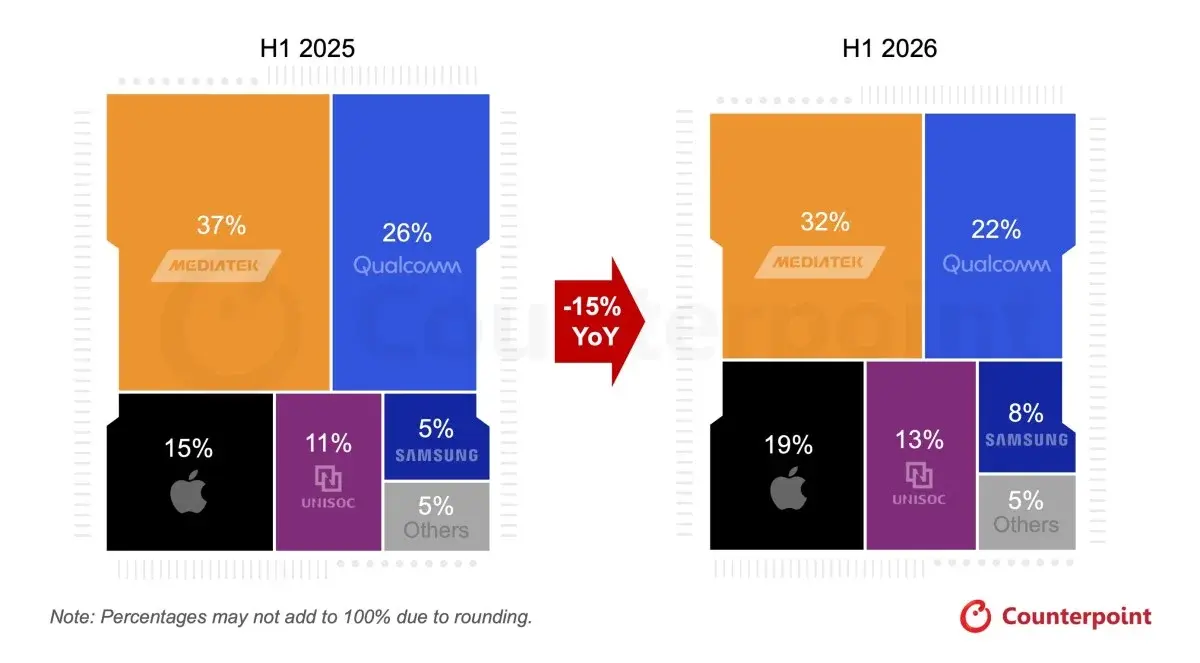
Conversely, other key players have defied the downward trend. Apple continues to bolster its shipment numbers, driven by sustained high demand for the iPhone 17 series and its proprietary A19 and A19 Pro silicon. Meanwhile, Unisoc has strategically captured the lower-end market by pivoting from 5G-enabled chips toward more cost-effective 4G solutions, often through partnerships with budget-friendly brands like Redmi and Poco.
Market experts warn that the entry-level smartphone segment may endure a severe 30 percent decline in chip shipments this year.
Long-Term Price Stabilization Remains Uncertain for Manufacturers
The broader semiconductor industry is currently navigating a complex period of price volatility regarding memory components. Although various manufacturers are attempting to balance supply and demand, the path to market equilibrium appears to be a multi-year effort. Industry analysts suggest that current pricing structures are unlikely to return to historical norms before the second half of 2027.
This prolonged recovery phase forces original equipment manufacturers to rethink their procurement strategies and supply chain management. The shift toward 4G alternatives in emerging markets highlights a broader consumer trend where affordability outweighs the immediate need for advanced network capabilities. As the industry waits for the memory chip crisis to fully resolve, manufacturers must remain agile in their hardware planning.
Given the ongoing challenges in the semiconductor supply chain and the current market shifts, what is your prediction regarding the future of device affordability and technology innovation; share your thoughts in the comments section below.
Your comment has been submitted,
it will be published after approval.