
Snapdragon 6 Gen 4 vs Dimensity 7400: Mid-Range Processor Showdown

Introduced in February 2025, the Snapdragon 6 Gen 4 and the Dimensity 7400 have officially entered the mid-range smartphone market, igniting a fierce competition between Qualcomm and MediaTek. Both chipsets leverage advanced 4nm manufacturing processes to deliver a blend of high performance and energy efficiency for modern mobile devices. While the Snapdragon 6 Gen 4 focuses on advanced architecture and elite gaming capabilities, the Dimensity 7400 prioritizes superior 5G data speeds and high clock frequencies. Tech enthusiasts and potential buyers are now closely evaluating benchmark metrics and technical specifications to determine which processor offers the more reliable long-term user experience.
- The Snapdragon 6 Gen 4 outperforms its competitor in both single-core and multi-core benchmark tests due to its modern core architecture.
- The Dimensity 7400 achieves higher peak 5G download speeds while lacking mmWave frequency support.
- The Snapdragon 6 Gen 4 provides more consistent graphical performance through the Adreno 810 GPU and specialized gaming optimization technologies.
Technical Architectures Offer Distinct Design Approaches
Although both processors utilize TSMC’s 4nm fabrication process, their underlying core configurations differ significantly. The Snapdragon 6 Gen 4 adopts a balanced 1+3+4 cluster arrangement, whereas the Dimensity 7400 favors a performance-heavy 4+4 structural design. These architectural choices reflect the different priorities of each manufacturer regarding power distribution and thermal management. 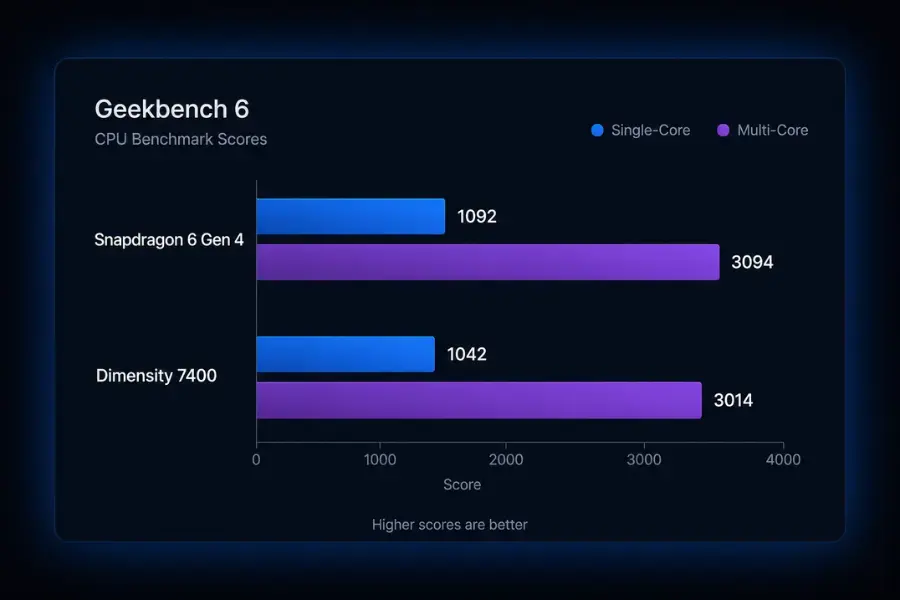
The Snapdragon 6 Gen 4 maintains a consistent lead in benchmark evaluations due to its refined and modern core architecture.
Benchmark Results Reveal Performance Disparities
In Geekbench 6 testing, the Snapdragon 6 Gen 4 secured a single-core score of 1092 and a multi-core score of 3094, effectively outpacing the Dimensity 7400. Furthermore, the Snapdragon chipset surpassed the 980,000 mark in AnTuTu v11, establishing a stronger profile for general multitasking and demanding applications. 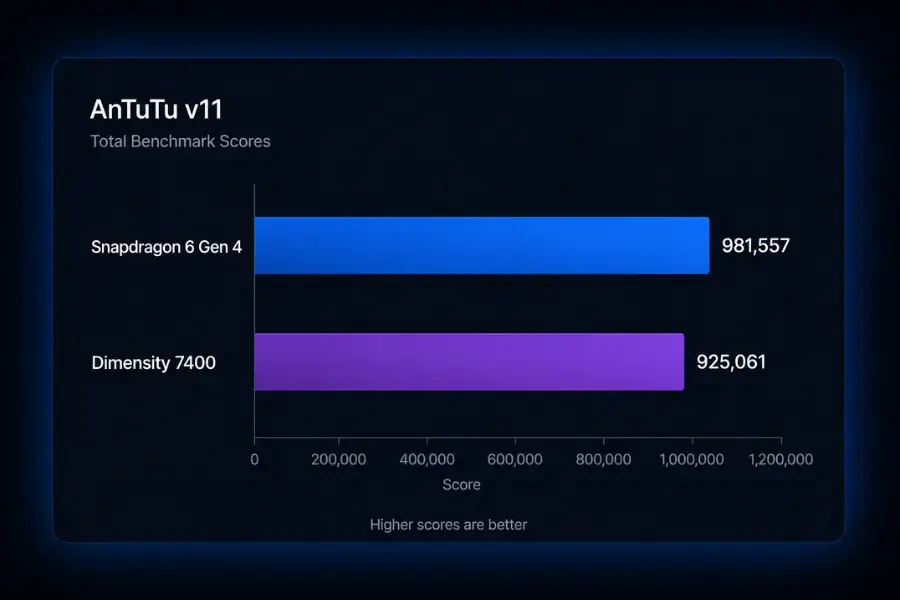 Regarding graphical output, the Adreno 810 GPU utilizes Snapdragon Elite Gaming support to mitigate frame drops during intensive gaming sessions. While the Mali-G615 MP2 found in the Dimensity 7400 handles daily tasks with ease, it struggles to match the optimized gaming stability provided by its rival.
Imaging and Connectivity Capabilities Support Different Needs
Both chipsets offer robust support for 200MP camera sensors and 4K video recording, yet their image processing philosophies diverge. The Snapdragon 6 Gen 4 employs Spectra Triple ISP technology, allowing it to process data from three sensors simultaneously to eliminate shutter lag. Conversely, the Dimensity 7400 focuses on Google Ultra HDR and hardware-accelerated noise reduction to enhance output quality. In the connectivity landscape, the Dimensity 7400 achieves a higher peak speed of 3.27 Gbps, but the inclusion of mmWave support in the Snapdragon 6 Gen 4 ensures more stable connections in high-density urban areas.
The Snapdragon 6 Gen 4 stands out as the superior choice for gaming enthusiasts requiring high graphical fidelity and consistent frame rates.
When choosing your next smartphone, do you prioritize pure raw processing power or advanced camera image processing? Please share your thoughts in the comments section regarding which chipset you believe offers a better daily experience between the Snapdragon 6 Gen 4 and the Dimensity 7400.
Your comment has been submitted,
it will be published after approval.