
Snapdragon 8 Elite Extreme Gen 6 Performance Results Surprise Experts


The upcoming Snapdragon 8 Elite Extreme Gen 6 chipset has made an unexpected appearance in the Geekbench database via the unreleased iQOO Pad Ultra tablet, identified by the model number iPA2691. While the device features a powerful eight-core architecture capable of reaching 5.01GHz, the initial benchmark scores have significantly underperformed relative to industry expectations. Equipped with 16GB of RAM and running an early version of the Android 17 operating system, the tablet struggled to deliver high figures in both single-core and multi-core evaluations. Industry analysts suggest that these underwhelming results likely stem from unoptimized pre-release software rather than inherent hardware flaws within the Snapdragon 8 Elite Extreme Gen 6 platform.
- The Snapdragon 8 Elite Extreme Gen 6 chipset recorded lower-than-anticipated benchmark scores in early testing.
- The iQOO Pad Ultra hardware integrates 16GB of RAM and operates on the Android 17 system.
- A specialized cooling fan module operates at speeds up to 14,500rpm to manage thermal output.
- Software optimization issues are considered the primary reason for the initial performance deficit.
Advanced Processor Architecture Targets Higher Performance
The architecture of the Snapdragon 8 Elite Extreme Gen 6 is built upon a sophisticated 2nm manufacturing process, which is designed to push the boundaries of mobile computing. According to the documented technical specifications, the processor utilizes a cluster of high-performance cores, including three units clocked at 3.74GHz, three at 4.03GHz, and two ultra-high-frequency cores reaching 5.01GHz. The system is further bolstered by the Adreno 850 GPU for graphics processing. 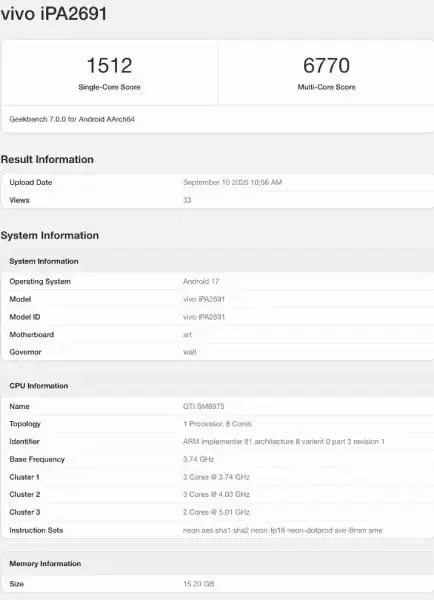 Despite these impressive technical specifications, the device managed only 1,512 in single-core and 6,770 in multi-core tests, figures that have raised questions among tech enthusiasts as they fall behind several previous-generation chipsets.
Thermal Management Influences Processing Power
Technical experts argue that these preliminary test results do not reflect the final potential of the hardware, pointing instead to the lack of integration between the chipset and the current firmware. The iQOO Pad Ultra is engineered with a high-capacity cooling solution to ensure sustained peak performance. Specifically, the device contains a 30 x 30 x 3.5mm internal fan module that reaches speeds of 14,500rpm, a feature meant to prevent thermal throttling under heavy workloads. This cooling solution indicates that the manufacturer is preparing the device for significant computational demands once the software environment is fully stabilized.
Market Expectations Remain High for Future Updates
With a scheduled release in the Chinese market toward the end of September, the iQOO Pad Ultra is expected to undergo extensive software tuning before it reaches consumers. The current performance bottleneck is typical for hardware tested with non-final Android versions. As developers refine the drivers and OS overhead for the Snapdragon 8 Elite Extreme Gen 6, industry observers anticipate a substantial improvement in actual benchmark metrics. The combination of cutting-edge 2nm silicon and aggressive active cooling suggests that once the software matures, the device will likely compete at the top of the performance charts, effectively silencing the concerns raised by these early, unoptimized test results.
Do you believe the Snapdragon 8 Elite Extreme Gen 6 will overcome its current performance hurdles through upcoming software updates, or are you concerned about the initial benchmarks? Please share your thoughts on the iQOO Pad Ultra and its hardware configuration in the comments section below.
Your comment has been submitted,
it will be published after approval.