
Tesla Revolutionizes Automotive Lighting With New Matrix Headlight Patent

Tesla has officially filed a groundbreaking patent with the U.S. Patent and Trademark Office that introduces a novel Tesla matrix headlight technology designed to replace traditional, bulky adaptive lighting systems. Developed by Tesla engineers to overcome spatial limitations in the Cybertruck, this innovation shifts the focus from expensive, complex mechanical hardware to a sophisticated, thin chemical film layer. By utilizing materials science to manage light emission, the company aims to reduce manufacturing costs significantly while maintaining regulatory compliance. This development underscores Tesla’s commitment to its first-principles philosophy, prioritizing efficiency and streamlined design over traditional automotive components.
- The new technology replaces heavy mechanical hardware with a cost-effective, thin-film layer applied to the headlamp surface.
- The system achieves 112 pixels of adaptive resolution, successfully exceeding the 100-pixel requirement set by NHTSA and Canadian regulations.
- Future maintenance costs are significantly lowered because the film layer can be replaced independently of the entire headlight module.
Traditional Adaptive Lighting Systems Require Complex Components
Conventional adaptive LED headlight systems rely on intricate assemblies, including micro-mirrors, deep lens housings, and sophisticated processor modules. These components are not only bulky but also contribute to high production costs and complex wiring requirements. In current modern vehicles, the damage to a single matrix headlight module can result in replacement costs exceeding 3,000 dollars, placing a significant financial burden on the vehicle owner.
Tesla’s new patent effectively eliminates the need for expensive, heavy-duty lighting hardware.
How the New Matrix Technology Functions
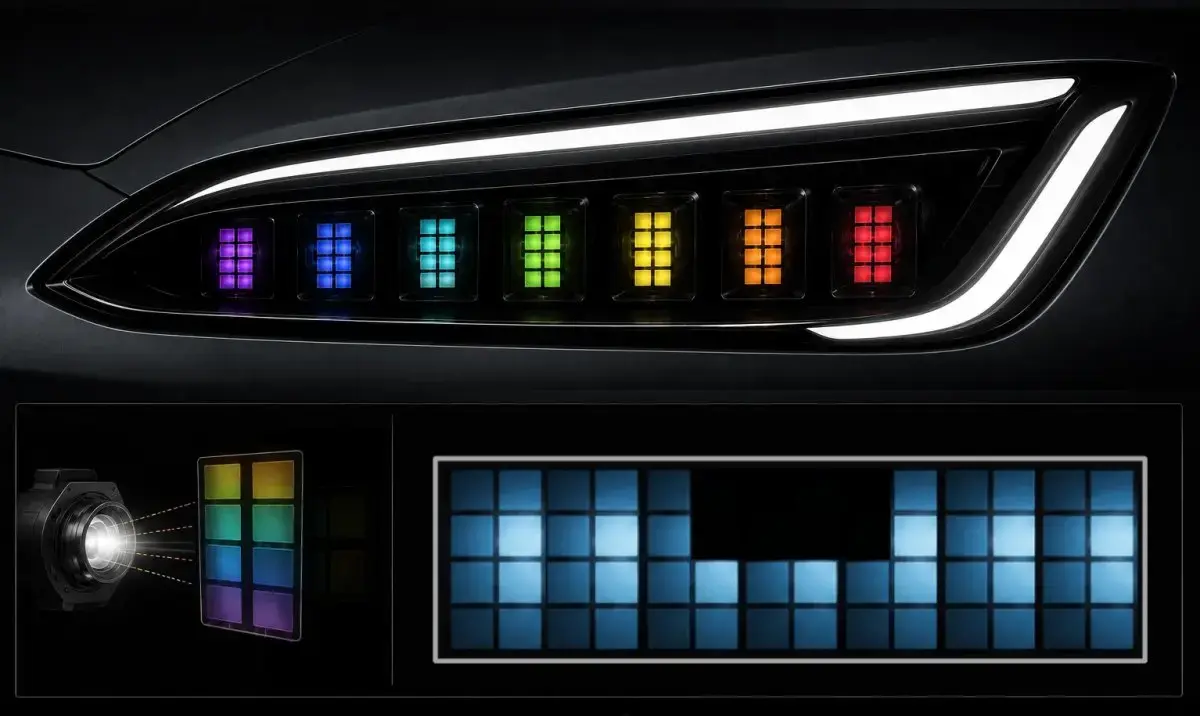
The core of this innovation lies in a specialized film layer containing photochromic microscopic particles. This film reacts directly to the frequency of the vehicle’s own LED light sources. By modulating the wavelength of the light, the system can render specific segments of the film opaque, blocking light emission as needed without requiring external sensors or additional processors. This autonomous reaction allows for precise light distribution that adapts to driving conditions in real-time.
Advanced Chemical Films Enhance Vehicle Design
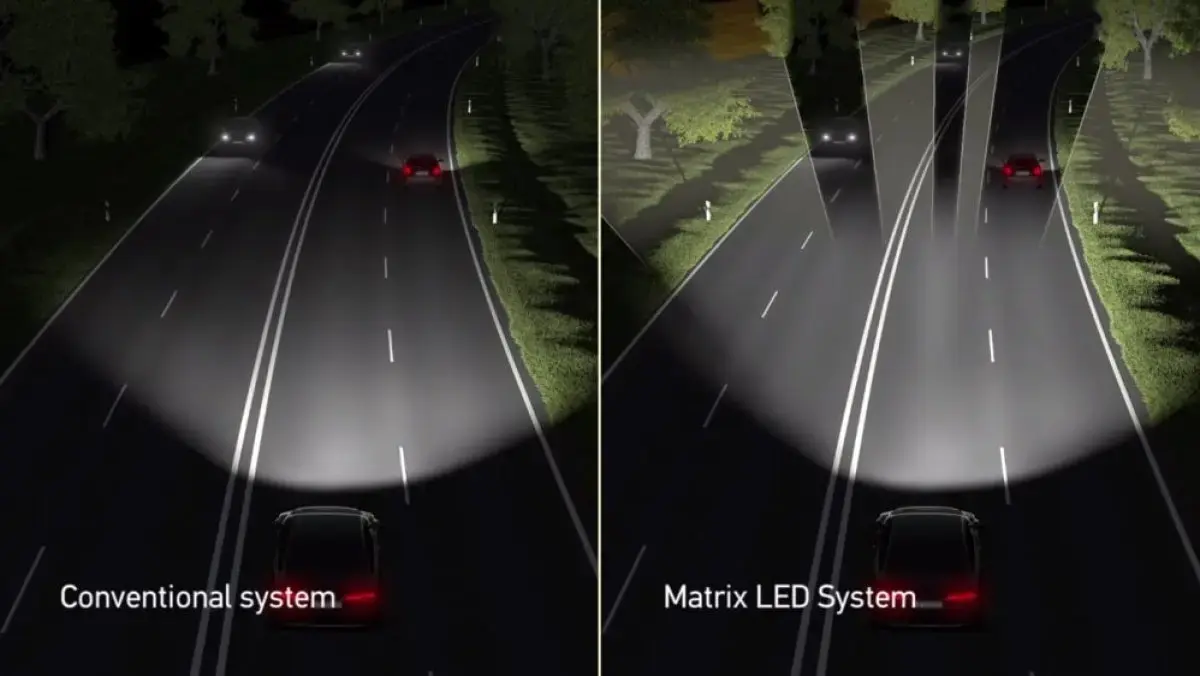
Each main LED bulb is fronted by eight distinct film segments, allowing for a total of 112 pixels of resolution. This resolution allows the vehicle to effectively manage high-beam patterns, ensuring that oncoming traffic is not blinded while the road remains illuminated. Beyond technical performance, the transition to millimeter-thin strips instead of large headlight boxes grants designers more flexibility in creating futuristic vehicle profiles.
This strategic shift emphasizes Tesla’s dominance in software-defined and material-focused automotive innovation.
By standardizing these thin-film solutions, Tesla continues to push the boundaries of manufacturing efficiency. The ability to replace a damaged film strip rather than an entire headlight unit represents a massive leap toward sustainable repair practices in the electric vehicle sector.
We are eager to hear your thoughts on whether this shift toward modular, film-based headlight technology will set a new standard for the entire automotive industry; please share your opinions in the comments section below.
Your comment has been submitted,
it will be published after approval.